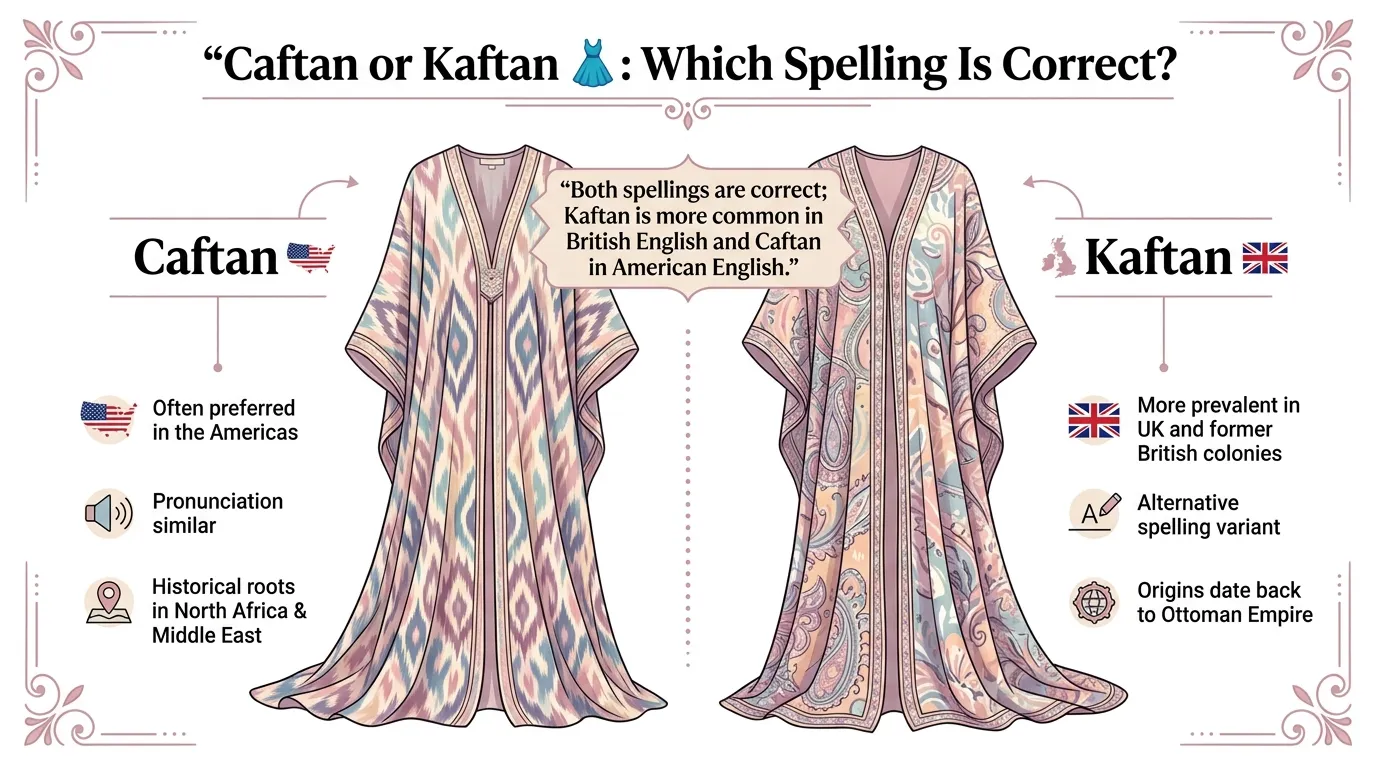
Both “caftan” and “kaftan” are correct spellings of the same loose-fitting garment; the choice mainly depends on regional spelling preferences. 👗
If you’ve ever shopped for a flowing robe, searched style guides, or read fashion blogs, you’ve likely wondered: “caftan or kaftan?” These two spellings look almost the same, sound alike, and often appear interchangeably online.
But does that mean both are correct? Should you use one over the other in writing or product descriptions? And why do people even search for this comparison?
Understanding the difference matters for writing, , and clear communication. Using the wrong version can make a blog post or product listing look less professional and it might even hurt search visibility.
People search caftan or kaftan to find the correct spelling, learn the meaning, and understand fashion history tied to the term. This confusion stems from the word’s long journey across regions and languages over centuries.
In this article, we’ll break everything down in simple, clear terms. From pronunciation to spelling, origins to trends, you’ll get a complete guide to using caftan and kaftan correctly if you’re writing for a global audience or simply describing your favorite summer outfit.
Caftan or Kaftan : Quick Answer
The short, direct answer is:
- Kaftan → Most widely accepted spelling today.
- Caftan → Alternative spelling that is also correct.
Both refer to the same garment a long, loose robe but “kaftan” is now more common in fashion writing, while “caftan” appears in older texts and some regions.
Examples
- She wore a beautiful kaftan to the beach party. 🌴
- The boutique sells embroidered caftans and tunics. 👗
👉 Simple Tip:
If you want to be safe in modern fashion writing, choose kaftan.
If you’re quoting older texts or specific regional sources, caftan is fine too.
The Origin of Caftan or Kaftan 📚
Understanding where the word comes from helps explain why both spellings exist.
Historical Roots
The garment we call a caftan or kaftan has ancient origins going back to the Middle East and Central Asia. It was traditionally a long robe worn by men and women of status in regions like Persia (modern-day Iran), the Ottoman Empire (Turkey), and North Africa.
Early Language Journey
- Original Roots: Likely from Turkish kaftan or Persian khaftan, meaning a long garment.
- Spread Over Time: As trade and cultural exchange grew, the word spread into Arabic, French, and ultimately English.
- Old English Adoption: Early English writers borrowed the term, often seeing it spelled caftan, influenced by French transliterations.
Why Two Spellings?
Because the word passed through many languages before settling in English, multiple spellings emerged. Over time:
- “Kaftan” became more common in English fashion and modern usage.
- “Caftan” remained in older literature and some dictionaries.
👉 The difference is historical, not semantic both spellings point to the same garment.
British English vs American English Spelling 🇬🇧🇺🇸
Unlike colour/color or centre/center, caftan and kaftan are not a clear British vs American split. Both forms appear in both versions of English. However, fashion trends and publishing standards have made one spelling more popular in modern usage.
Comparison Table
| Region / Use Case | Preferred Spelling | Example Usage |
| British English Content 🇬🇧 | kaftan (more common) | “She chose a silk kaftan for summer.” |
| American English Content 🇺🇸 | kaftan (more common) | “These embroidered kaftans are trending.” |
| Older Text / Historical Sources | caftan | “He wore a traditional caftan in the manuscript.” |
| Global Fashion Sites 🌍 | kaftan | “Best kaftans to wear this season.” |
👉 Spelling is not regional, but usage trends vary. Today, kaftan dominates fashion writing, while caftan appears in historical contexts.
Which Spelling Should You Use?
Here’s how to choose based on your audience:
🇺🇸 USA
- Use kaftan for fashion articles, product descriptions, , and normal writing.
- Caftan is acceptable but less common.
🇬🇧 UK & Commonwealth
- Use kaftan for style guides, blogs, and modern content.
- Caftan works in historical/literary contexts.
🌍 Global Audience
- Kaftan is safest.
- If quoting a source or title with caftan, keep it as it is.
👉 Rule of Thumb:
Use kaftan when you’re unsure.
Common Mistakes with Caftan or Kaftan ❌
Even good writers slip up. Here are frequent errors and how to correct them:
❌ Incorrect → ✔️ Correct
- The new cafton dress is beautiful
→ The new kaftan dress is beautiful - She bought two caftans and one kaftan
→ She bought two kaftans and one caftan (don’t mix in the same context) - Kaften designs are trending this year
→ Kaftan designs are trending this year
👉 Common mistake: inventing variants like kaften, caften, or kaftune these are incorrect.
Caftan or Kaftan in Everyday Examples
Knowing how the word fits into real writing helps you avoid errors.
1. Emails
- “Please review the kaftan designs before the catalog launch.”
- “Our historical costume collection includes several embroidered caftans.”
2. News
- “Elegant kaftans are this summer’s fashion staple.”
- “Museum exhibit showcases Ottoman caftan robes from the 18th century.”
3. Social Media
- “Just ordered the cutest kaftan 🌺 #summerstyle”
- “Check out these vintage caftan looks! 👑”
4. Formal Writing
- “The research paper analyzes the cultural significance of the Islamic caftan.”
- “Designers are reimagining the traditional kaftan in contemporary fashion.”
👉 Use kaftan for modern contexts and caftan when referencing historical or specific quoted sources.
Caftan or Kaftan : Google Trends & Usage Data
Search engine and trend data show how people use the terms globally.
General Observations
- “Kaftan” trends higher in searches related to fashion, shopping, and seasonal wear.
- “Caftan” appears more in searches tied to history, culture, and museums.
By Context
- Fashion & Ecommerce: Kaftan dominates.
- History & Culture: Caftan still appears often due to academic and museum references.
By Country
- 🇺🇸 United States: Kaftan is much more popular in fashion queries.
- 🇬🇧 United Kingdom: Kaftan leads, but caftan still appears in historical searches.
- 🌍 Global: Kaftan ahead overall due to ecommerce and style content.
👉 For and visibility, kaftan is the stronger target keyword.
Comparison Table (Keyword Variations Side-by-Side)
| Feature | Kaftan 🌟 | Caftan 📜 |
| Modern fashion writing | High | Low |
| Historical/literary use | Moderate | High |
| E-commerce listings | Very High | Low |
| Search popularity | Higher | Lower |
| Region-specific usage | Global main choice | Historical contexts |
| Formal writing fit | Contemporary topics | Academic/historical |
| Recommended choice | Yes | Yes (context-bound) |
FAQs
1. Which spelling is correct: caftan or kaftan?
👉 Both are correct, but kaftan is more common today, especially in fashion.
2. Why are there two spellings?
👉 The word traveled through languages (Persian, Arabic, Turkish, French), leading to multiple spellings in English.
3. Is caftan British or American English?
👉 Neither specifically both spellings appear in all variants of English. Kaftan is more modern and widely used.
4. Can I use caftan and kaftan interchangeably?
👉 Yes, if the context matches. But don’t mix them in the same piece.
5. Is kaftan better for ?
👉 Yes it has higher search popularity, especially in fashion and ecommerce topics.
6. How do I choose between the two?
👉 Use kaftan for modern style and shopping content; use caftan when referring to historical garments or quoted text.
7. Are there other correct variants?
👉 No variants like kaften or caften are incorrect.
Conclusion
The question “caftan or kaftan?” is a common one, especially in fashion writing, blogging, and ecommerce. Both spellings have historical roots and point to the same garment a long, loose robe with cultural importance across many regions.
However, modern usage shows a clear pattern: kaftan is the more widely accepted and searched spelling today, particularly in fashion content, shopping guides, and style blogs.
That said, caftan still has value in historical, academic, and cultural contexts. You might encounter it in museum catalogs, costume history books, or older texts that quoted non-English sources. When writing, choose the form that best matches your audience and purpose.
If your goal is high search visibility and modern relevance, kaftan is the safer and stronger choice. If you are discussing tradition or history, caftan is appropriate.
Remember not to mix the two in the same piece, and always consider your reader’s expectations. With this clear guide, you can now use caftan and kaftan confidently and accurately in any context from fashion tips to cultural essays.
Read more about!
Knifes or Knives 🔪: Which Spelling Is Correct?
Feast or Famine: Meaning & Usage 🍽️

Hello, I am Henry P. Whitmore, an English language scholar and grammar author known for my contributions to English grammar education. I am recognized for presenting complex grammatical rules in a clear, structured, and student-friendly manner, making my work valuable for learners, teachers, and non-native speakers of English.