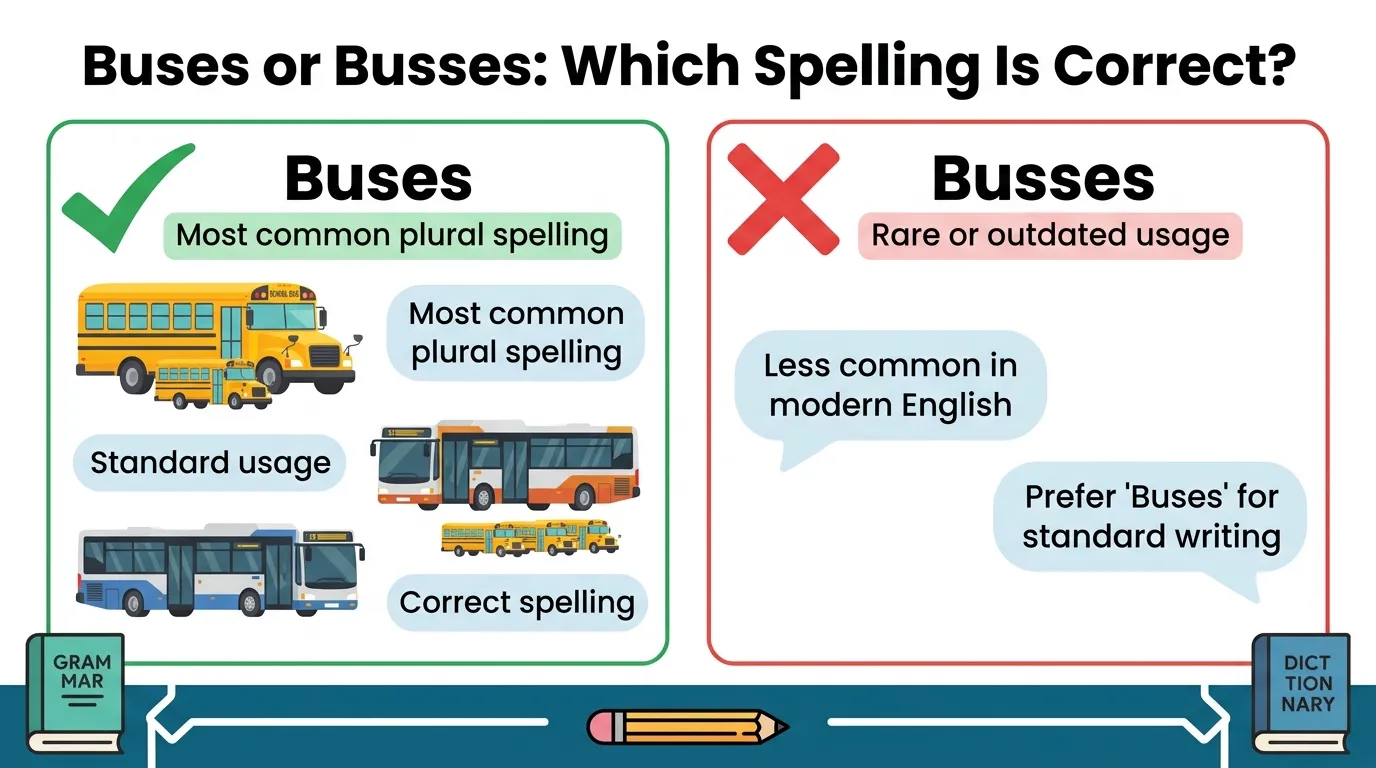
Buses is the correct and preferred plural of bus, while busses is rare and usually associated with the word buss (meaning a kiss). 🚍
Have you ever wondered if the correct plural of bus is buses or busses? Many writers, students, and English learners search for this answer because both spellings appear online and in books. This can make the choice confusing.
The good news is that there is a simple answer. While both words exist in English, they do not always mean the same thing. In modern writing, buses is the standard plural form of bus.
The spelling busses is much less common and is often linked to a different meaning of the word buss, which means a kiss.
Understanding the difference helps you avoid spelling mistakes in school assignments, business emails, articles, and social media posts.
In this guide, you’ll learn the origin of both spellings, how British and American English use them, common mistakes to avoid, and which version is best for your audience.
Buses or Busses: Quick Answer
Buses is the correct and preferred plural form of bus.
Examples:
✅ The city added five new buses this year.
✅ School buses arrive at 8 a.m.
⚠️ Busses is sometimes accepted as a plural form, but it is uncommon and may confuse readers.
Quick Rule: Use buses when talking about more than one bus.
The Origin of Buses or Busses
The word bus comes from the word omnibus, which was used in the 1800s to describe a public vehicle carrying passengers.
As English evolved, omnibus was shortened to bus. When forming the plural, writers generally added -es, creating buses.
The spelling busses appeared because many English words ending in a consonant sometimes double the final letter before adding a suffix. Over time, however, buses became the dominant spelling.
Another reason for confusion is that buss is an older English word meaning a kiss. The plural and verb forms of that word are often spelled busses.
Historical Development
| Period | Common Form |
| 1800s | Omnibuses |
| Early 1900s | Buses and Busses |
| Modern English | Buses (preferred) |
British English vs American English Spelling
Both British and American English generally prefer buses.
While you may occasionally see busses in older publications, style guides and dictionaries in both regions recommend buses for transportation vehicles.
Comparison
| Meaning | American English | British English |
| More than one bus | Buses | Buses |
| Rare alternative spelling | Busses | Busses |
| Kiss (verb form of buss) | Busses | Busses |
Examples
American English:
- The city operates hundreds of buses.
British English:
- London’s red buses are famous worldwide.
Which Spelling Should You Use?
The best spelling depends on clarity, but in almost every case, buses is the safest choice.
Use “Buses” If:
- You write for a US audience.
- You write for a UK audience.
- You create business content.
- You write academic papers.
- You publish online content.
Use “Busses” Only If:
- You are quoting historical text.
- You are discussing the word buss (kiss).
- You intentionally follow an older spelling style.
Recommendation
For modern English, always choose buses.
Common Mistakes with Buses or Busses
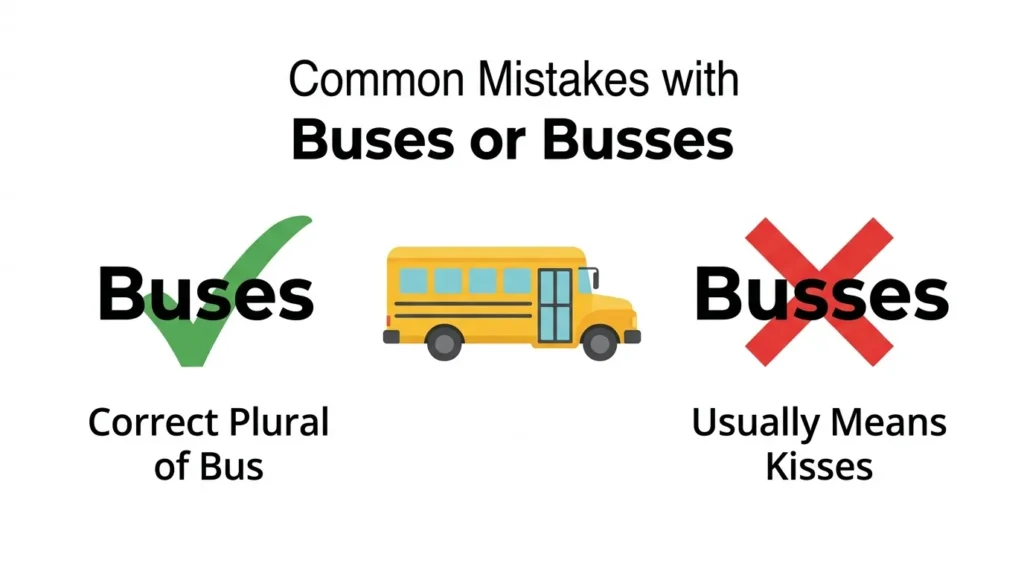
Many writers make these errors:
| Incorrect | Correct |
| Three busses arrived. | Three buses arrived. |
| School busses are late. | School buses are late. |
| The city bought new busses. | The city bought new buses. |
| Many busses run daily. | Many buses run daily. |
Why It Happens
People often think a doubled s is needed because the word ends with s. However, modern English dictionaries list buses as the preferred plural.
Buses or Busses in Everyday Examples
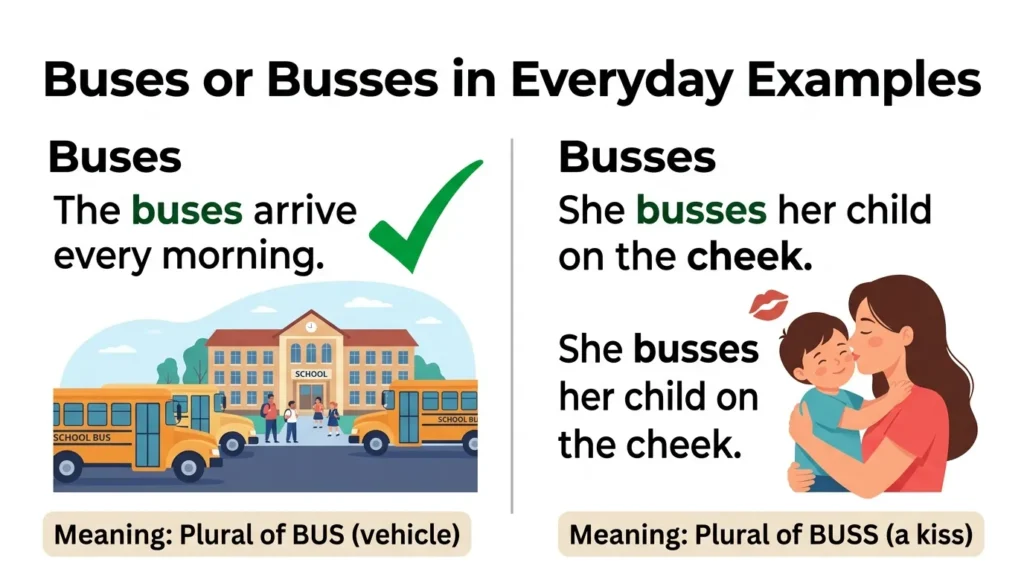
“The company provides shuttle buses for employees.”
News
“New electric buses will reduce pollution in the city.”
Social Media
“Waiting for the buses again today!”
Formal Writing
“The transportation department purchased twenty additional buses.”
Education
“The yellow school buses arrived before classes began.”
Buses or Busses: Google Trends & Usage Data
Search and usage data show that buses is far more popular than busses.
Popularity by Country
| Country | Preferred Spelling |
| United States | Buses |
| United Kingdom | Buses |
| Canada | Buses |
| Australia | Buses |
| New Zealand | Buses |
Usage Context
| Context | Preferred Form |
| Transportation | Buses |
| News Articles | Buses |
| Academic Writing | Buses |
| Government Documents | Buses |
| Historical Texts | Sometimes Busses |
Modern search trends consistently show buses receiving significantly more usage than busses.
Comparison: Buses vs Busses
| Feature | Buses | Busses |
| Standard modern plural of bus | ✅ Yes | ⚠️ Rare |
| Recommended by dictionaries | ✅ Yes | ❌ Usually No |
| Common in professional writing | ✅ Yes | ❌ Rare |
| Can cause confusion | ❌ No | ✅ Yes |
| Related to the word “buss” (kiss) | ❌ No | ✅ Yes |
FAQs
1. Is it buses or busses?
Buses is the standard and preferred plural of bus.
2. Is busses wrong?
Not completely. It exists but is uncommon and usually avoided in modern writing.
3. Which spelling do dictionaries prefer?
Most major dictionaries prefer buses.
4. Do British people write buses or busses?
British English normally uses buses.
5. Do Americans use buses or busses?
American English strongly prefers buses.
6. Why do some people write busses?
Some follow older spelling patterns or confuse it with the word buss.
7. Should I use buses in professional writing?
Yes. Buses is the recommended choice for professional, academic, and online content.
Conclusion
The debate over buses or busses is simpler than it first appears. In modern English, buses is the accepted and preferred plural form of bus. It is used by major dictionaries, style guides, schools, businesses, and publishers across the English-speaking world. Although busses is not always technically incorrect, it is rare and can confuse readers because it is also connected to the older word buss, meaning a kiss.
For clear communication, choose buses whenever you refer to transportation vehicles. This rule works for American English, British English, Canadian English, Australian English, and most global audiences. Using the standard spelling helps your writing look professional and trustworthy.
If you remember one thing from this guide, let it be this: When talking about more than one bus, write buses not busses. Following this simple rule will keep your writing accurate and easy to understand.
Read more about!
Alive or Dead: What’s the Difference?
Throught or Through: Which Spelling Is Correct?