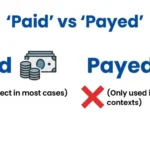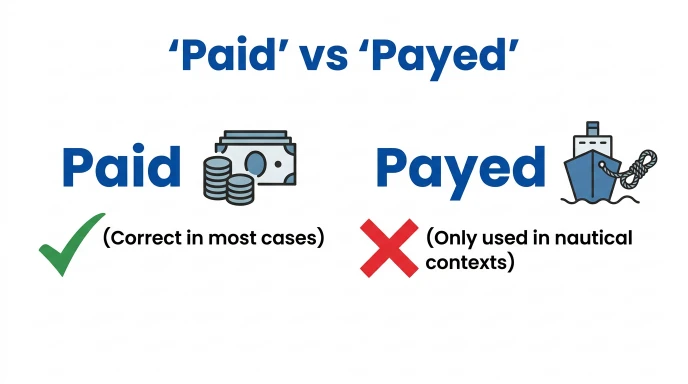
Paid is the correct spelling in almost all cases, while payed is only used in rare nautical or rope-related contexts.
Have you ever wondered if you should write paid or payed? Many English learners and even native speakers mix up these two words because they look similar.
Since both come from the verb pay, it seems logical that payed could be the past tense. However, English has many irregular verbs, and pay is one of them.
The confusion becomes even greater because payed is actually a real word, but it is only used in special situations related to ships and ropes.
In everyday writing, business emails, school assignments, news articles, and social media posts, paid is almost always the correct choice.
This guide explains the difference between paid and payed in simple language. You’ll learn their meanings, origins, spelling rules, common mistakes, real-life examples, and which version you should use depending on your audience.
By the end of this article, you’ll know exactly when to write paid and when payed is appropriate.
Paid or Payed : Quick Answer
Paid is the correct past tense and past participle of pay in almost every situation.
Examples:
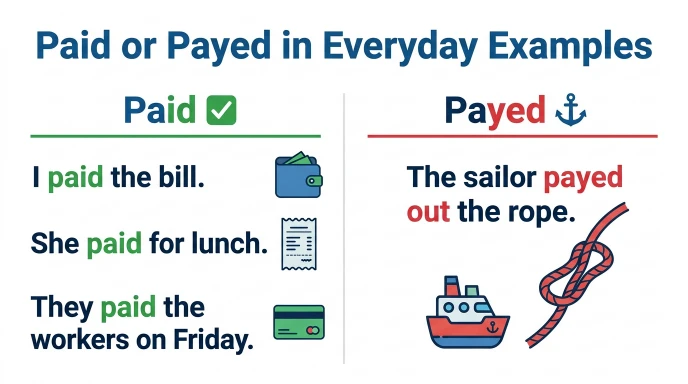
- ✅ I paid the bill yesterday.
- ✅ She paid for lunch.
- ✅ We have paid our taxes.
Payed is only correct in special nautical meanings, such as letting out rope or sealing a ship’s deck.
Example:
- ✅ The sailors payed out the rope.
Quick Rule:
| Word | Correct Usage |
| Paid | Money, bills, wages, prices, costs |
| Payed | Ships, ropes, and nautical terms only |
The Origin of Paid or Payed
The verb pay comes from the Old French word paier, meaning “to satisfy a debt.”
Over time, English changed the past tense from payed to paid. This made pay one of the language’s irregular verbs, similar to:
- Say → Said
- Lay → Laid
- Pay → Paid
The spelling payed did not disappear completely. Instead, it remained in maritime English, where it has a different meaning. Sailors use payed when talking about letting out rope or covering wooden ships with tar to make them waterproof.
Because these nautical uses are rare, most people only need the word paid.
British English vs American English Spelling
Unlike words such as colour/color or realise/realize, there is no spelling difference between British and American English for the past tense of pay.
Both countries use paid in normal writing.
| Context | British English | American English |
| Money | Paid | Paid |
| Salary | Paid | Paid |
| Bill | Paid | Paid |
| Invoice | Paid | Paid |
| Nautical meaning | Payed | Payed |
Examples
British English:
- I paid the electricity bill.
American English:
- She paid for the tickets online.
Both versions follow exactly the same rule.
Which Spelling Should You Use?
The answer is simple.
If you write for the United States
Use paid.
If you write for the United Kingdom
Use paid.
If you write for Australia, Canada, New Zealand, or other Commonwealth countries
Use paid.
If you write for an international audience
Always use paid unless you are discussing ships or sailing.
For almost every reader, paid is the correct spelling.
Common Mistakes with Paid or Payed
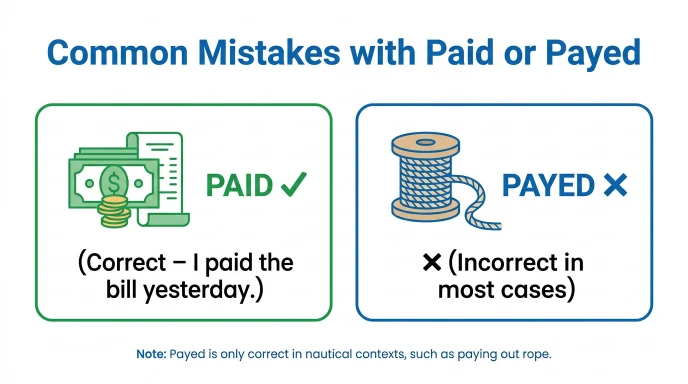
Many writers assume every regular verb ends in -ed, leading them to write payed by mistake.
Incorrect vs Correct
❌ I payed the rent.
✅ I paid the rent.
❌ She has payed the bill.
✅ She has paid the bill.
❌ We payed for dinner.
✅ We paid for dinner.
✅ The crew payed out the rope. (Correct nautical use.)
Easy Tip
Think of these pairs:
- Say → Said
- Lay → Laid
- Pay → Paid
Paid or Payed in Everyday Examples
In Emails
I have paid the invoice today.
In News
The company paid millions in taxes.
On Social Media
Finally paid off my student loan!
In Formal Writing
The customer paid the full amount before delivery.
In Everyday Conversation
- I paid cash.
- She paid by card.
- We paid the hotel online.
- Have you paid the bill yet?
Paid or Payed : Google Trends & Usage Data
Google search data consistently shows that paid is searched and used far more often than payed.
The reason is simple:
- Paid appears in business, education, finance, shopping, and everyday conversation.
- Payed mostly appears in sailing, boating, and maritime history.
Popularity by Context
| Context | Common Word |
| Banking | Paid |
| Shopping | Paid |
| Business | Paid |
| Payroll | Paid |
| Education | Paid |
| Maritime | Payed |
Popularity by Country
| Country | Common Spelling |
| United States | Paid |
| United Kingdom | Paid |
| Canada | Paid |
| Australia | Paid |
| India | Paid |
| Pakistan | Paid |
Paid vs Payed Comparison
| Feature | Paid | Payed |
| Correct past tense of pay | ✅ Yes | ❌ No |
| Used for money | ✅ Yes | ❌ No |
| Used in business | ✅ Yes | ❌ No |
| Used in schools | ✅ Yes | ❌ No |
| Used in emails | ✅ Yes | ❌ No |
| Used in shipping | ❌ No | ✅ Yes |
| Common in everyday English | ✅ Yes | Rare |
FAQs
1. Is it paid or payed?
Paid is correct in almost every situation.
2. Is payed ever correct?
Yes. It is correct only in nautical language when talking about ropes or sealing ships.
3. Why isn’t payed the normal past tense?
Because pay is an irregular verb, its past tense became paid.
4. Do British people say paid or payed?
They use paid, just like Americans.
5. Can I write “I payed the bill”?
No. The correct sentence is I paid the bill.
6. Which spelling should students use?
Students should always use paid unless writing about sailing.
7. Is paid used worldwide?
Yes. It is the accepted spelling in all major English-speaking countries.
Conclusion
The difference between paid and payed is much simpler than many people think. Although both words exist in English, they have very different uses. Paid is the standard past tense and past participle of pay, making it the correct choice whenever you talk about money, bills, salaries, invoices, shopping, or financial transactions. It is the spelling used in schools, businesses, newspapers, official documents, and everyday conversations across the United States, the United Kingdom, Canada, Australia, and other English-speaking countries.
On the other hand, payed survives only as a specialized nautical term. Sailors use it when referring to letting out rope or waterproofing wooden ships with tar. Outside of these rare maritime situations, using payed is considered a spelling mistake. When in doubt, remember the simple rule: if your sentence involves paying money, the correct word is paid. Following this guideline will help your writing stay accurate, professional, and easy for readers to understand.
Read more about!
Til or Till: Which Spelling Is Correct?
Alive or Dead: What’s the Difference?

Hello, I am Henry P. Whitmore, an English language scholar and grammar author known for my contributions to English grammar education. I am recognized for presenting complex grammatical rules in a clear, structured, and student-friendly manner, making my work valuable for learners, teachers, and non-native speakers of English.