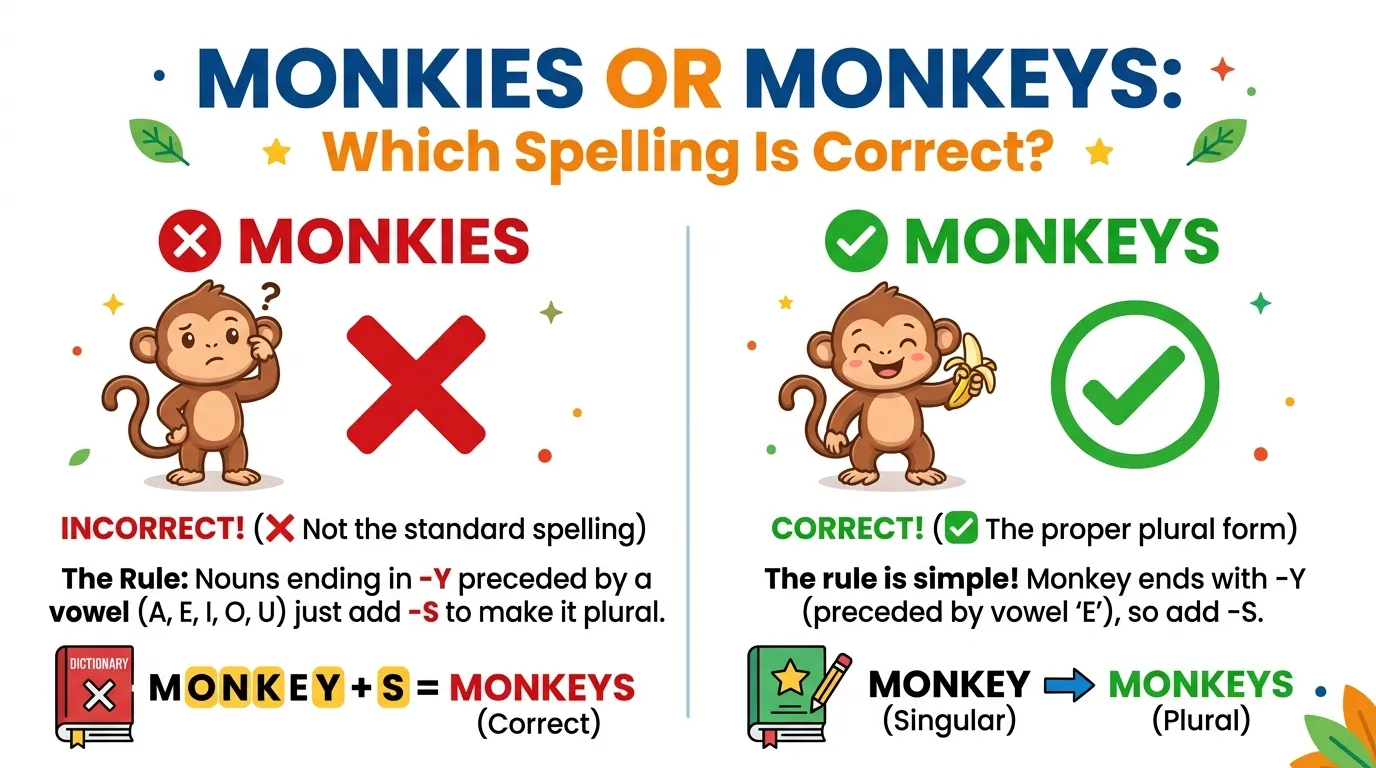
Monkeys is the correct plural of monkey, while monkies is a common spelling mistake. ✅🐵
Have you ever typed “monkies” and wondered if it was correct? You’re not alone. Many people search for “monkies or monkeys” because English plural rules can be confusing.
Some words ending in -y change to -ies when made plural, such as baby → babies and city → cities. Because of this pattern, many writers assume that monkey becomes monkies.
The confusion is understandable, but there is a simple rule that explains why one spelling is correct and the other is not.
If you’re writing a school paper, social media post, article, email, or professional document, using the correct plural form helps your writing look polished and accurate.
In this guide, you’ll learn the correct spelling, the grammar rule behind it, the history of the word, differences between British and American English, common mistakes, real-world examples, and usage trends. By the end, you’ll know exactly when to use monkeys and why monkies should usually be avoided.
Monkies or Monkeys: Quick Answer
Monkeys is the correct plural form of monkey.
Monkies is incorrect in standard English.
Examples
✅ The monkeys climbed the trees.
✅ We saw several monkeys at the zoo.
❌ The monkies climbed the trees.
❌ We saw several monkies at the zoo.
The correct spelling is always monkeys.
The Origin of Monkies or Monkeys
The word monkey entered English several centuries ago. Linguists are not completely certain of its exact origin, but it has been used in English since the late Middle Ages.
The spelling confusion comes from English pluralization rules. Many nouns ending in a consonant followed by y change to -ies in the plural:
- Baby → Babies
- Lady → Ladies
- City → Cities
However, when a word ends in a vowel + y, you simply add -s:
- Toy → Toys
- Key → Keys
- Monkey → Monkeys
Since monkey ends with the vowel e before y, the correct plural is monkeys.
British English vs American English Spelling
There is no difference between British and American English for this word.
Both varieties use monkeys as the correct plural form.
Comparison
| Form | British English | American English | Correct? |
| Monkeys | Yes | Yes | ✅ Correct |
| Monkies | No | No | ❌ Incorrect |
Examples
British English
- The monkeys live in tropical forests.
American English
- The monkeys were playing in the enclosure.
The spelling remains the same worldwide.
Which Spelling Should You Use?
The answer is simple: use monkeys in every situation.
| Audience | Recommended Spelling |
| US Readers | Monkeys |
| UK Readers | Monkeys |
| Canada | Monkeys |
| Australia | Monkeys |
| Academic Writing | Monkeys |
| Business Writing | Monkeys |
| Global Audience | Monkeys |
There is no situation where monkies is preferred in standard English.
Common Mistakes with Monkies or Monkeys
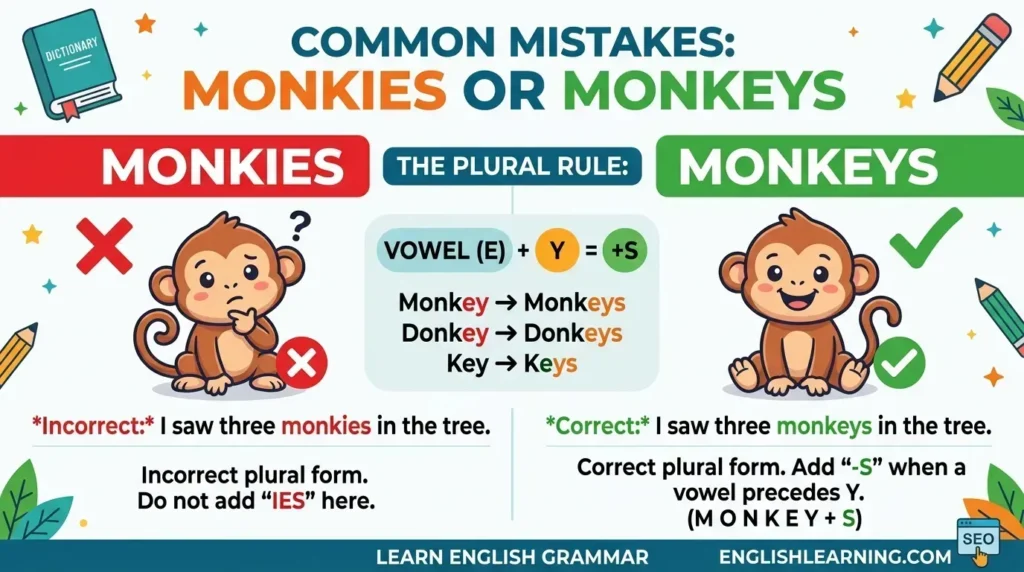
Many writers apply the wrong plural rule.
Frequent Errors
| Mistake | Correct Form |
| Monkies | Monkeys |
| Monkeys | Monkeys |
| Thinking monkey follows baby → babies | Monkey follows toy → toys |
| Using monkies in formal writing | Use monkeys |
Corrections
❌ The monkies were noisy.
✅ The monkeys were noisy.
❌ Several monkeys sat on the branch.
✅ Several monkeys sat on the branch.
❌ We photographed many monkies.
✅ We photographed many monkeys.
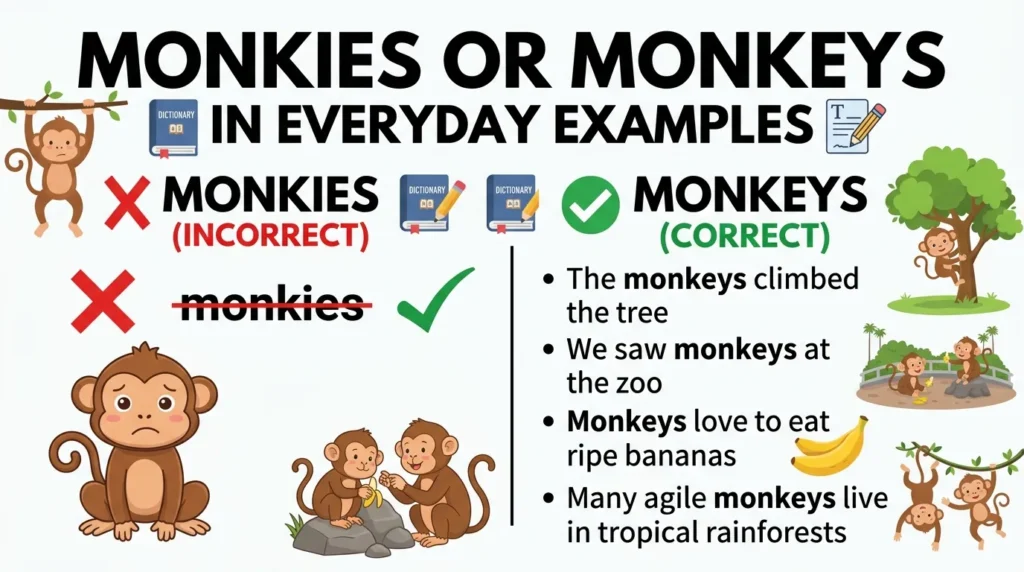
Monkies or Monkeys in Everyday Examples
Emails
- The zoo recently welcomed two new monkeys.
- Our students learned about monkeys in science class.
News Writing
- Researchers observed monkeys using tools.
- The monkeys were released into a protected habitat.
Social Media
- Look at these adorable monkeys! 🐵
- The monkeys at the sanctuary were so playful today.
Formal Writing
- Monkeys play an important role in many ecosystems.
- Several species of monkeys are endangered.
Monkies or Monkeys: Google Trends & Usage Data
Searches for “monkies or monkeys” are common because people want to verify the correct plural spelling.
Popularity Comparison
| Form | Popularity |
| Monkeys | Extremely High |
| Monkies | Very Low |
Country Usage
- United States: Monkeys dominates usage.
- United Kingdom: Monkeys is standard.
- Canada: Monkeys is preferred.
- Australia: Monkeys is universally accepted.
Most searches for monkies come from spelling checks, grammar questions, and educational research.
Monkies vs Monkeys Comparison
| Feature | Monkies | Monkeys |
| Correct English Spelling | No | Yes |
| Dictionary Accepted | No | Yes |
| Academic Writing | Avoid | Use |
| Business Writing | Avoid | Use |
| Everyday Writing | Avoid | Use |
| Global Acceptance | Very Low | Very High |
| Recommended Choice | No | Yes |
FAQs
Is monkies or monkeys correct?
Monkeys is correct. Monkies is incorrect.
Why is it monkeys and not monkies?
Because monkey ends with a vowel (e) followed by y, so you add -s.
Is monkies a real word?
No. It is generally considered a spelling mistake.
Do British and American English spell monkeys differently?
No. Both use monkeys.
What is the plural of monkey?
The plural of monkey is monkeys.
Are monkeys following the same rule as toys?
Yes. Both words end with a vowel before y, so they take -s.
Can I use monkies in formal writing?
No. Use monkeys in all formal and professional writing.
Conclusion
The answer to “monkies or monkeys” is clear: monkeys is the only correct plural form in standard English. While many people assume the word should follow the pattern of baby → babies or city → cities, the grammar rule is different. Because monkey ends with a vowel plus y, you simply add -s to create the plural.
This rule also applies to words like toy → toys, key → keys, and journey → journeys. The spelling monkies is a common mistake that appears when writers apply the wrong pluralization rule.
If you’re writing for school, work, social media, journalism, or professional publications, monkeys is always the correct choice. There are no regional differences between British and American English, making it a safe spelling for global audiences.
Remember this easy rule: if a word ends with a vowel before y, add -s, not -ies. Following this guideline will help you avoid mistakes and write with confidence.
Read more about!
Proove or Prove 🤔 : Which Spelling Is Correct?
Caftan or Kaftan 👗: Which Spelling Is Correct?

Hello, I am Henry P. Whitmore, an English language scholar and grammar author known for my contributions to English grammar education. I am recognized for presenting complex grammatical rules in a clear, structured, and student-friendly manner, making my work valuable for learners, teachers, and non-native speakers of English.