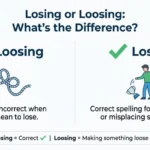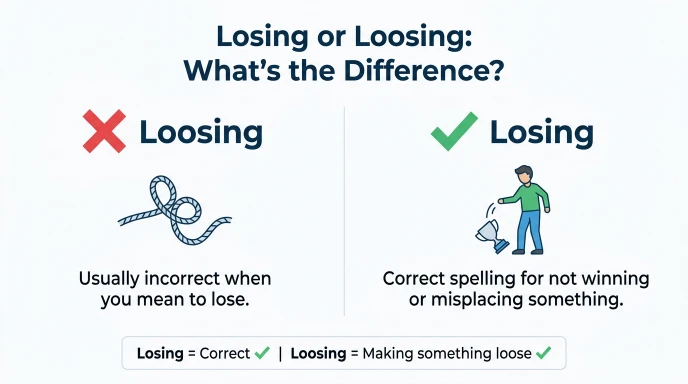
Losing means not winning or no longer having something, while loosing means releasing or setting something free.
Have you ever typed “loosing” when you meant “losing”? You are not alone. These two words look almost the same, but they have very different meanings.
Many English learners, students, writers, and even native speakers mix them up because only one extra “o” changes the word.
If you are writing an email, school paper, social media post, or business document, using the wrong spelling can confuse your readers. The good news is that the difference is simple once you understand it.
This guide explains losing or loosing in easy English. You will learn the correct spelling, the history of both words, when to use each one, common mistakes to avoid, and real-life examples.
We will also compare British and American English, answer frequently asked questions, and explain which spelling fits different audiences. By the end of this article, you will never confuse losing and loosing again.
Losing or Loosing : Quick Answer
Losing is the correct word when you mean not winning or no longer having something.
Loosing is a different word. It means releasing, letting go, or setting something free. It is much less common.
Examples
✅I am losing my keys.
✅Our team is losing the match.
✅She is losing weight.
✅The soldier was loosing an arrow.
✅They were loosing the dogs.
Quick Rule:
- Losing = Not winning or no longer having something
- Loosing = Releasing or setting free
The Origin of Losing or Loosing
Although these words look alike, they come from different forms of the verb lose.
Lose comes from Old English losian, meaning “to perish,” “be destroyed,” or “fail to keep.”
From this verb came:
- Lose
- Lost
- Losing
The word loose has a different meaning. It describes something that is not tight.
From loose comes the verb loose, meaning to release.
That creates:
- Loose
- Loosed
- Loosing
The confusion happens because lose and loose are spelled similarly but have different meanings.
British English vs American English Spelling
Unlike many English words, there is no spelling difference between British and American English.
Both countries use:
- Losing for not winning.
- Loosing for releasing.
| Meaning | British English | American English |
| Not winning | Losing | Losing |
| Misplacing something | Losing | Losing |
| Releasing something | Loosing | Loosing |
Examples
| British English | American English |
| We are losing money. | We are losing money. |
| She is losing hope. | She is losing hope. |
| The hunter was loosing arrows. | The hunter was loosing arrows. |
There is no regional spelling difference.
Which Spelling Should You Use?
The correct choice depends on what you want to say.
For American readers
Use losing unless you mean releasing something.
For British readers
Use losing in everyday writing.
For Commonwealth countries
Australia, Canada, New Zealand, and South Africa also use losing in normal writing.
For global audiences
Use losing almost every time.
Use loosing only in special contexts like:
- History
- Military writing
- Archery
- Poetry
- Literature
Common Mistakes with Losing or Loosing
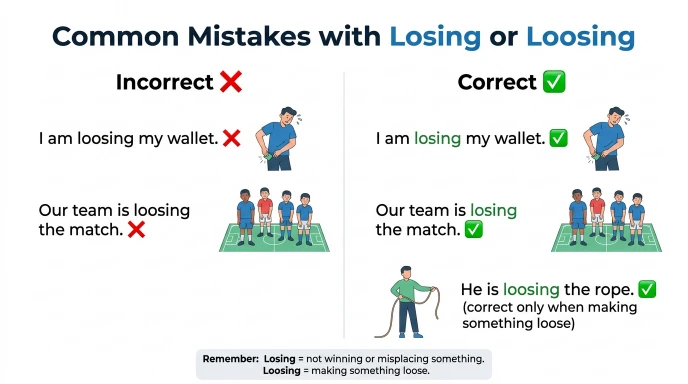
Many people accidentally add an extra o.
Incorrect
❌ I am loosing my wallet.
✅ I am losing my wallet.
❌ We are loosing the game.
✅ We are losing the game.
❌ She keeps loosing her phone.
✅ She keeps losing her phone.
Correct use of loosing:
✅ The knight was loosing arrows at the enemy.
Losing or Loosing in Everyday Examples
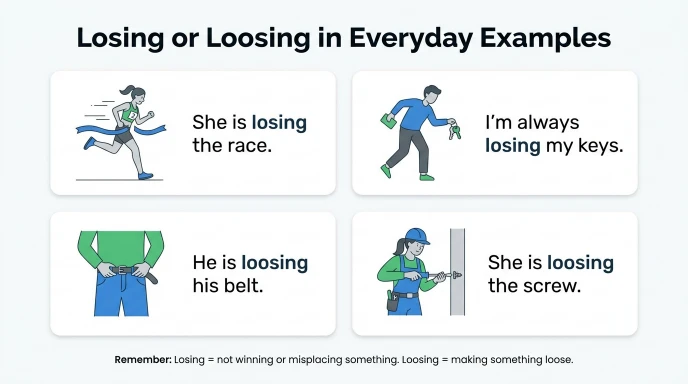
Emails
✅ We are losing customers this month.
News
✅ The company is losing millions every year.
Social Media
✅ I’m losing my mind waiting for the weekend!
School Writing
✅ Many animals are losing their natural habitat.
Business Writing
✅ Our team is losing market share.
Historical Writing
✅ The archers were loosing arrows across the battlefield.
Losing or Loosing: Google Trends & Usage Data
Search data shows that losing is searched far more often than loosing because it is used in everyday conversation, education, sports, business, and news.
The word loosing appears much less often and is mainly searched because people want to know if it is a spelling mistake or a real word.
Popular countries searching for “losing”
- United States
- United Kingdom
- Canada
- Australia
- India
Common search contexts
- Losing weight
- Losing money
- Losing hair
- Losing games
- Losing sleep
Common search contexts for “loosing”
- Loosing vs losing
- Loosing arrows
- Meaning of loosing
- Is loosing a word?
Comparison
| Feature | Losing | Loosing |
| Correct everyday word | ✅ Yes | ❌ No |
| Means not winning | ✅ Yes | ❌ No |
| Means misplacing something | ✅ Yes | ❌ No |
| Means releasing something | ❌ No | ✅ Yes |
| Common in daily English | ✅ Very common | ❌ Rare |
| Used in sports | ✅ Yes | ❌ No |
| Used in business | ✅ Yes | ❌ No |
| Used in archery | ❌ No | ✅ Yes |
FAQs
1. Is it losing or loosing?
Usually, losing is correct. Loosing means releasing something.
2. Is “loosing” a real word?
Yes. It is a real English word but is rarely used.
3. Why do people confuse losing and loosing?
Because the words look very similar, and many people think lose should have two “o”s.
4. How do I remember the difference?
Think of lose → losing.
Think of loose → loosing.
5. Can I write “I’m loosing weight”?
No.
The correct sentence is:
I’m losing weight.
6. When should I use loosing?
Use it only when talking about releasing something, such as arrows, animals, or ropes.
7. Which spelling is more common?
Losing is far more common in everyday English.
Conclusion
The difference between losing and loosing is easy once you know their meanings. Losing is the word you should use when talking about not winning, misplacing something, or having less of something. It appears every day in conversations, books, newspapers, emails, business writing, and online posts. In contrast, loosing is a real but uncommon word that means releasing or setting something free. You will mostly see it in historical writing, archery, military stories, or literature.
There is no spelling difference between British and American English for these words. Both varieties use losing for everyday situations and loosing only when the meaning is “to release.” If you are ever unsure, ask yourself if you mean “not winning” or “letting something go.” In almost every modern sentence, losing will be the correct choice. Learning this simple rule will help you write with greater accuracy, avoid common spelling mistakes, and communicate more clearly in every type of writing.
Read more about!
Throught or Through: Which Spelling Is Correct?
Alive or Dead: What’s the Difference?