“Divine” is the correct spelling, while “Devine” is usually a misspelling or a surname. 😊
Have you ever wondered whether to write devine or divine? This confusion is common among English learners, writers, and even native speakers. Many people search for “devine or divine” because they are unsure which spelling is correct and when to use it.
Using the wrong form can make writing look unprofessional or confusing, especially in emails, social media, blogs, or academic content.
The word divine has multiple uses. It can mean “godly or heavenly,” “excellent or delightful,” or “to foresee or predict.” On the other hand, devine is usually a surname or a proper noun.
Some people mistakenly use devine instead of divine, which can lead to misunderstandings.
In this article, we will clarify the difference between devine or divine, explore the origin of the words, examine British and American English usage, highlight common mistakes, and provide practical examples. By the end, you will know exactly which spelling to use and how to avoid common errors.
Devine or Divine – Quick Answer
- ✅ Divine = Correct spelling when describing something heavenly, excellent, or foreseeing.
- Example: The chef prepared a divine meal.
- ⚠️ Devine = Usually a surname or proper noun.
- Example: Mary Devine attended the conference.
Rule of thumb: Use divine for descriptive purposes. Use Devine only as a name.
The Origin of Devine or Divine
Divine
- Origin: Middle English devine, from Latin divinus, meaning “godlike.”
- Historical use: Applied to gods, prophecy, or heavenly qualities.
- Modern use: Describes anything extraordinarily good or associated with deity.
Devine
- Origin: Typically a surname of Irish or English origin.
- Historical use: Family names, sometimes derived from Gaelic words.
- Modern use: Proper noun, not interchangeable with the adjective divine.
Why Confusion Exists
- Phonetic similarity causes people to mistakenly spell divine as devine.
- Autocorrect or typing errors often reinforce the wrong spelling.
- Proper nouns like Devine exist, so search engines sometimes show mixed results.
British English vs American English Spelling
| Feature | British English | American English |
| Heavenly or excellent | Divine | Divine |
| Surname | Devine | Devine |
| Adjective usage | Divine | Divine |
| Verb (to foretell) | Divine | Divine |
| Spelling difference | None | None |
✔️ Both British and American English use divine for general purposes. The spelling of Devine as a surname is consistent worldwide.
Which Spelling Should You Use?
✅ Use Divine if:
- Describing godly, heavenly, or exceptionally good qualities.
- Writing figuratively to praise something.
- Discussing prophecy or foretelling.
👉 Example: The sunset over the mountains was divine.
✅ Use Devine if:
- Referring to a person’s surname or proper noun.
- Citing someone in formal writing.
👉 Example: Professor Devine presented the lecture on medieval art.
Common Mistakes with Devine or Divine
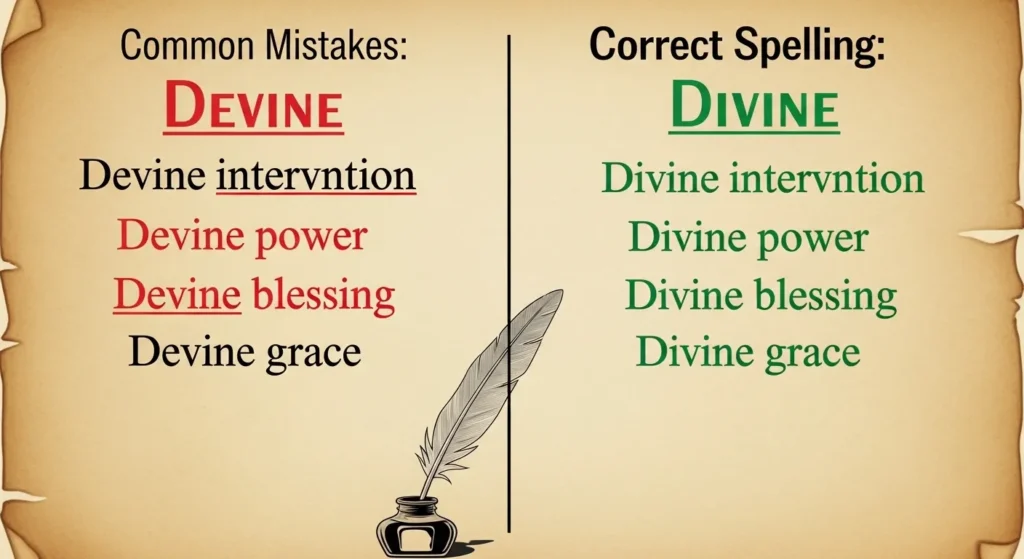
❌ Mistake 1: Using devine instead of divine
- Wrong: The chocolate cake was devine.
- Correct: The chocolate cake was divine.
❌ Mistake 2: Capitalizing divine unnecessarily
- Wrong: She had a Divine idea.
- Correct: She had a divine idea.
❌ Mistake 3: Confusing Devine the surname with divine the adjective
- Wrong: Mr. divine explained the theory.
- Correct: Mr. Devine explained the theory.
❌ Mistake 4: Overusing divine in casual speech
- Use sparingly to avoid exaggeration or cliché: The movie was divine is fine, but repeated usage may reduce impact.
Devine or Divine in Everyday Examples
Emails
- Correct: Your proposal has a divine attention to detail.
- Incorrect: Your proposal has a devine attention to detail.
News Articles
- The singer’s divine performance captivated the audience.
- Dr. Devine appointed as chair of the committee.
Social Media
- This outfit is absolutely divine!
- Shoutout to Mary Devine for her amazing work.
Formal Writing
- The architecture of the cathedral was divine in its elegance.
- Researcher Dr. Devine authored the latest study on genetics.
Devine or Divine – Google Trends & Usage Data
Search Trends
- Divine is far more commonly searched than Devine, indicating that most users seek the adjective.
- Devine searches spike occasionally, usually related to people or news about someone with that surname.
Popularity by Region
- United States: High searches for divine in lifestyle, food, and religion contexts.
- United Kingdom: Similar trend; Devine searches usually refer to notable individuals.
- Global: Divine is more common in general content; Devine niche.
Context-Based Insight
- Writers, bloggers, and marketers mostly use divine.
- Legal documents, genealogy, and news often reference Devine.
Comparison Table: Devine vs Divine
| Feature | Divine | Devine |
| Meaning | Heavenly, excellent, godly, foretelling | Surname / proper noun |
| Usage | General descriptive writing | Names of people |
| Audience | Everyone | Specific individuals |
| Examples | The cake was divine. | Dr. Devine led the seminar. |
| Frequency | Very common | Rare / niche |
FAQs
1. Is devine ever correct?
Yes, only as a surname or proper noun.
2. What is the correct adjective for godly or heavenly?
It is divine.
3. Can divine be capitalized?
Only capitalize if it starts a sentence or is part of a title.
4. Are there British vs American differences?
No, the adjective divine is the same in both variants.
5. Why do people spell divine as devine?
Phonetic similarity and autocorrect errors cause confusion.
6. Can Devine appear in fiction?
Yes, when naming characters or people.
7. How do I remember the difference?
Divine = godly or excellent; Devine = proper name.
Conclusion
When deciding between devine or divine, the key is context. Divine is the correct spelling for anything related to godly, heavenly, excellent, or foretelling qualities. It is versatile, used in everyday writing, figurative expressions, social media, formal content, and even culinary or artistic descriptions.
Devine, on the other hand, is typically a surname and should be capitalized when used as a proper noun.
Using the wrong form can confuse readers or appear unprofessional. British and American English do not differ in this case the spelling remains consistent worldwide.
Remember, divine describes excellence, godliness, or insight, while Devine refers to people. Mastering this distinction ensures clarity, accuracy, and confidence in your writing.
Read more about!
Grimey or Grimy 🤔 – Which Spelling Is Correct?

Hello, I am Henry P. Whitmore, an English language scholar and grammar author known for my contributions to English grammar education. I am recognized for presenting complex grammatical rules in a clear, structured, and student-friendly manner, making my work valuable for learners, teachers, and non-native speakers of English.