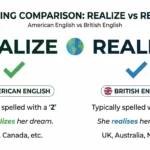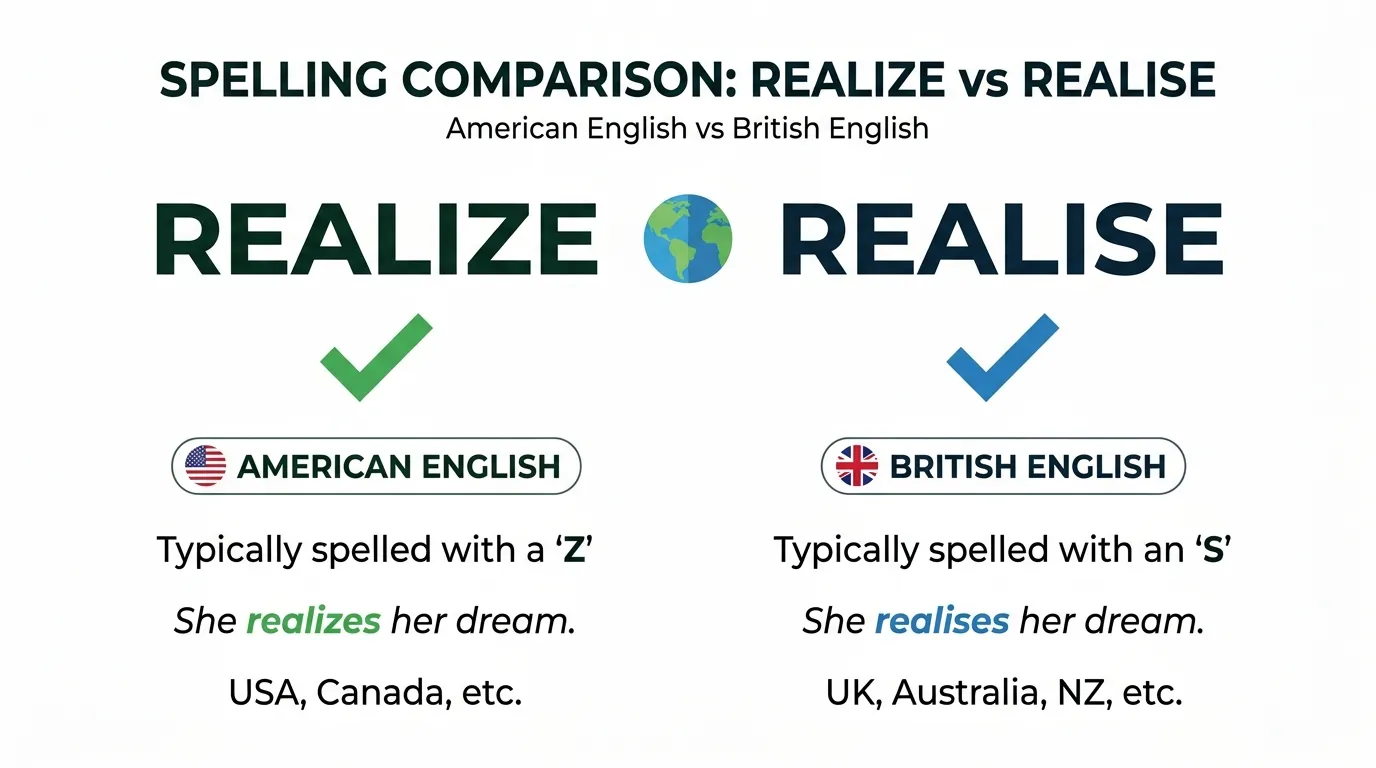
Realize is the correct American English spelling, while Realise is the correct British English spelling both have the same meaning. ✔️
Have you ever wondered if to write realize or realise? If so, you’re not alone.
This is one of the most common spelling questions in English. Both forms appear in books, websites, emails, and news articles, which makes many writers unsure about which version is correct.
People search for “realize or realise” because they want to know if one spelling is wrong, if the choice depends on the country, and which version they should use in professional writing.
The confusion comes from the fact that English has different spelling standards in different parts of the world.
The good news is that both spellings are correct. The difference is not about meaning but about regional spelling conventions. Realize is more common in American English, while realise is widely used in British English and many Commonwealth countries.
In this guide, you’ll learn the difference between realize and realise, their history, usage rules, common mistakes, examples, and advice on choosing the right spelling for your audience.
Realize or Realise: Quick Answer
Both realize and realise are correct.
- Realize is preferred in American English.
- Realise is preferred in British English and many Commonwealth countries.
Examples
✅ I didn’t realize the meeting was today. (American English)
✅ I didn’t realise the meeting was today. (British English)
Both sentences have the same meaning.
The Origin of Realize or Realise
The verb realize comes from French and Latin roots related to making something real or becoming aware of something.
Historically, both -ize and -ise spellings have existed in English for centuries. In fact, many British publishers traditionally used -ize forms, even though -ise later became more common in everyday British writing.
Over time, spelling preferences developed differently in various English-speaking countries:
- American English largely adopted -ize.
- British English increasingly favored -ise.
- Some British publishers still use -ize today.
This explains why both spellings are accepted in many dictionaries.
British English vs American English Spelling
The main difference is regional preference.
Comparison
| Spelling | American English | British English | Meaning |
| Realize | Preferred | Accepted by some publishers | Become aware |
| Realise | Rare | Preferred | Become aware |
Examples
American English
- I realize my mistake.
- She realized the answer immediately.
British English
- I realise my mistake.
- She realised the answer immediately.
The meaning remains identical.
Which Spelling Should You Use?
Choose the spelling based on your audience.
| Audience | Recommended Spelling |
| United States | Realize |
| Canada | Usually Realize |
| United Kingdom | Realise |
| Australia | Realise |
| New Zealand | Realise |
| Global Audience | Either, but stay consistent |
If you’re writing for an international audience, either spelling works as long as you use it consistently throughout the document.
Common Mistakes with Realize or Realise
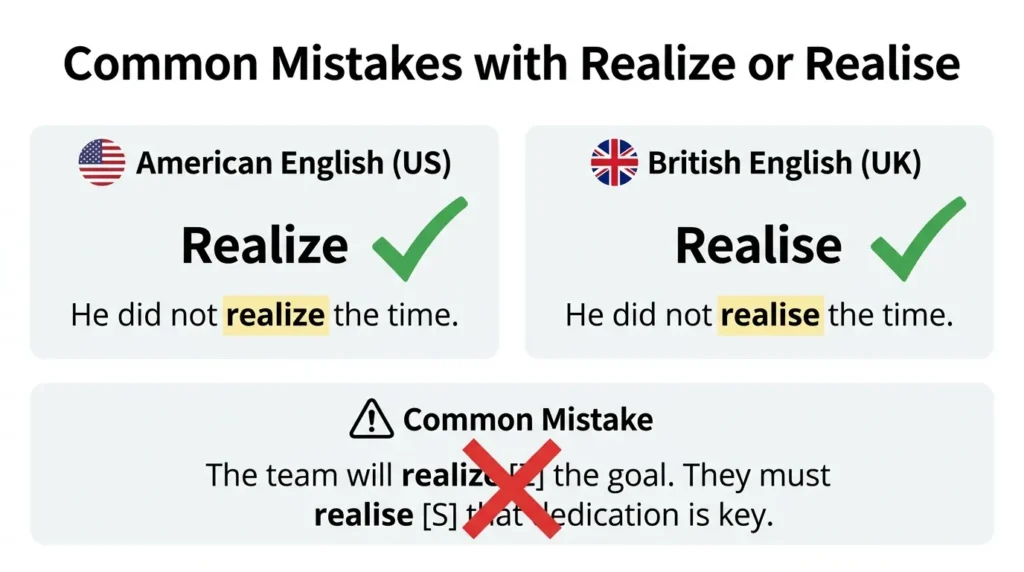
Many writers mix the two spellings in the same piece of writing.
Frequent Errors
| Mistake | Correction |
| Using realize and realise in the same article | Choose one style |
| Thinking realise is incorrect | It is correct in British English |
| Thinking realize is only American slang | It is standard English |
| Switching spelling mid-document | Stay consistent |
Corrections
❌ I realise the problem and later realized the solution.
✅ I realise the problem and later realised the solution.
✅ I realize the problem and later realized the solution.
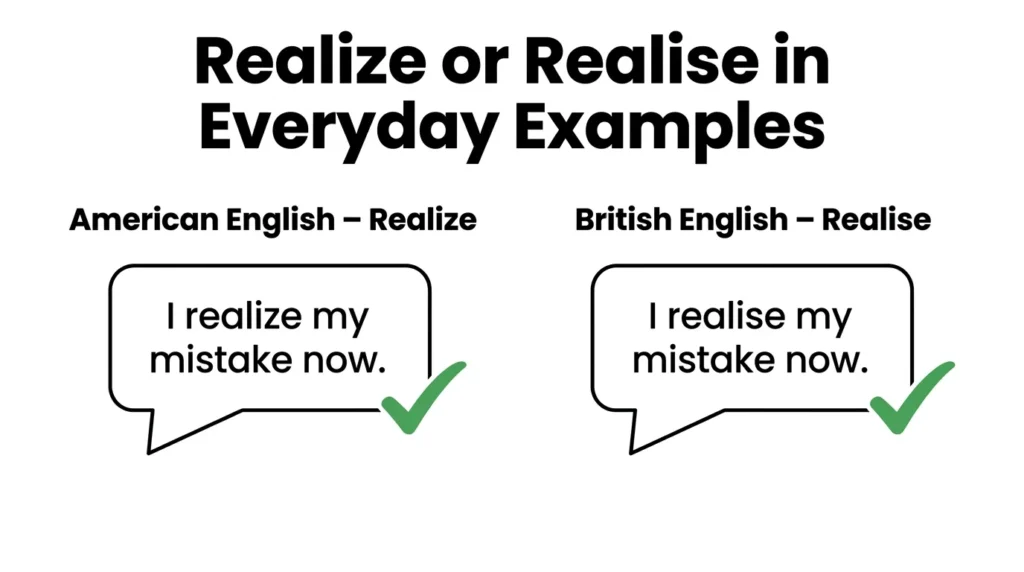
Realize or Realise in Everyday Examples
Emails
American Style
- I realize there was a misunderstanding.
British Style
- I realise there was a misunderstanding.
News Writing
- Experts realize the risks involved.
- Experts realise the risks involved.
Social Media
- Just realized it’s Friday! 🎉
- Just realised it’s Friday! 🎉
Formal Writing
- Researchers realize the importance of the findings.
- Researchers realise the importance of the findings.
Realize or Realise: Google Trends & Usage Data
Search data shows strong regional preferences.
Popularity by Region
| Region | Preferred Form |
| United States | Realize |
| Canada | Realize |
| United Kingdom | Realise |
| Australia | Realise |
| New Zealand | Realise |
General Usage Trends
- Realize dominates North American content.
- Realise is common in British and Commonwealth publications.
- Both spellings appear frequently online.
- Search interest increases among students, writers, and English learners.
Realize vs Realise Comparison
| Feature | Realize | Realise |
| Correct Spelling | Yes | Yes |
| American English | Preferred | Rare |
| British English | Accepted by some publishers | Preferred |
| Academic Writing | Common in US | Common in UK |
| Business Writing | Common in US | Common in UK |
| Meaning | Same | Same |
| Global Acceptance | High | High |
FAQs
Is realize or realise correct?
Both are correct. The choice depends on regional spelling conventions.
Is realize American English?
Yes. Realize is the preferred spelling in American English.
Is realise British English?
Yes. Realise is the preferred spelling in modern British English.
Do realize and realise mean the same thing?
Yes. They have exactly the same meaning.
Which spelling should I use in professional writing?
Use the version that matches your audience and remain consistent.
Is realize accepted in the UK?
Yes. Some British publishers and style guides accept realize.
Can I use both spellings in one document?
No. It is best to choose one spelling style and use it consistently.
Conclusion
The question of realize or realise is not about right versus wrong. Both spellings are correct and widely accepted in English. The difference comes from regional spelling preferences rather than meaning or grammar.
If you’re writing for an American audience, realize is the preferred choice. If you’re writing for readers in the United Kingdom, Australia, New Zealand, or many Commonwealth countries, realise is usually the better option. Both words mean the same thing: to become aware of something or understand it clearly.
The most important rule is consistency. Mixing realize and realise within the same article, report, or website can look unprofessional. Pick the spelling that matches your audience and use it throughout your writing.
By understanding the difference between realize and realise, you can write with confidence, follow regional conventions, and communicate clearly with readers around the world.
Read more about!
Specialty or Speciality 🤔: Which Is Correct?
Throught or Through: Which Spelling Is Correct?

Hello, I am Henry P. Whitmore, an English language scholar and grammar author known for my contributions to English grammar education. I am recognized for presenting complex grammatical rules in a clear, structured, and student-friendly manner, making my work valuable for learners, teachers, and non-native speakers of English.