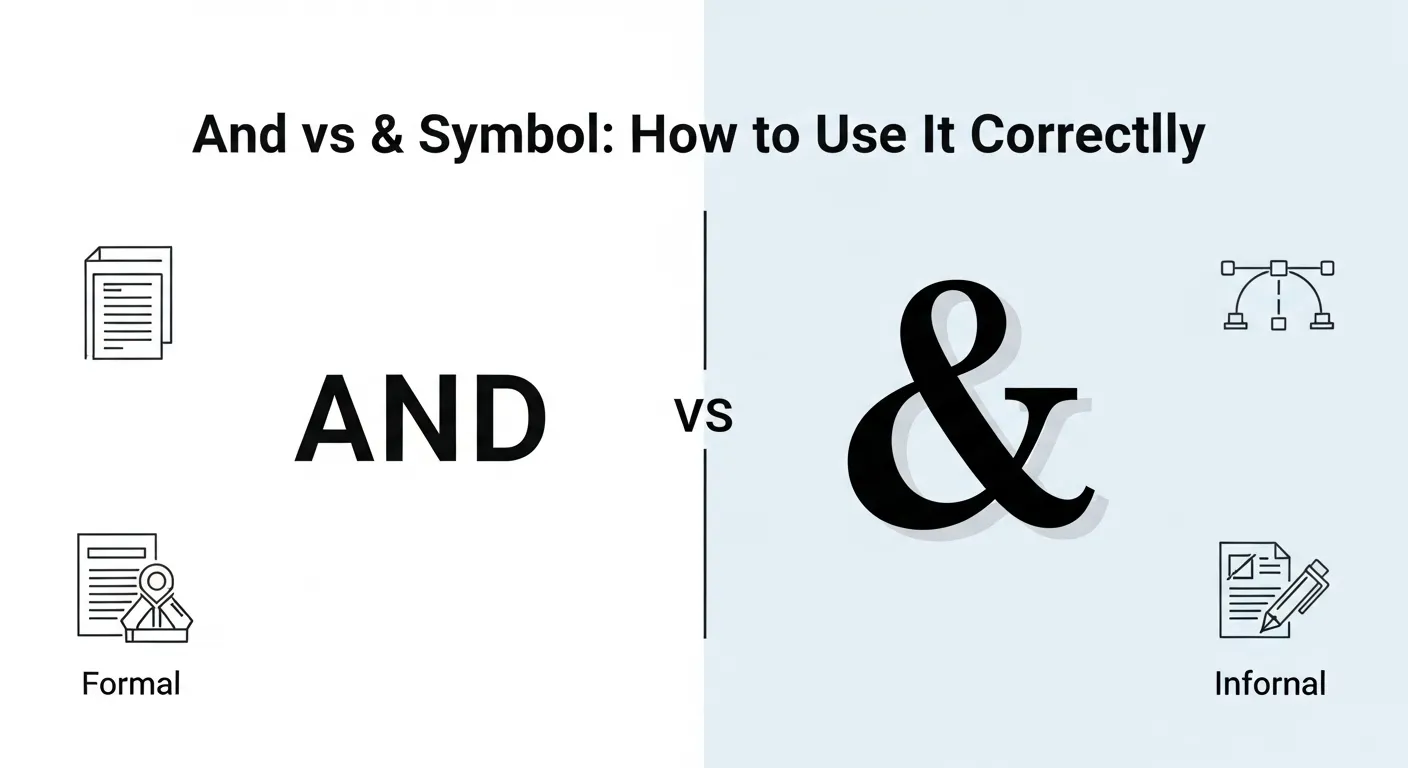
“‘&’ is a symbol for ‘and’ used mainly in informal writing, branding, and design, while ‘and’ is preferred in formal writing and sentences.”
Have you ever wondered whether to write and or use the symbol & in your writing? You’re not alone. Many people search for “and or symbol” because both are correct in English, but using them incorrectly can create confusion in professional, academic, or casual writing.
The symbol &, called an ampersand, is widely used in company names, branding, design, and informal contexts. However, in formal writing, emails, essays, or reports, the word and is usually preferred. Misunderstanding when to use & versus and can make documents look unprofessional or inconsistent.
This article provides a clear, simple guide to using and and the ampersand symbol. We’ll cover their history, correct usage, British vs American rules, common mistakes, and real-life examples from emails, social media, news, and formal writing.
You’ll also learn when it is acceptable to use the ampersand and when you should stick with and. By the end of this guide, you will confidently know how to use both forms correctly.
And or Symbol – Quick Answer
- ✅ And = Standard word used in all formal writing and most contexts.
- ✅ & (Symbol) = Ampersand; used in company names, titles, design, or informal contexts.
Examples:
- Formal writing: We need coffee and snacks. ✔️
- Company name: Johnson & Johnson ✔️
- Social media/design: Rock & Roll Night ✔️
✔️ Rule of thumb: Use and for regular writing, & for branding, titles, or visual emphasis.
The Origin of And or Symbol
The Word “And”
- Origin: Old English and, meaning “in addition to”
- Function: Conjunction connecting words, phrases, or clauses
- Usage: Has remained mostly unchanged in spelling and function
The Ampersand “&”
- Origin: Derived from Latin et, meaning “and”
- First appeared in 1st-century Roman scripts
- Name “ampersand” comes from “and per se and”, used in English alphabet recitations in the 19th century
- Modern use: Represents and symbolically, often for brevity, design, or style
Why Both Forms Exist
- And is grammatical and formal
- & is visual, shorthand, or brand-oriented
- Confusion arises because people sometimes use & in formal writing incorrectly
British English vs American English Spelling
| Feature | British English | American English |
| Standard writing | And | And |
| Company names | Use & in branding | Use & in branding |
| Formal essays | Avoid & | Avoid & |
| Social media/design | Ampersand common | Ampersand common |
| Style guides | Usually prefer “and” | Same |
✔️ There is no spelling difference; rules are the same in both English variants. The difference is in stylistic usage.
Which Form Should You Use?
✅ Use And if:
- Writing formal emails, essays, reports
- Joining ideas in text
- Following professional style guides (APA, MLA, Chicago)
👉 Example: Please bring pencils and notebooks.
✅ Use & (Ampersand) if:
- Writing company or brand names
- Adding visual style in titles, headings, or design
- Social media posts, marketing, or casual writing
👉 Example: Procter & Gamble announced a new product.
Audience-Based Advice:
- US and UK audience: Follow the same rules
- Global: Stick with and for formal writing, use & for brands or design
Common Mistakes with And or Symbol
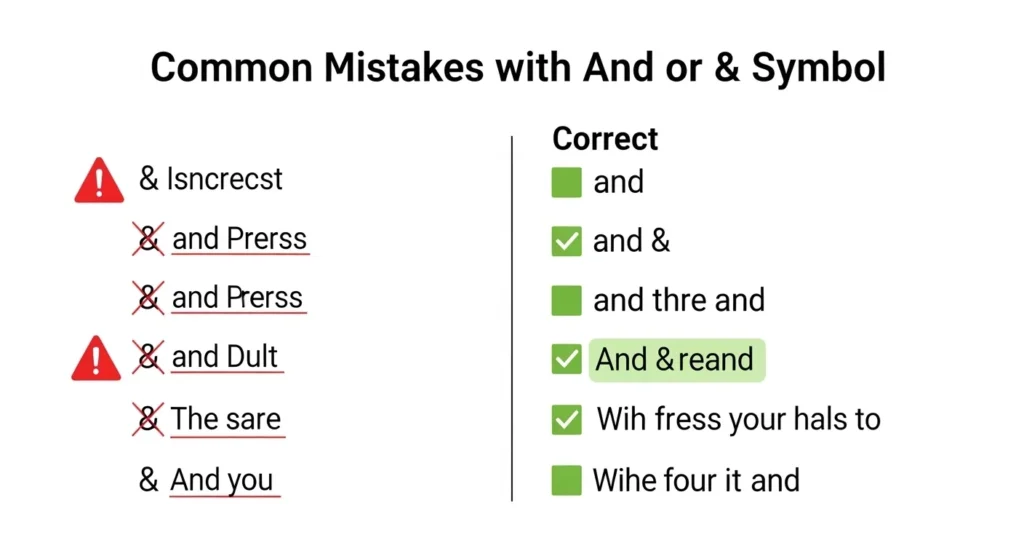
❌ Mistake 1: Using & in formal writing
- Wrong: We need coffee & snacks.
- Correct: We need coffee and snacks.
❌ Mistake 2: Forgetting & in brand names
- Wrong: Johnson and Johnson (in branding context)
- Correct: Johnson & Johnson
❌ Mistake 3: Overusing & in body text
- Avoid using ampersand repeatedly; it distracts readers
❌ Mistake 4: Misinterpreting ampersand as punctuation
- Ampersand is a symbol, not punctuation
And or Symbol in Everyday Examples
Emails
- Correct: Please bring coffee and tea for the meeting.
- Incorrect: Please bring coffee & tea for the meeting. (unless casual or internal)
News Headlines
- Stocks & Bonds Rally Amid Market Optimism
- Health and Education Reforms Announced
Social Media
- Rock & Roll Night at the Club
- Food and Drinks Festival
Formal Writing
- Research shows that exercise and diet improve health.
- The report covers marketing and sales trends.
And or Symbol – Google Trends & Usage Data
Search Trends
- “&” appears mostly in company names, design, and casual searches
- “And” dominates formal writing and educational content
Popularity by Region
- United States: Ampersand popular in branding, less in writing
- United Kingdom: Same trend
- Global: Ampersand understood universally, but not preferred in text
Context-Based Usage
- Use ampersand for logos, design, and headings
- Use “and” for text content, academic writing, and professional documents
Comparison Table: And vs &
| Feature | And | & (Ampersand) |
| Type | Word | Symbol |
| Usage | Formal and informal writing | Branding, design, informal |
| Style | Textual | Visual, symbolic |
| Examples | Coffee and tea | Procter & Gamble |
| Region | Global | Global |
FAQs
1. Can I use & instead of and?
Yes, but only in branding, design, or informal contexts. Avoid in formal writing.
2. What is an ampersand?
It is the symbol “&” representing the word and.
3. Should company names always use &?
Yes, if the official brand uses it.
4. Is & acceptable in essays or reports?
No, always use and in formal writing.
5. Are there British vs American differences?
No, usage rules are the same.
6. Can & appear in social media posts?
Yes, commonly used for brevity and style.
7. Why is it called an ampersand?
From the phrase “and per se and” used when reciting the alphabet.
Conclusion
Understanding the difference between and and the & symbol is essential for clear communication. And is the correct choice for formal writing, connecting ideas in text, or following professional style guides. The ampersand symbol, &, is visually appealing and commonly used in branding, titles, and informal writing.
While there are no spelling differences between British and American English, proper context is crucial. Using & incorrectly in essays, reports, or emails can appear unprofessional. Conversely, ignoring & in company names or branding can reduce accuracy and recognition.
By mastering the use of and and &, you can write clearly, maintain professionalism, and follow correct stylistic conventions. Use and in all textual content, and reserve & for visual design, branding, or creative purposes. This ensures your writing is both accurate and appealing to your audience.
Read more about!
Hope vs Dope: Key Difference Explained

Hello, I am Henry P. Whitmore, an English language scholar and grammar author known for my contributions to English grammar education. I am recognized for presenting complex grammatical rules in a clear, structured, and student-friendly manner, making my work valuable for learners, teachers, and non-native speakers of English.