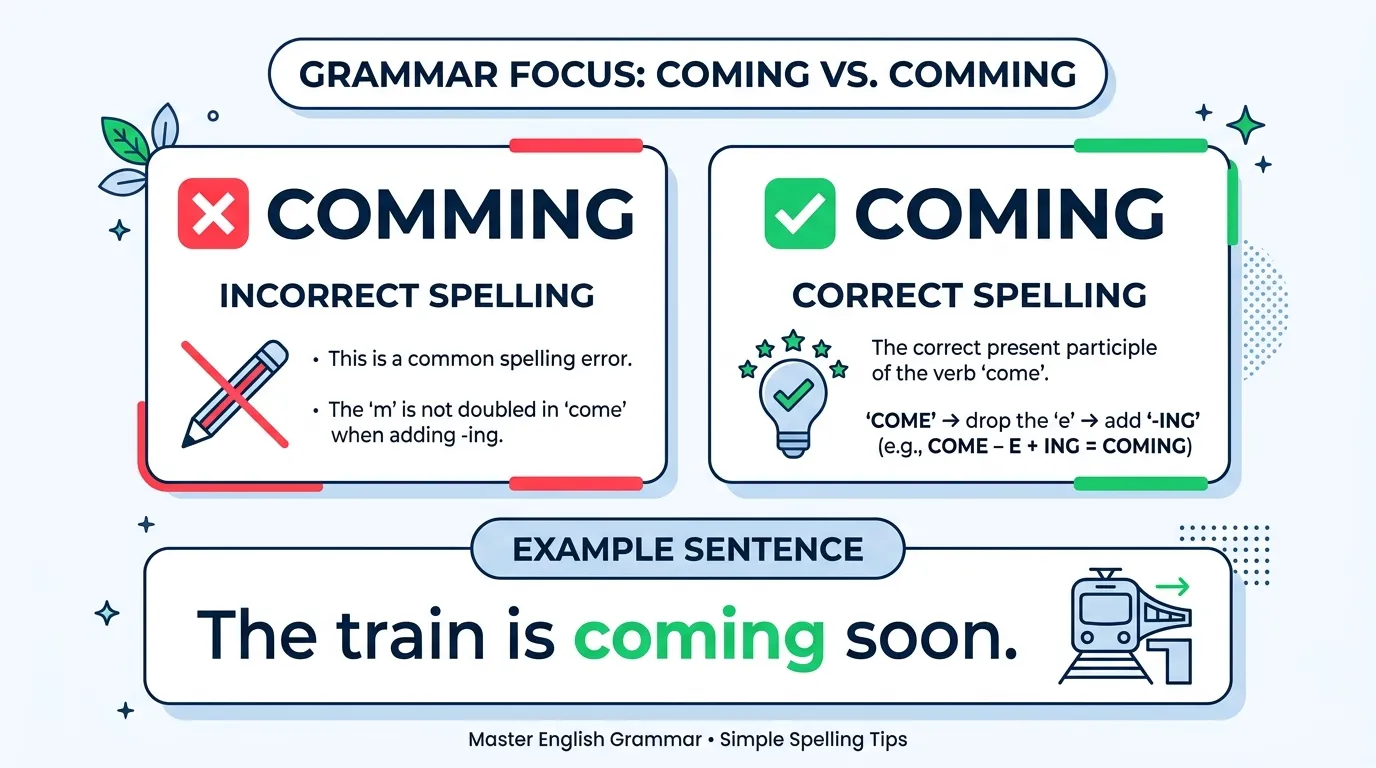
Coming is the correct spelling ✅, while comming is a common misspelling and should not be used in standard English.
Have you ever typed “comming” and wondered if it was correct? You’re not alone. Many English learners and native speakers search for “comming or coming” because the words look similar and English spelling rules can be confusing.
The confusion usually happens when people apply the double-consonant rule incorrectly. Since some words double the final consonant before adding -ing, many writers assume that come becomes comming. However, that is not how English spelling works in this case.
Understanding the correct spelling is important for emails, school assignments, business writing, social media posts, and professional communication. A simple spelling mistake can make your writing look less polished and may distract readers from your message.
In this guide, you’ll learn the correct spelling, where the confusion comes from, how British and American English treat the word, common mistakes to avoid, real-world examples, Google Trends insights, and answers to frequently asked questions.
Comming or Coming : Quick Answer
Coming is the correct spelling. ✅
Comming is incorrect and should not be used in standard English.
Examples
The train is coming soon.
She is coming to the meeting tomorrow.
Winter is coming earlier this year.
The train is comming soon.
She is comming to the meeting tomorrow.
The Origin of Comming or Coming
The word coming comes from the verb come, which has roots in Old English cuman.
When adding -ing to the verb come, English spelling rules require dropping the silent e before adding the suffix:
- come + ing = coming
This follows the same pattern as:
- make → making
- take → taking
- write → writing
The spelling comming developed because many people mistakenly think the m should double before adding -ing. However, English spelling rules do not support this change for the verb come.
British English vs American English Spelling
Good news: there is no difference between British and American English for this word.
Both varieties use coming.
| Usage | British English | American English |
| Correct spelling | Coming | Coming |
| Incorrect spelling | Comming | Comming |
| Formal writing | Coming | Coming |
| Everyday writing | Coming | Coming |
Unlike words such as “colour/color” or “travelling/traveling,” this word remains the same in both versions of English.
Which Spelling Should You Use?
You should always use coming, regardless of your audience.
For US Readers
Use coming.
For UK Readers
Use coming.
For Australia, Canada, New Zealand, and Other Commonwealth Countries
Use coming.
For Global Audiences
Use coming because it is the only accepted spelling in modern English.
Common Mistakes with Comming or Coming
Here are some frequent errors people make.
| Incorrect | Correct |
| Comming soon | Coming soon |
| I am comming | I am coming |
| She is comming today | She is coming today |
| They are comming over | They are coming over |
| Event comming next week | Event coming next week |
Why People Make This Mistake
Many writers incorrectly apply the consonant-doubling rule.
For example:
- run → running
- swim → swimming
Because these words double a consonant, people assume come follows the same pattern. It does not.
Comming or Coming in Everyday Examples
Emails
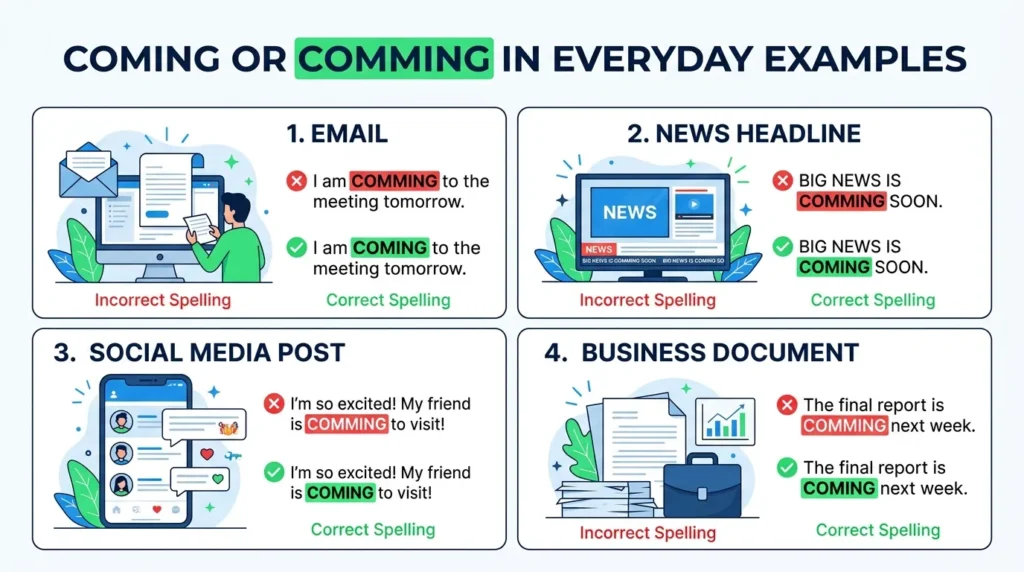
I am coming to the meeting at 10 AM.
Thank you for your message. I will be coming tomorrow.
News Headlines
New regulations are coming next year.
A major storm is coming toward the coast.
Social Media
Big news is coming soon!
Summer is coming and everyone is excited.
Formal Writing
The changes are coming into effect next month.
Additional resources are coming to support the project.
Comming or Coming : Google Trends & Usage Data
Search data shows that coming is overwhelmingly more popular than comming.
Usage Insights
- Coming appears in books, newspapers, websites, and academic writing worldwide.
- Comming mainly appears as a spelling mistake.
- Searches for comming or coming are common among students, English learners, and writers checking spelling.
- English-speaking countries such as the United States, United Kingdom, Canada, Australia, and India overwhelmingly use coming.
Comparison Table
| Variation | Correct? | Common Usage |
| Coming | ✅ Yes | Extremely common |
| Comming | ❌ No | Misspelling |
| Come | ✅ Yes | Base verb |
| Coming soon | ✅ Yes | Very common phrase |
Frequently Asked Questions
1. Is comming a real word?
No. Comming is considered a misspelling of coming.
2. Why is it coming and not comming?
Because the silent e in come is removed before adding -ing.
3. Is coming correct in British English?
Yes. British English uses coming.
4. Is coming correct in American English?
Yes. American English also uses coming.
5. What spelling should I use in professional writing?
Always use coming.
6. Why do people write comming?
Many people incorrectly apply the consonant-doubling rule used in words like running and swimming.
7. How can I remember the correct spelling?
Think of the rule:
come → remove the e → coming
This makes it easy to remember.
Conclusion
The answer to “comming or coming” is simple: coming is the correct spelling, while comming is a misspelling. The confusion often comes from English consonant-doubling rules, but the verb come follows a different pattern. Instead of doubling the m, English removes the silent e and adds -ing, creating the word coming.
This spelling remains the same in American English, British English, Canadian English, Australian English, and other forms of modern English. If you are writing an email, a social media post, a news article, or a professional document, coming is always the correct choice.
If you ever feel unsure, remember the simple formula: come + ing = coming. Following this rule will help you avoid one of the most common spelling mistakes in English and make your writing clearer, more accurate, and more professional.
Read more about!
Knifes or Knives 🔪: Which Spelling Is Correct?
Proove or Prove 🤔 : Which Spelling Is Correct?
Caftan or Kaftan 👗: Which Spelling Is Correct?

Hello, I am Henry P. Whitmore, an English language scholar and grammar author known for my contributions to English grammar education. I am recognized for presenting complex grammatical rules in a clear, structured, and student-friendly manner, making my work valuable for learners, teachers, and non-native speakers of English.