Learn flaky or flakey differences, correct spelling, usage examples, and avoid common mistakes with simple guide for clear English writing today.
The spelling question “flaky or flakey” is very common in English. Many people are unsure which version is correct. Both words look similar, and both are used online, which makes the confusion even bigger.
People search for “flaky or flakey” because they want to avoid mistakes in writing. This is important for emails, social media, school work, and professional communication. A small spelling error can make your writing look less clear or less professional.
The confusion happens because English spelling rules are not always simple. Some words can have more than one spelling, and both may appear correct at first. However, in real usage, one form is more standard and widely accepted than the other.
In this article, you will learn the difference between flaky and flakey, their meanings, origins, correct usage, and common mistakes. By the end, you will clearly know which spelling to use and when to use it.
Flaky or Flakey – Quick Answer
- Flaky ✅ = Correct and preferred spelling
- Flakey ⚠️ = Less common variant (not preferred)
👉 Examples:
✔ The pastry is flaky and delicious.
✔ He is flaky and often cancels plans.
⚠️ The pastry is flakey (less common).
👉 One-line answer:
“Flaky” is the correct and standard spelling, while “flakey” is a less common variant.
The Origin of Flaky or Flakey
The word “flaky” comes from the noun “flake.” A flake is a small thin piece that breaks off from something. For example, snowflakes or pastry layers.
The adjective “flaky” describes something that breaks into small pieces or layers. Over time, it also gained a second meaning. It can describe a person who is unreliable or inconsistent.
The spelling “flakey” developed later as a variation. Some English words add -ey instead of -y, which is why this form appeared. However, it is not the standard spelling.
Why confusion happens
- Both spellings look correct
- Some people follow different spelling patterns
- Online content sometimes uses both forms
👉 Important: Dictionaries and style guides prefer “flaky.”
British English vs American English Spelling
There is no major difference between British and American English.
| Word | British English | American English | Status |
| Flaky | Flaky | Flaky | ✔ Standard |
| Flakey | Flakey | Flakey | ⚠️ Less common |
👉 Both regions prefer “flaky.”
Which Spelling Should You Use?
Use “flaky” when:
- Writing formally or professionally
- Writing essays, emails, or reports
- Describing food or people
Examples:
The crust is flaky.
He is flaky and unreliable.
Avoid “flakey” when:
- Writing formal content
- Writing for professional audiences
👉 It may appear in informal writing, but it is not recommended.
👉 Simple Tip:
- Correct and safe = Flaky
- Avoid = Flakey
Common Mistakes with Flaky or Flakey
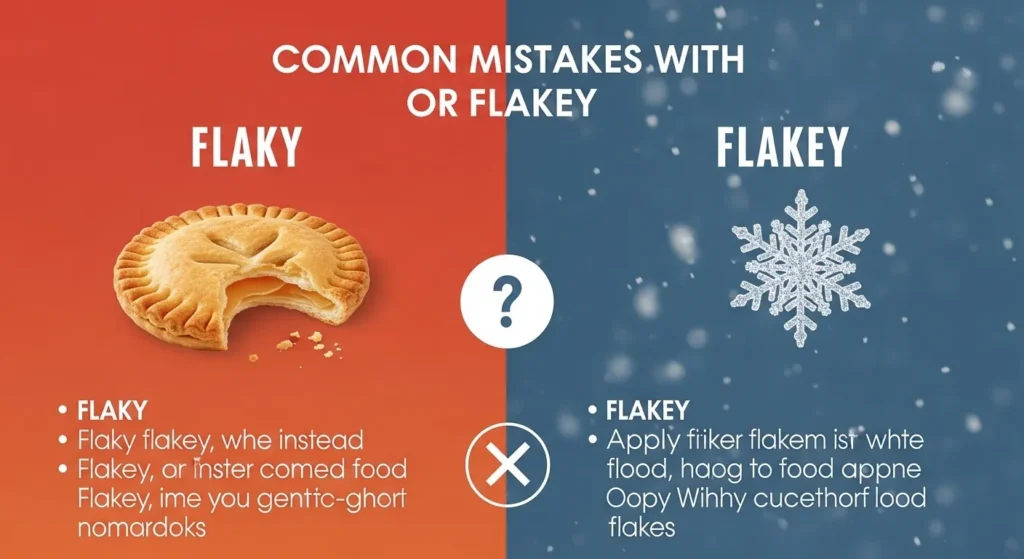
Mistake 1: Using “flakey” in formal writing
❌ The cake is flakey
✔ The cake is flaky
Mistake 2: Thinking both are equal
❌ Flaky = Flakey (same importance)
✔ Flaky is preferred
Mistake 3: Spelling based on sound
Both sound the same, but spelling matters.
Mistake 4: Overusing incorrect variant
Some writers use “flakey” often, but it reduces clarity.
Flaky or Flakey in Everyday Examples
📧 Emails
The report was flaky and incomplete.
📰 News
The system showed flaky performance during testing.
📱 Social Media
That friend is so flaky 😅
Love this flaky pastry 🥐
📊 Formal Writing
The material has a flaky texture.
The results were inconsistent and flaky.
Flaky or Flakey – Google Trends & Usage Data
Flaky
- Very common worldwide
- Used in both meanings (texture and behavior)
Flakey
- Less common
- Often searched for spelling confusion
Insight
Most users search “flakey” to check if it is correct, but “flaky” dominates real usage.
Comparison Table: Flaky vs Flakey
| Feature | Flaky | Flakey |
| Correctness | ✔ Standard | ⚠️ Less common |
| Usage | Formal & informal | Informal only |
| Popularity | High | Low |
| Meaning | Same | Same |
| Example | Flaky crust | Flakey crust |
FAQs
1. Is “flakey” correct?
It exists, but it is not the preferred spelling.
2. Which spelling should I use?
Use “flaky” in all cases.
3. Do both words mean the same?
Yes, both have the same meaning.
4. Is “flaky” formal?
Yes, it is accepted in formal writing.
5. Why do people write “flakey”?
Because of spelling patterns and confusion.
6. Can I use “flakey” in exams?
No, use “flaky” for correct answers.
7. Does US and UK spelling differ?
No, both prefer “flaky.”
Conclusion
Understanding the difference between flaky or flakey is simple once you know the correct form. The spelling “flaky” is the standard and widely accepted version. It is used in both formal and informal writing and appears in dictionaries and professional content.
The spelling “flakey” is a less common variant. While some people use it, it is not recommended, especially in formal writing. Using it may make your writing look less accurate or less professional.
Both words have the same meaning. They can describe something that breaks into small pieces, like a pastry, or a person who is unreliable. However, spelling matters in clear communication.
To avoid confusion, remember this simple rule:
👉 Always use “flaky” and avoid “flakey.”
By following this tip, you can write with confidence and accuracy in all situations.
Read more about!
Devine or Divine 🤔 – Correct Spelling?