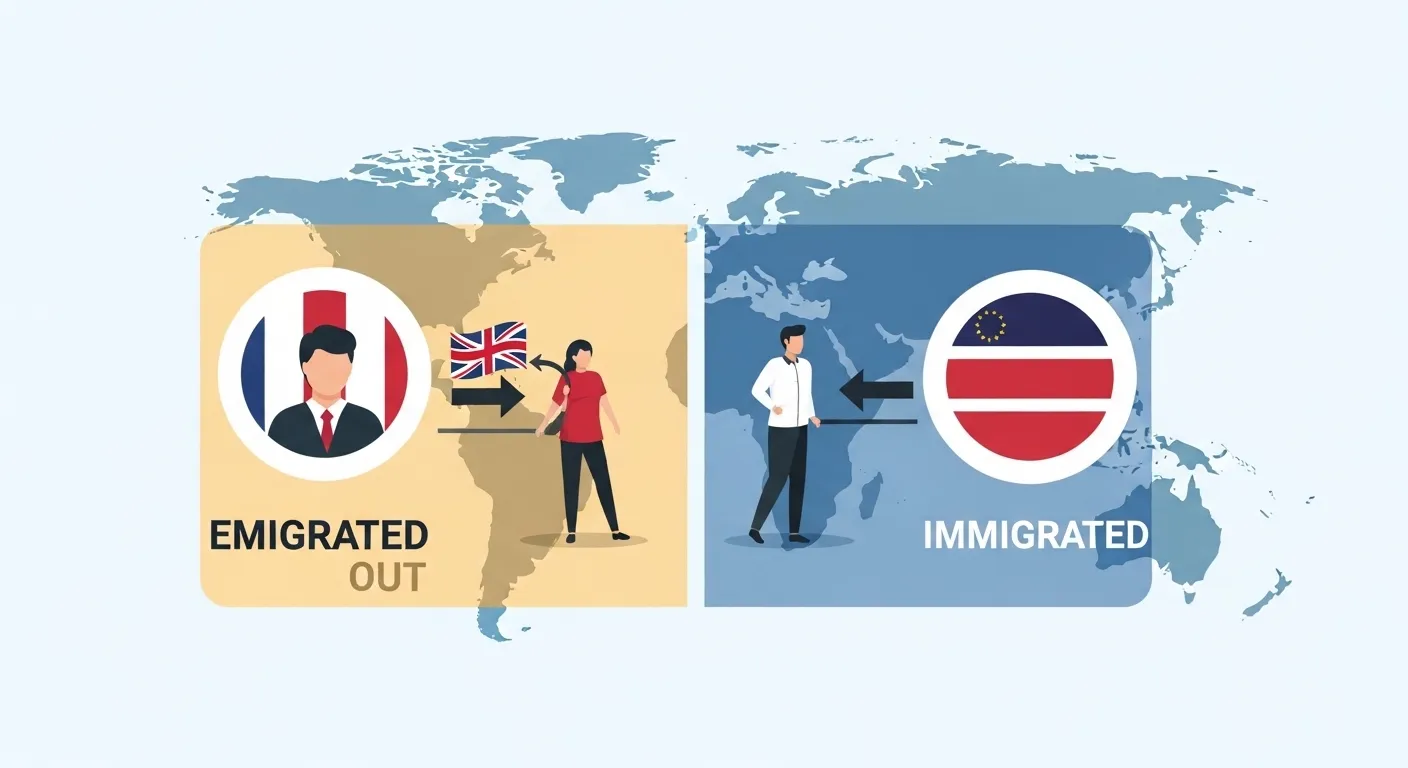
“Emigrated” means leaving a country, while “immigrated” means moving into a new country. 😊
Understanding the difference between emigrated or immigrated can be confusing for many English learners and even native speakers. Both words relate to moving from one country to another, but they describe opposite perspectives.
People often search for “emigrated or immigrated” because they want to write correctly in essays, reports, news articles, or social media posts. Using the wrong term can make your writing seem inaccurate or unclear.
Emigrated refers to leaving one’s country to live elsewhere, while immigrated refers to entering a new country to settle.
The confusion arises because both words describe migration but focus on different sides of the journey. Correct usage is essential for professional writing, journalism, historical records, and even casual conversation.
In this article, we will clarify the difference between emigrated and immigrated, explain the origin of both words, compare British and American English usage, highlight common mistakes, provide practical examples, and offer guidance based on audience and context.
We’ll also explore Google Trends, usage data, and FAQs, so you can confidently use the correct term every time.
Emigrated or Immigrated – Quick Answer
- ✅ Emigrated = Left your own country to live in another.
- Example: She emigrated from Ireland to Canada in 2010.
- ✅ Immigrated = Moved into a new country to live there.
- Example: He immigrated to the United States in 2005.
Rule of thumb:
- Emigrate = Exit your country.
- Immigrate = Enter a new country.
The Origin of Emigrated or Immigrated
Emigrate
- Origin: Late 16th century, from Latin emigrare (“to move away”).
- Historical use: Used to describe leaving one’s homeland for another country.
- Modern use: Still refers to people leaving their country, often for economic, political, or personal reasons.
Immigrate
- Origin: Early 17th century, from Latin immigrare (“to move into”).
- Historical use: Refers to entering and settling in a new country.
- Modern use: Commonly used in legal, historical, and social contexts.
Why Confusion Exists
- Both words describe migration but focus on different perspectives.
- Writers often mix them up because they sound similar and relate to the same event.
British English vs American English Spelling
| Feature | British English | American English |
| Emigrate | Emigrate | Emigrate |
| Immigrate | Immigrate | Immigrate |
| Past tense | Emigrated / Immigrated | Emigrated / Immigrated |
| Common usage | Both terms used equally | Both terms used equally |
| Examples | They emigrated from Spain. | They immigrated to the USA. |
✔️ Both British and American English spell and use these words the same way. Differences are mostly in regional context, not spelling.
Which Spelling Should You Use?
✅ Use Emigrated if:
- Writing from the perspective of leaving a country.
- Reporting historical or personal migration events.
- Example: Many people emigrated from Germany before World War II.
✅ Use Immigrated if:
- Writing from the perspective of entering a new country.
- Discussing settlement, legal status, or integration.
- Example: They immigrated to Canada seeking better opportunities.
Common Mistakes with Emigrated or Immigrated
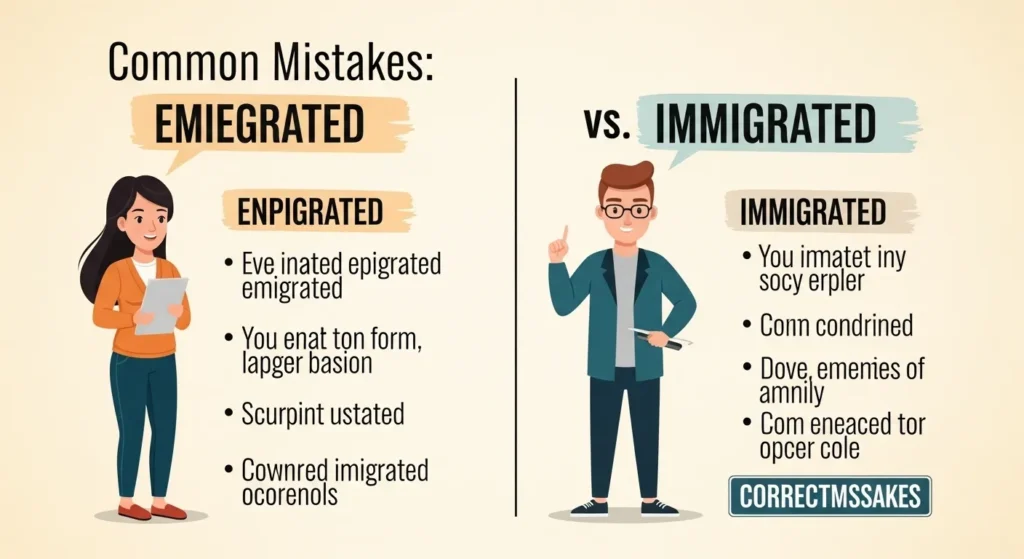
❌ Mistake 1: Using the wrong perspective
- Wrong: He immigrated from Ireland to the UK.
- Correct: He emigrated from Ireland to the UK.
❌ Mistake 2: Confusing past and present tense
- Wrong: She emigrate last year.
- Correct: She emigrated last year.
❌ Mistake 3: Using interchangeably in formal writing
- Wrong: They emigrated to France and immigrated to France.
- Correct: Use one depending on perspective.
❌ Mistake 4: Omitting context
- Always clarify origin and destination to avoid ambiguity.
Emigrated or Immigrated in Everyday Examples
Emails
- Our colleague emigrated from Australia last year.
- He immigrated to the US in 2018 for work.
News Articles
- Thousands of citizens emigrated from Venezuela amid economic crisis.
- New policies help immigrants integrate after they immigrate to Canada.
Social Media
- Grandma emigrated from Italy decades ago.
- My friend immigrated to the UK for university.
Formal Writing / Reports
- The report analyzed trends in emigration and immigration over the last 50 years.
Emigrated or Immigrated – Google Trends & Usage Data
Search Trends
- Immigrated is often searched more in the US due to legal and policy discussions.
- Emigrated is more commonly searched in the UK or countries people leave.
Popularity by Country
- United States: High interest in immigrated related to visa and settlement.
- United Kingdom: Higher searches for emigrated, focusing on leaving the country.
- Global: Both terms are relevant depending on migration context.
Context-Based Insight
- Journalists, historians, and educators need both terms to accurately describe migration events.
- Social media and personal writing often mix them without understanding perspective.
Comparison Table: Emigrated vs Immigrated
| Feature | Emigrated | Immigrated |
| Meaning | Left one’s country | Entered a new country |
| Perspective | Exit | Entry |
| Example | She emigrated from India. | She immigrated to Canada. |
| Usage | Historical, personal, official | Legal, social, settlement |
| Audience | Everyone | Everyone |
FAQs
1. What is the difference between emigrated and immigrated?
Emigrated = leaving a country; Immigrated = entering a country.
2. Can I use them interchangeably?
No, perspective matters. Choose based on whether focus is leaving or entering.
3. Which is more common in the US?
Immigrated, because most discussions focus on entering the country.
4. Which is more common in the UK?
Emigrated, because many people search regarding leaving the country.
5. Are there British vs American spelling differences?
No, both use the same spelling. Context may differ.
6. How do I remember the difference?
Think: Emigrate = Exit; Immigrate = In.
7. Can these terms be used for animals or organizations?
Yes, when describing relocation or migration, but typically applied to humans.
Conclusion
Choosing between emigrated or immigrated depends on perspective. If you focus on leaving your home country, use emigrated. If the focus is entering a new country, use immigrated. Both words are correct and spelled the same in British and American English, but misunderstanding their usage can lead to confusing or inaccurate writing.
By remembering Emigrate = Exit and Immigrate = In, you can write clearly in essays, reports, articles, and casual communication. Always clarify origin and destination to avoid ambiguity, and ensure past tense is used for completed actions.
Proper usage enhances professionalism, improves clarity, and ensures readers accurately understand migration context. Mastering this distinction is crucial for writers, educators, journalists, and anyone discussing migration or relocation.
Blonde or Brunette 🤔 – What’s the Difference?