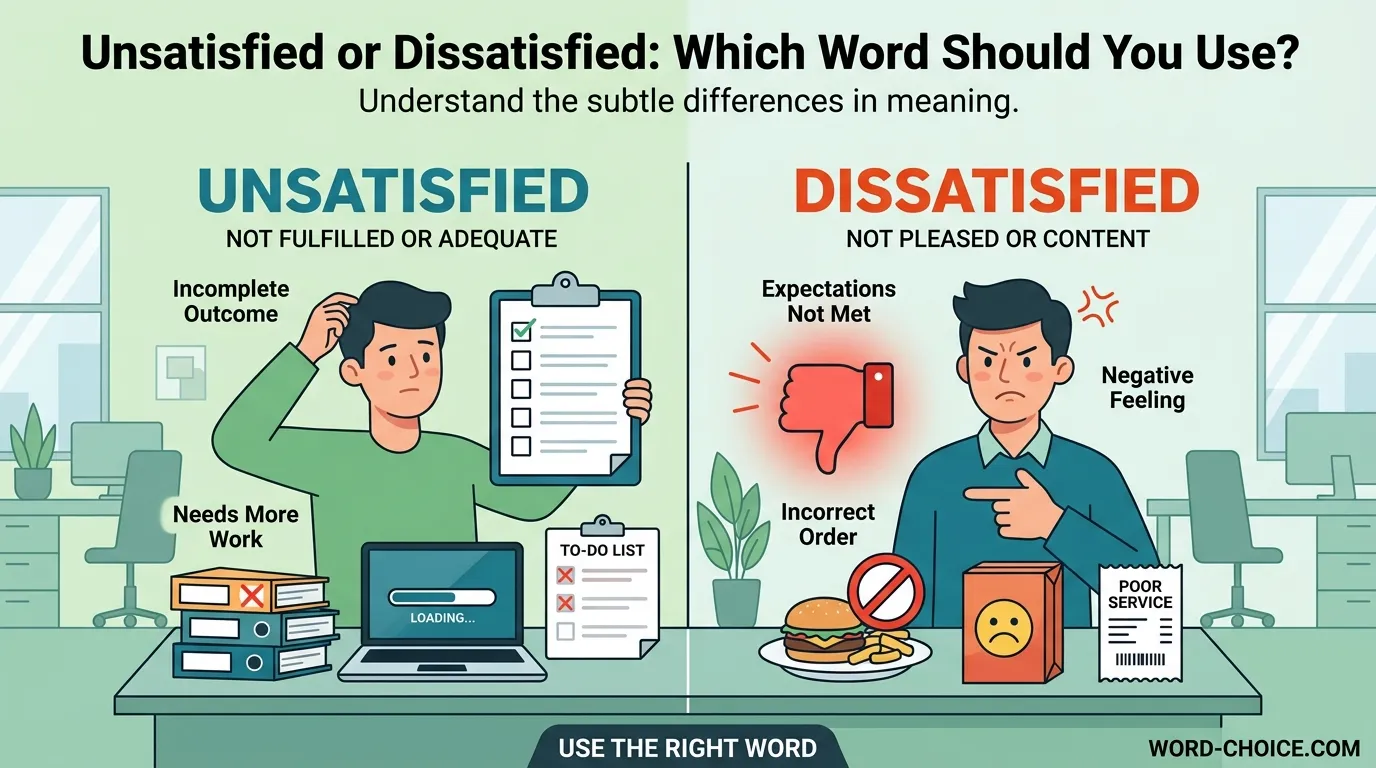
Unsatisfied means not fully fulfilled or completed, while dissatisfied means unhappy or disappointed with something.
Many writers, students, and professionals struggle with whether to use “unsatisfied or dissatisfied.” Both words seem similar, but they have different meanings. People search this keyword because they want to use the right word in emails, reports, or speeches. Using the wrong one can change the meaning of a sentence or make it unclear. This article clears up the confusion and makes it easy to remember which word fits which situation.
Understanding the difference between unsatisfied and dissatisfied helps you sound more professional and precise. We will explain the quick answer, the origin of both words, how British and American English treat them, common mistakes to avoid, and examples of how to use each in real life.
You’ll even find a side‑by‑side comparison table, FAQs, and Google Trends data showing how people search for these terms around the world. By the end of this guide, you’ll confidently choose the right word every time.
Unsatisfied or Dissatisfied : Quick Answer
Quick Answer:
- Unsatisfied means not fully filled or contented often used for physical needs or hunger.
- Dissatisfied means unhappy with quality, service, or results used for feelings of displeasure.
Examples:
- I was unsatisfied after the small lunch.
- Customers were dissatisfied with the slow service.
Tip: If the issue is lack of fulfillment, use unsatisfied. If the issue is unhappiness about quality or experience, use dissatisfied.
The Origin of Unsatisfied or Dissatisfied
Understanding where these words come from helps you remember their meaning.
Unsatisfied
- Prefix: un‑ (not)
- Root: satisfied (from Latin satis meaning “enough”)
- Meaning: not made enough, not fulfilled
Originally, unsatisfied was used to describe needs or desires that were not completely met.
Dissatisfied
- Prefix: dis‑ (a negative or opposite force)
- Root: satisfied
- Meaning: opposite of satisfied unhappy with outcome
Dissatisfied came from Latin roots showing a direct opposite of being satisfied. It grew to describe people’s feelings after poor experiences.
These two words look alike but grew from slightly different word roots. The un‑ prefix simply negates (makes opposite), while dis‑ suggests a deeper reversal of feeling.
British English vs American English Spelling
The good news is that both British English and American English spell these words the same. There are no regional spelling differences here. The difference is in meaning, not spelling.
| Term | British English | American English | Notes |
| Unsatisfied | Unsatisfied | Unsatisfied | Same spelling, same meaning |
| Dissatisfied | Dissatisfied | Dissatisfied | Same spelling, same meaning |
Key point: American and British English agree on spelling and meaning for these words. Just choose based on context.
Which Spelling Should You Use?
Since there is no spelling difference between British and American English, the choice depends on audience and meaning:
For US audiences
✔ Use unsatisfied for unmet physical needs or vague fulfillment
✔ Use dissatisfied for displeasure with service, quality, or result
For UK/Commonwealth audiences
✔ Use the same: unsatisfied and dissatisfied with correct meaning
✔ No need for any spelling change
Global writing
✔ Always use the form that matches meaning
✔ Check the sentence to decide emotional vs physical lack
Example:
- International menu review: “Customers were unsatisfied with portion sizes but dissatisfied with slow service.”
Common Mistakes with Unsatisfied or Dissatisfied
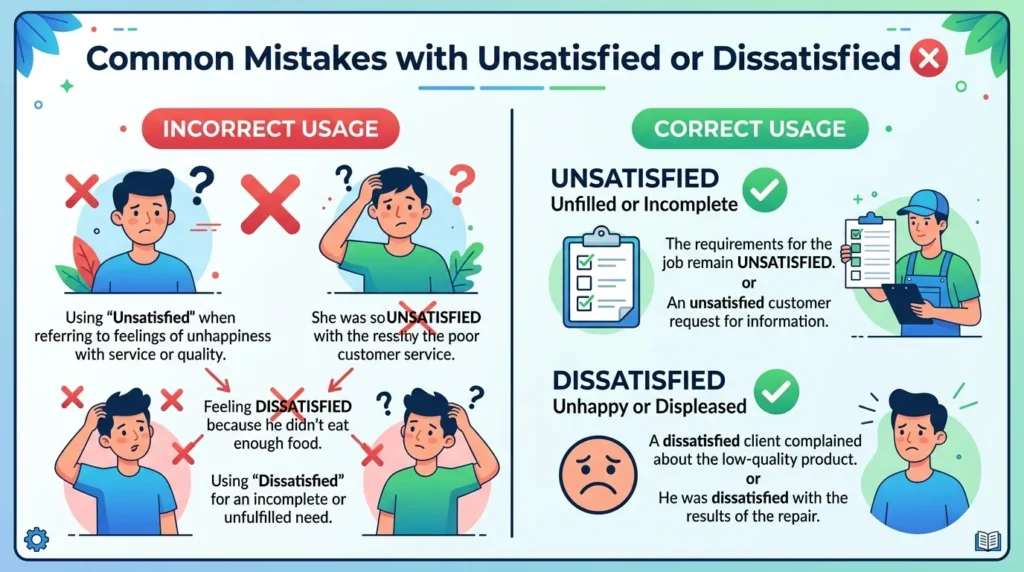
Many people mix up these two words. Here are frequent errors and how to fix them:
1: Using dissatisfiedfor hunger
- Wrong: I am dissatisfied after breakfast.
- Correct: I am unsatisfied after breakfast.
2: Using unsatisfiedfor bad service
- Wrong: Customers were unsatisfied with the delay.
- Correct: Customers were dissatisfied with the delay.
3: Assuming they mean the same thing
- Unsatisfied is about lack of fullness
- Dissatisfied is about unhappiness with experience
4: Mixing spelling
There is no un‑satisfied or dis‑satisfied with extra hyphens the correct forms are one word.
Quick fix rule: If someone is upset with quality, use dissatisfied. If someone didn’t get enough, use unsatisfied.
Unsatisfied or Dissatisfied in Everyday Examples
Let’s look at real, simple examples in different writing contexts:
Emails
- I was unsatisfied with the amount of work completed. (physical lack)
- Many clients are dissatisfied with the response time. (emotional unhappiness)
News Headlines
- Restaurant customers dissatisfied with wait times.
- Workers say they felt unsatisfied with break lengths.
Social Media
- I left the concert early because the sound was bad totally dissatisfied.
- Had one cookie still unsatisfied.
Formal Reports
- Survey shows 40% of participants are dissatisfied with product quality.
- Sales team remains unsatisfied with projected targets.
These show how meaning changes with context.
Unsatisfied or Dissatisfied : Google Trends & Usage Data
Search patterns tell us what people want:
🔎 Global Search Interest
- Dissatisfied has more search interest than unsatisfied
- People often search for customer dissatisfied, dissatisfied meaning, and unsatisfied definition
📍 Top Countries Searching
- United States
- United Kingdom
- Canada
- Australia
- India
🕵️ Common Search Queries
- “Unsatisfied vs dissatisfied meaning”
- “Dissatisfied with service examples”
- “Unsatisfied definition grammar”
- “Difference between unsatisfied and dissatisfied”
Why this matters: People search these words when writing business reviews, academic papers, and grammar questions.
Comparison Table: Unsatisfied vs Dissatisfied
| Feature | Unsatisfied | Dissatisfied |
| Meaning | Lacking fullness or completion | Emotionally unhappy with quality |
| Main use | Physical or incomplete needs | Feelings, opinions, expectations |
| Examples | unsatisfied hunger | dissatisfied customer |
| Emphasis | Not enough | Not happy |
| Emotional tone | Neutral | Negative |
| Common contexts | quantity, fulfillment | quality, satisfaction |
This table makes the difference clear and simple.
FAQs
1. Are unsatisfied and dissatisfied interchangeable?
No. Unsatisfied means lacking completeness. Dissatisfied means unhappy with quality.
2. Which word is stronger in emotion?
Dissatisfied often has more emotional impact than unsatisfied.
3. Can unsatisfied be used for feelings?
Rarely. It usually refers to a lack of physical or measurable fullness.
4. Is there a spelling difference in British vs American English?
No. Both are spelled the same in British and American English.
5. When should I use unsatisfied?
Use it when someone doesn’t feel complete or fully met.
6. When should I use dissatisfied?
Use it when someone is unhappy with a result, service, or experience.
7. Can these words appear together?
Yes: I was unsatisfied with the portion size and dissatisfied with the service.
8. Is dissatisfied more formal than unsatisfied?
Both are formal, but dissatisfied is more common in professional writing.
Conclusion
Choosing between unsatisfied or dissatisfied comes down to meaning, not spelling. They both spell the same in American and British English and have no spelling variants. The real difference lies in context: unsatisfied refers to a lack of completeness or fulfillment, such as not getting enough food or not meeting a basic need. Dissatisfied refers to emotional displeasure with quality, service, or results.
When you write, think about what you want to express. If someone didn’t get enough or feels incomplete, choose unsatisfied. If someone is unhappy with an experience, choose dissatisfied. This small choice can make your writing clearer, more accurate, and more professional.
Now you know how to use both words with confidence in emails, essays, customer feedback, and daily conversations. The next time someone asks about unsatisfied or dissatisfied, you can answer with clarity and authority.
Read more about!
Pint or Quart 🥛 : What’s the Difference and Which One Should You Use?

Hello, I am Henry P. Whitmore, an English language scholar and grammar author known for my contributions to English grammar education. I am recognized for presenting complex grammatical rules in a clear, structured, and student-friendly manner, making my work valuable for learners, teachers, and non-native speakers of English.