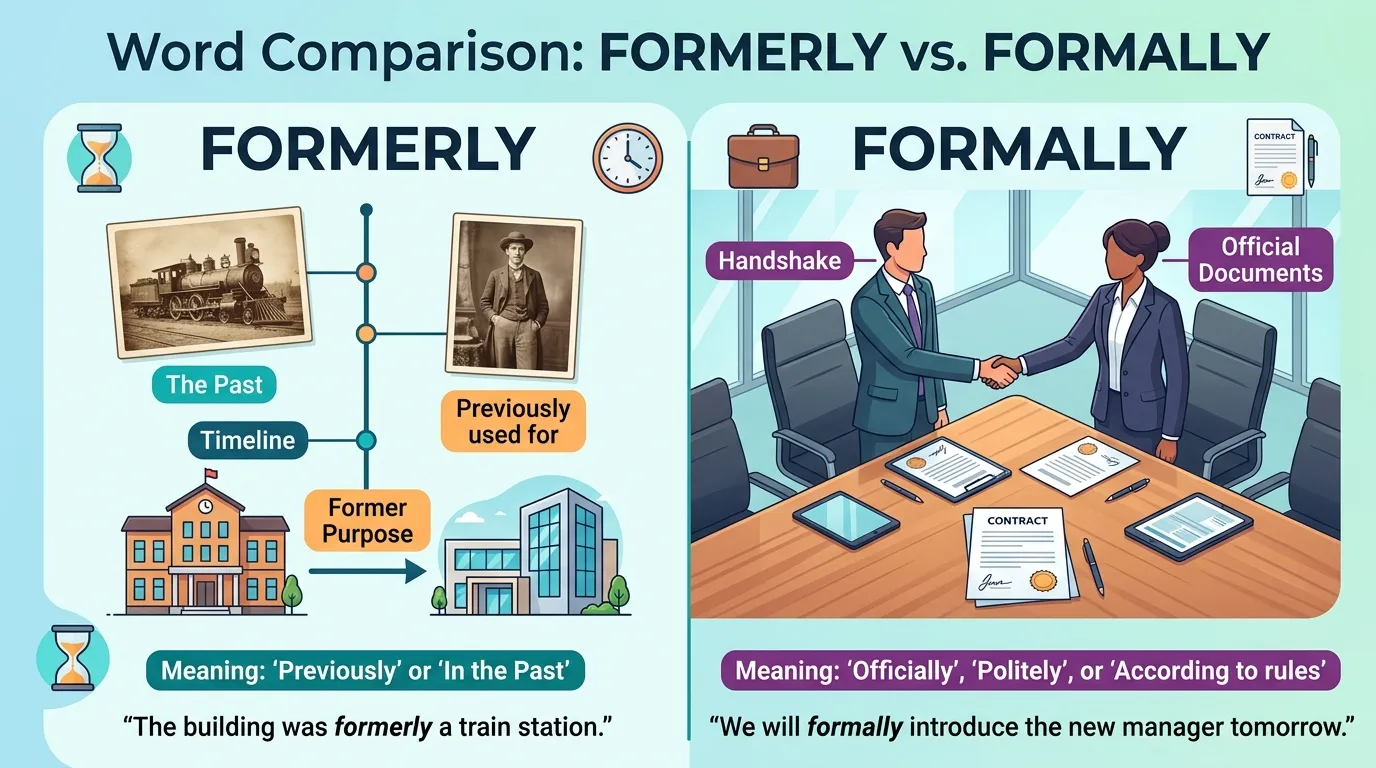
“Formerly” means previously or in the past, while “formally” means officially, properly, or in a formal manner. ✍️⏳
Many English learners and even native speakers confuse “formerly” and “formally.” These two words look very similar, but their meanings are completely different. A small spelling change can lead to a big mistake in writing.
People often search for formerly or formally when writing emails, essays, job applications, or official documents. The confusion happens because both words come from the same root word “form,” but they are used in different contexts.
For example, saying “He was formally known as John” is incorrect. The correct word is formerly because it refers to the past. On the other hand, “She dressed formerly for the event” is also wrong you should use formally to describe style or behavior.
This article will clear up the confusion. You will learn the meanings, origins, differences, and correct usage of formerly vs formally in simple language. By the end, you will confidently use the right word in any situation.
Formerly or Formally : Quick Answer ✅
- Formerly = In the past
- Formally = In a proper or official way
Examples:
- He was formerly a teacher. 👨🏫
- She was formally invited to the event. 🎉
👉 Simple Tip:
- Past time = Formerly
- Official/style = Formally
The Origin of Formerly or Formally 📚
Both words come from the base word “form,” but their meanings changed over time.
Formerly
- Origin: Old English “forma” (meaning “first” or “earlier”)
- Meaning: Something that happened in the past
Formally
- Origin: Latin “formalis” (meaning “according to rules”)
- Meaning: Done in a proper or official way
👉 Even though they look similar, their roots lead to different meanings.
British English vs American English Spelling 🇬🇧🇺🇸
There is no spelling difference between British and American English for these words.
Both use:
- Formerly
- Formally
Comparison Table
| Word | Meaning | Example Sentence |
| Formerly | In the past | He was formerly a manager |
| Formally | Official/proper | She was formally introduced |
👉 Spelling stays the same worldwide.
Which Spelling Should You Use? 🌍
The choice depends on meaning, not location.
- Use formerly when:
- Talking about the past ⏳
- Referring to previous roles or names
- Use formally when:
- Talking about official actions 📄
- Describing polite or proper behavior
Audience Tip:
- 🇺🇸 USA → Same usage
- 🇬🇧 UK → Same usage
- 🌍 Global → Follow context
👉 Always think: past vs official.
Common Mistakes with Formerly or Formally ❌
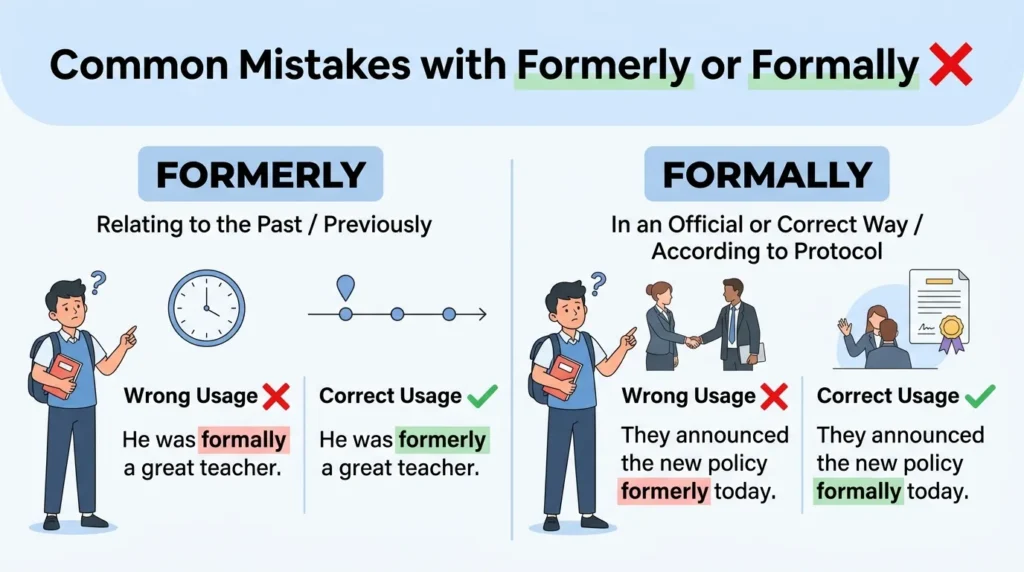
❌ Incorrect → ✔️ Correct
- He was formally known as Alex ❌
→ He was formerly known as Alex ✔️ - She was formerly dressed for the party ❌
→ She was formally dressed for the party ✔️ - Formerly means official ❌
→ Formerly means past ✔️ - Formally means past ❌
→ Formally means proper or official ✔️
👉 Rule:
- Time (past) = Formerly
- Style/official = Formally
Formerly or Formally in Everyday Examples ✍️
1. Emails
- “The company was formerly known as ABC Ltd.”
- “You are formally invited to the meeting.”
2. News
- “The actor, formerly a teacher, gained fame.”
- “The law was formally approved yesterday.”
3. Social Media
- “This place was formerly a café 😲”
- “He was formally dressed for the event 👔”
4. Formal Writing
- “The building was formerly used as a school.”
- “The agreement was formally signed.”
Formerly or Formally : Google Trends & Usage Data 📊
- Formerly is more used in:
- History
- News
- Biographies
- Formally is more used in:
- Business writing
- Invitations
- Legal documents
Popularity by Region
- USA 🇺🇸 → Both words widely used
- UK 🇬🇧 → Same usage patterns
- Global 🌍 → “Formerly known as” is very common
👉 Both words are popular but used in different contexts.
Comparison Table (Side-by-Side) 📋
| Feature | Formerly ⏳ | Formally 📄 |
| Meaning | In the past | Official/proper |
| Usage | Time reference | Style/behavior |
| Example | Formerly known | Formally invited |
| Context | History, change | Business, events |
| Memory Trick | Former = Past | Formal = Official |
FAQs ❓
1. What is the difference between formerly and formally?
👉 Formerly refers to the past, while formally refers to something official.
2. Is “formerly known as” correct?
👉 Yes, it means a previous name.
3. Can formally mean polite?
👉 Yes, it can describe polite or proper behavior.
4. Are these words used differently in the UK and US?
👉 No, both use them the same way.
5. Why are formerly and formally confusing?
👉 They look and sound similar but have different meanings.
6. How can I remember the difference?
👉 Formerly = past, Formally = official.
7. Can I use them interchangeably?
👉 No, using the wrong one changes the meaning.
Conclusion 📝
The difference between formerly and formally is easy once you understand their meanings. Formerly is used to talk about the past. It describes something that was true before but is not true now. For example, a company may be “formerly known” by another name.
On the other hand, formally is used to describe something done in an official, proper, or polite way. It is common in business, events, and formal communication. For example, someone may be “formally invited” to a meeting or ceremony.
The key to using these words correctly is remembering a simple idea: formerly = past, formally = official. This small trick can help you avoid common mistakes in writing and speaking.
There is no difference between British and American English for these words, so you only need to focus on context. By practicing and using real-life examples, you can confidently use formerly and formally in any situation.
Read more about!
Slip or Trip 🤔 : What’s the Difference and When to Use Each?