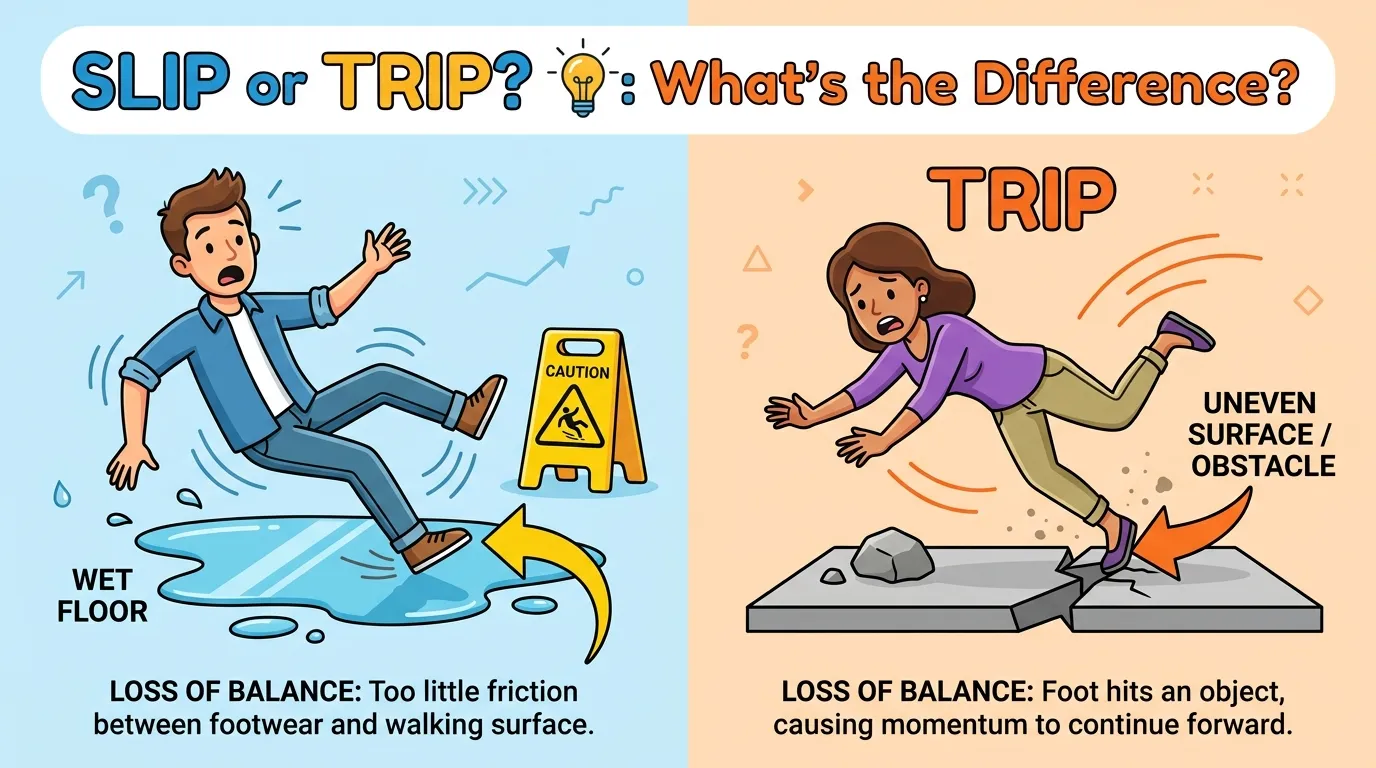
Slip means to lose balance accidentally on a surface, while trip means to stumble after hitting something with your foot.
Many people confuse “slip” and “trip.” These two words are common in daily life, safety rules, and workplace reports. They sound simple, but they describe different types of accidents.
People often search “slip or trip” because they want to understand the difference. This is especially important in workplaces, schools, and public areas. Using the wrong word can cause confusion, especially in safety reports or formal writing.
For example, did someone fall because the floor was wet? That is a slip. Did someone fall because they hit an object? That is a trip. Small details matter here.
This guide will explain the meaning, origin, and correct usage of slip vs trip in very simple words. You will also learn how to avoid common mistakes and use these words correctly in real life.
By the end, you will clearly know when to say slip and when to say trip.
Slip or Trip : Quick Answer ✅
- Slip = Lose balance due to a smooth or wet surface
- Trip = Lose balance by hitting something with your foot
Examples:
- He slipped on the wet floor. 💧
- She tripped over a stone. 🪨
👉 Simple Tip:
- Wet or smooth surface = Slip
- Object in the way = Trip
The Origin of Slip or Trip 📚
Slip
- Origin: Old English “slipan”
- Meaning: To slide or move smoothly
- Used for losing balance on slippery surfaces
Trip
- Origin: Middle English “trippen”
- Meaning: To stumble or step lightly
- Later used for hitting something and falling
👉 Both words come from different roots but relate to movement and balance.
British English vs American English Spelling 🇬🇧🇺🇸
There is no spelling difference between British and American English for these words.
Both regions use:
- Slip
- Trip
Comparison Table
| Word | Meaning | Example Sentence |
| Slip | Fall due to smooth surface | He slipped on ice. |
| Trip | Fall due to obstacle | She tripped over a wire. |
👉 Spelling stays the same worldwide.
Which Spelling Should You Use? 🌍
You do not need to worry about region. The choice depends on situation, not country.
- Use slip when:
- Floor is wet 💧
- Surface is smooth 🧊
- Use trip when:
- Object blocks your path 🪜
- You hit something with your foot
Audience Tip:
- 🇺🇸 USA → Same usage
- 🇬🇧 UK → Same usage
- 🌍 Global → Follow meaning
👉 Always focus on cause of the fall.
Common Mistakes with Slip or Trip ❌
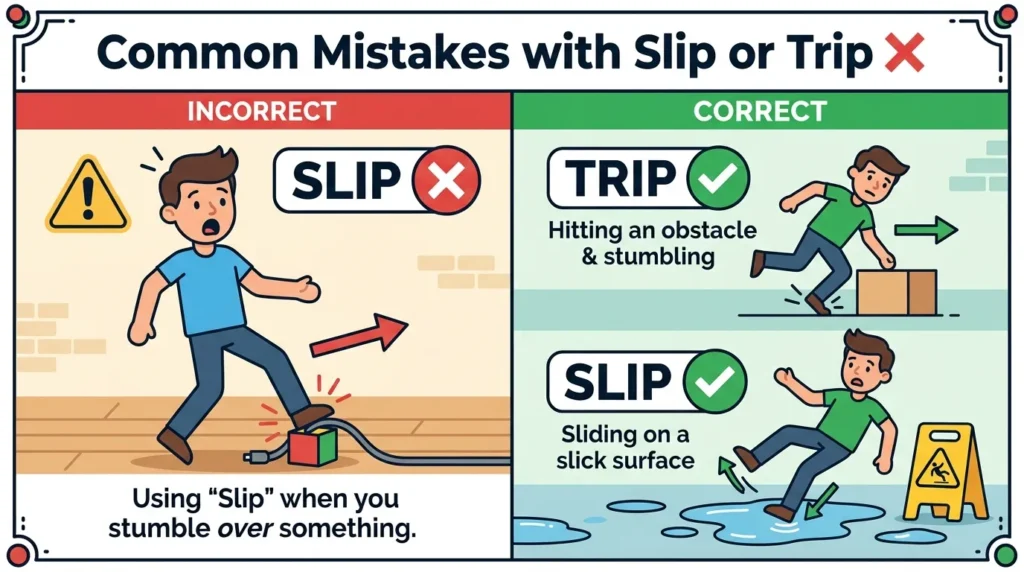
❌ Incorrect → ✔️ Correct
- He tripped on ice ❌
→ He slipped on ice ✔️ - She slipped over a rock ❌
→ She tripped over a rock ✔️ - Slip means falling only ❌
→ Slip means sliding or losing balance ✔️ - Trip means walking only ❌
→ Trip means stumbling over something ✔️
👉 Rule:
- Smooth surface = Slip
- Object/obstacle = Trip
Slip or Trip in Everyday Examples ✍️
1. Emails
- “The worker slipped on the wet floor.”
- “He tripped over a cable.”
2. News
- “Several people slipped due to icy roads.”
- “A pedestrian tripped on broken pavement.”
3. Social Media
- “I almost slipped in the bathroom 😅”
- “I tripped on the stairs today 😬”
4. Formal Writing
- “The accident occurred when the employee slipped.”
- “The injury was caused when the person tripped over equipment.”
Slip or Trip : Google Trends & Usage Data 📊
- Slip is more used in:
- Weather news (ice, rain)
- Safety warnings
- Workplace reports
- Trip is more used in:
- Daily life stories
- Injury reports
- Road and path accidents
Popularity by Region
- USA 🇺🇸 → Both used equally
- UK 🇬🇧 → Common in safety laws
- Global 🌍 → “Slip and fall” is a popular phrase
👉 Both words are widely searched for safety understanding.
Comparison Table (Side-by-Side) 📋
| Feature | Slip 💧 | Trip 🪨 |
| Cause | Wet/smooth surface | Object/obstacle |
| Movement | Sliding | Stumbling |
| Example | Slip on ice | Trip over a wire |
| Common Use | Safety, weather | Daily accidents |
| Memory Trick | Slip = Slide | Trip = Hit object |
FAQs ❓
1. What is the difference between slip and trip?
👉 Slip is caused by a wet surface, while trip is caused by hitting an object.
2. Can you slip and trip at the same time?
👉 Yes, but usually one is the main cause.
3. Is “slip and fall” correct?
👉 Yes, it is a common phrase in safety and law.
4. What causes most slips?
👉 Wet floors, ice, and smooth surfaces.
5. What causes trips?
👉 Obstacles like wires, stairs, or uneven ground.
6. Are slip and trip used differently in the UK and US?
👉 No, both use them the same way.
7. How can I remember the difference?
👉 Slip = slide, Trip = hit something.
Conclusion 📝
Understanding the difference between slip and trip is simple when you focus on the cause of the fall. A slip happens when you lose balance due to a wet or smooth surface. It often involves sliding, like on water, ice, or polished floors. On the other hand, a trip happens when your foot hits an object or obstacle, such as a rock, wire, or uneven step.
The key idea is easy to remember: slip = slide, trip = hit something. This small trick can help you avoid common mistakes in both speaking and writing. These words are widely used in safety rules, workplace reports, and daily conversations, so using them correctly is important.
There is no spelling difference between British and American English, which makes things even easier. You only need to focus on the situation, not the region. By practicing real-life examples and understanding their meanings, you can confidently use slip and trip in any context.
Using the correct word improves clarity, especially in professional and safety communication. It ensures your message is clear, accurate, and easy to understand.
Read more about!
Man or Mandrill 🤔: What’s the Difference and Which Word Should You Use?

Hello, I am Henry P. Whitmore, an English language scholar and grammar author known for my contributions to English grammar education. I am recognized for presenting complex grammatical rules in a clear, structured, and student-friendly manner, making my work valuable for learners, teachers, and non-native speakers of English.