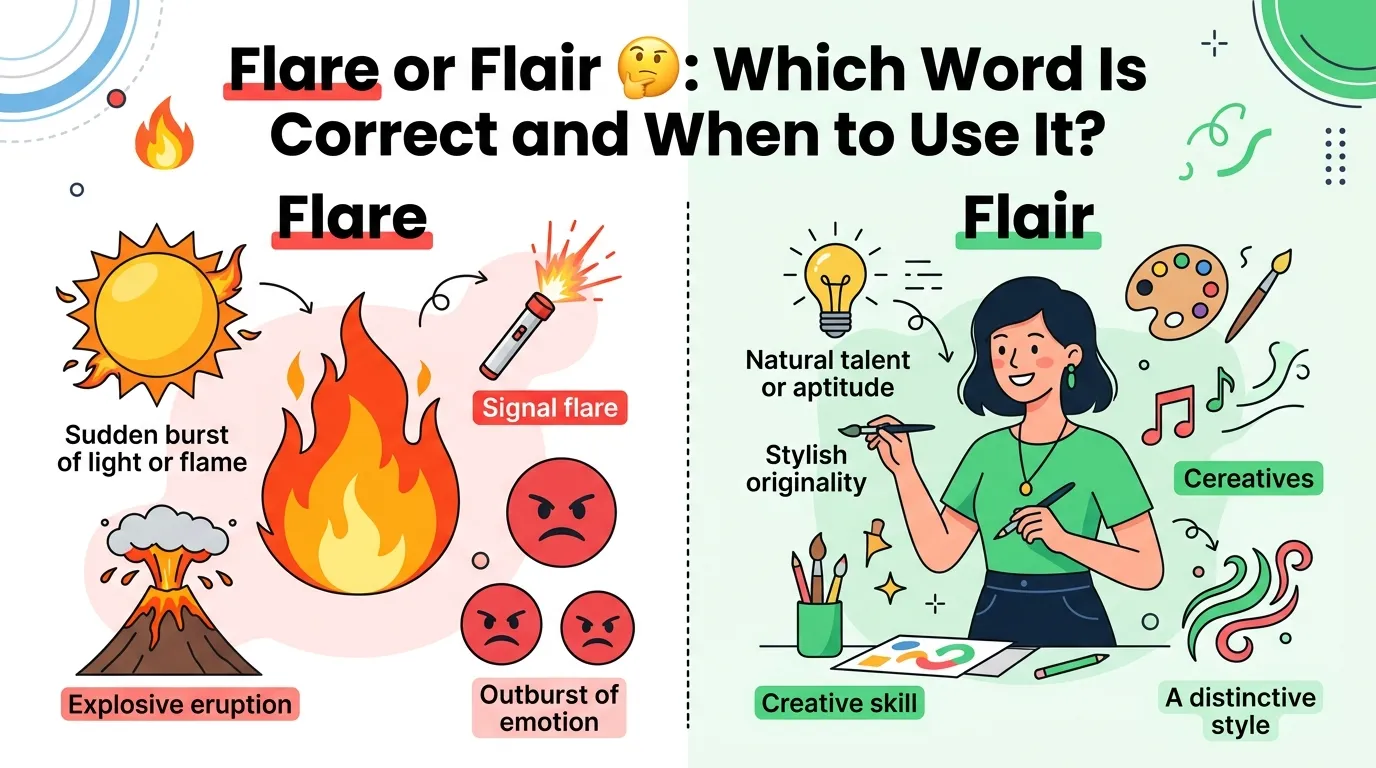
Flare usually means a sudden burst of light or emotion, while flair means natural talent or stylish skill in something.
Many people get confused between “flare” and “flair.” They look similar, sound alike, and are often used in writing, emails, and social media. But they do not mean the same thing.
This confusion happens because both words share a similar pronunciation. A small spelling change creates a big meaning difference. Using the wrong one can make your sentence unclear or even incorrect.
For example, saying “She has a natural flare for music” is wrong. The correct word is flair. On the other hand, “The fire gave off a bright flair” is also incorrect you should use flare.
This article solves that confusion. You will learn the meanings, origins, differences, and correct usage of flare vs flair. By the end, you will easily choose the right word every time.
Flare or Flair : Quick Answer ✅
- Flare = A sudden burst of light, fire, or emotion
- Flair = Natural talent, style, or skill
Examples:
- The fire began to flare in the wind. 🔥
- She has a flair for design. 🎨
👉 Simple Tip:
- Think flare = fire
- Think flair = talent
The Origin of Flare or Flair 📚
Both words come from different language roots, which explains their meanings.
Flare
- Origin: Old English / Middle English
- Meaning: To spread outward or burn brightly
- It was used to describe flames and light
Flair
- Origin: French word “flair”
- Meaning: Sense of smell or natural instinct
- Over time, it evolved to mean talent or style
👉 Even though they sound alike, their origins are completely different.
British English vs American English Spelling 🇬🇧🇺🇸
Good news: There is no spelling difference between British and American English for these words.
Both regions use:
- Flare for fire/light
- Flair for talent/style
Comparison Table
| Word | Meaning | Example Sentence |
| Flare | Light, fire, burst | The signal flare lit the sky. |
| Flair | Talent, style, ability | He writes with flair. |
👉 Unlike words like color/colour, these remain the same worldwide.
Which Spelling Should You Use? 🌍
Choosing the correct word depends on meaning, not location.
- Use flare when talking about:
- Fire 🔥
- Light 💡
- Sudden emotions 😠
- Use flair when talking about:
- Talent 🎯
- Creativity 🎨
- Personal style 💃
Audience Tip:
- 🇺🇸 USA → Same usage
- 🇬🇧 UK → Same usage
- 🌍 Global → Follow meaning, not region
👉 Always focus on context, not country.
Common Mistakes with Flare or Flair ❌
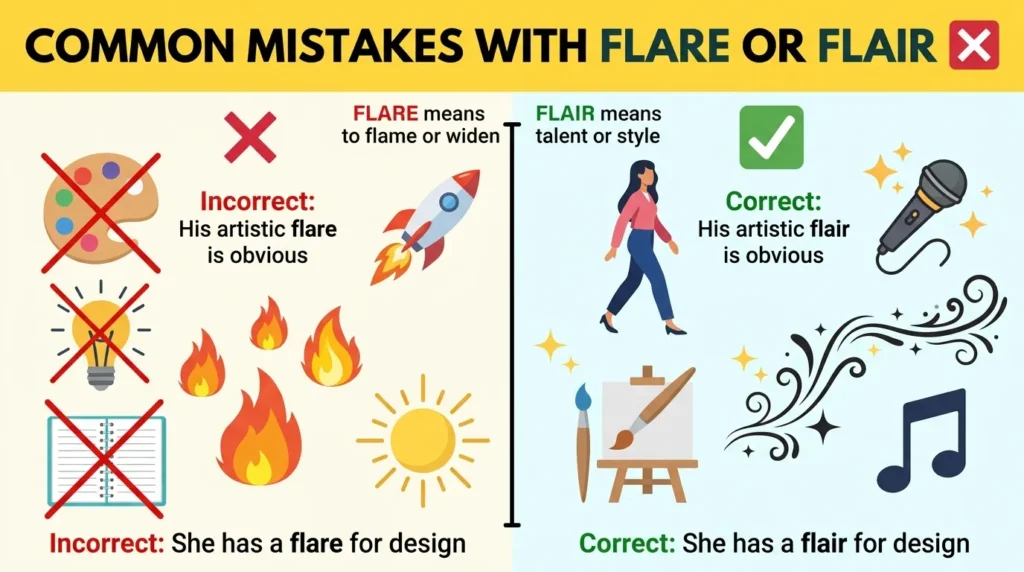
Here are mistakes people often make:
❌ Incorrect → ✔️ Correct
- She has a flare for singing ❌
→ She has a flair for singing ✔️ - The match caused a bright flair ❌
→ The match caused a bright flare ✔️ - His anger began to flair up ❌
→ His anger began to flare up ✔️
👉 Rule:
- Skills = flair
- Fire/emotion = flare
Flare or Flair in Everyday Examples ✍️
1. Emails
- “You handled the presentation with great flair.”
- “The issue may flare up again if ignored.”
2. News
- “Wildfires continue to flare across the region.”
- “The artist is known for her unique flair.”
3. Social Media
- “He dances with style and flair 💃”
- “Drama started to flare up again 😬”
4. Formal Writing
- “The conflict began to flare due to tension.”
- “She showed a flair for leadership.”
Flare or Flair : Google Trends & Usage Data 📊
- Flare is more common in:
- News (fires, medical flare:ups, conflict)
- Science and health
- Flair is more common in:
- Creative writing
- Fashion and design
- Social media
Popularity by Region
- USA 🇺🇸 → Uses both correctly in context
- UK 🇬🇧 → Same usage patterns
- Global 🌍 → “Flair” trending in lifestyle topics
👉 Both words are widely used, but in different contexts.
Comparison Table (Side:by:Side) 📋
| Feature | Flare 🔥 | Flair 🎨 |
| Meaning | Burst of light/fire | Talent or style |
| Usage | Physical/emotional | Personal ability |
| Example | Flames flare up | Flair for music |
| Memory Trick | Flare = Fire | Flair = Talent |
FAQs ❓
1. Is it flare or flair for talent?
👉 Use flair for talent.
2. What does flare mean?
👉 A sudden burst of fire, light, or emotion.
3. Can flair mean style?
👉 Yes, it means natural style or elegance.
4. Is “flare up” correct?
👉 Yes, “flare up” means to suddenly increase.
5. Do British and American English differ here?
👉 No, both use the same spelling.
6. Why are flare and flair confusing?
👉 They sound similar but have different meanings.
7. How can I remember the difference?
👉 Flare = Fire 🔥, Flair = Talent 🎨
Conclusion 📝
Understanding the difference between flare and flair is simple once you focus on meaning. These words may sound the same, but they belong to completely different contexts.
Flare is linked to fire, light, or sudden emotional reactions. It describes something that bursts or spreads quickly. In contrast, flair is about talent, creativity, and personal style. It highlights someone’s natural ability to do something well.
The key to using them correctly is remembering a small trick: flare = fire, flair = talent. This quick memory tip can save you from common mistakes in writing and speaking. Also, keep in mind that both British and American English use these words the same way, so you don’t need to worry about regional differences.
By practicing with real examples and paying attention to context, you can easily master flare vs flair. Using the correct word not only improves your writing but also makes your communication clearer and more professional.
Read more about!
Man or Mandrill 🤔: What’s the Difference and Which Word Should You Use?

Hello, I am Henry P. Whitmore, an English language scholar and grammar author known for my contributions to English grammar education. I am recognized for presenting complex grammatical rules in a clear, structured, and student-friendly manner, making my work valuable for learners, teachers, and non-native speakers of English.