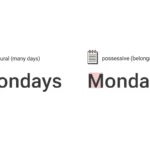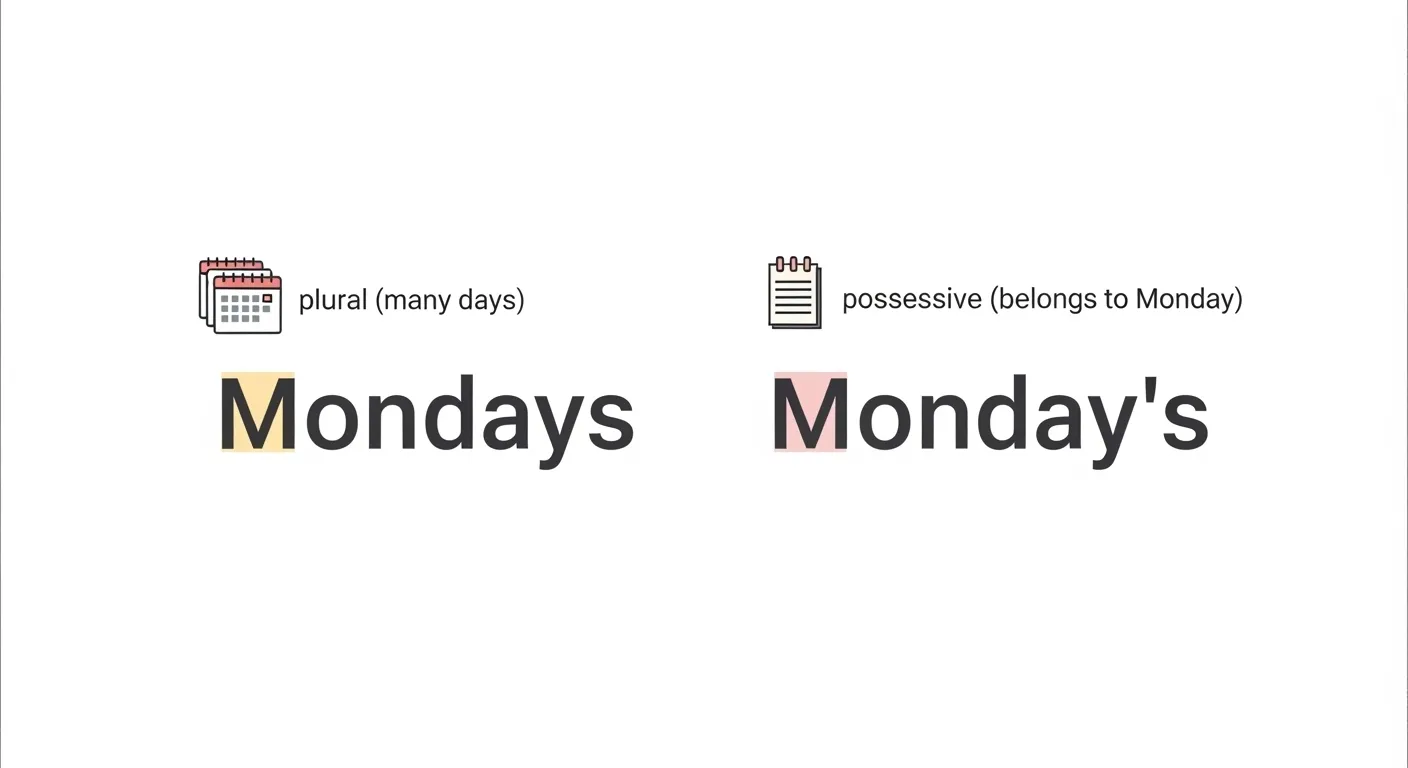
“Mondays” is plural, “Monday’s” is possessive—use based on context.
Many people get confused between “mondays” and “monday’s” because both look correct—but they are used in very different ways. This small punctuation mark (the apostrophe) can completely change the meaning of a sentence
. That’s why this keyword is commonly searched by students, writers, bloggers, and professionals who want to improve their English.
The confusion usually comes from not knowing when to show plural (more than one Monday) and when to show possession (something belongs to Monday). For example, is it correct to say “I hate monday’s” or “I hate mondays”? One is right, and the other is a common mistake.
This article will give you a clear, simple explanation of both forms. You’ll learn when to use each, how British and American English treat them, and how to avoid common errors. By the end, you’ll feel confident using “mondays” and “monday’s” correctly in everyday writing.
Mondays or Monday’s – Quick Answer
“Mondays” is the plural form of Monday.
“Monday’s” shows possession (something belongs to Monday).
Examples:
- ✅ I don’t like mondays. (correct – plural)
- ❌ I don’t like monday’s. (incorrect)
- ✅ Monday’s meeting is important. (correct – possession)
- ✅ Monday’s weather was sunny.
👉 Simple Rule:
- Use mondays for more than one Monday
- Use monday’s when something belongs to Monday
The Origin of Mondays or Monday’s
The word “Monday” comes from Old English “Monandæg,” meaning “Moon’s day.” It was named after the moon in early Germanic cultures.
Over time, English grammar added rules:
- Add “s” → to make plurals → Mondays
- Add “’s” → to show possession → Monday’s
The confusion exists because both forms look similar but follow different grammar rules.
Why the Confusion Happens:
- Apostrophes are often misunderstood
- People think “’s” always means plural (it does not)
- Informal writing (like social media) spreads incorrect usage
British English vs American English Spelling
Good news: There is no difference between British and American English for this keyword. Both follow the same grammar rules.
Comparison Table:
| Usage Type | British English | American English | Example |
| Plural | Mondays | Mondays | I work on Mondays |
| Possessive | Monday’s | Monday’s | Monday’s meeting |
| Incorrect Usage | Monday’s (plural) ❌ | Monday’s (plural) ❌ | I hate Monday’s |
👉 Both styles agree:
- Mondays = plural
- Monday’s = possession
Which Spelling Should You Use?
Choosing the right spelling depends on your sentence, not your country.
Use “Mondays” when:
- You talk about routine or repeated days
- Example: I go to the gym on mondays.
Use “Monday’s” when:
- Something belongs to Monday
- Example: Monday’s schedule is busy.
Audience-Based Advice:
- 🇺🇸 US audience → follow standard grammar (same rule)
- 🇬🇧 UK/Commonwealth → same rule applies
- 🌍 Global writing → keep it simple and correct
👉 Tip: If you can replace it with “of Monday,” then use Monday’s.
Common Mistakes with Mondays or Monday’s
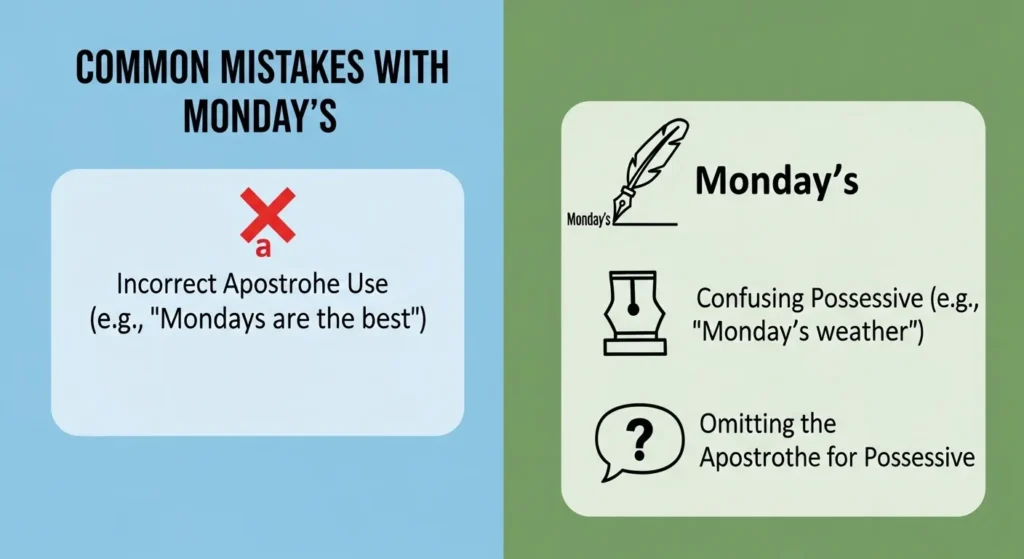
Here are frequent errors people make:
❌ Wrong vs ✅ Correct:
- ❌ I hate monday’s
✅ I hate mondays - ❌ All monday’s are busy
✅ All mondays are busy - ❌ The meeting is on mondays’s
✅ The meeting is on Monday’s - ❌ Mondays meeting is canceled
✅ Monday’s meeting is canceled
👉 Biggest Mistake:
Using apostrophe for plural (this is incorrect!)
Mondays or Monday’s in Everyday Examples
📧 Emails:
- Let’s schedule this for Monday’s meeting.
- I am available on mondays.
📰 News:
- Stocks fell sharply on Monday’s trading session.
- Markets usually drop on mondays.
📱 Social Media:
- Ugh, I hate mondays 😩
- Ready for Monday’s grind 💼
📝 Formal Writing:
- The report from Monday’s session was approved.
- Attendance is required on all mondays.
Mondays or Monday’s – Google Trends & Usage Data
Search data shows that many users confuse these two forms. The keyword “mondays or monday’s” is popular in:
- 🇺🇸 United States
- 🇬🇧 United Kingdom
- 🇮🇳 India
- 🇵🇰 Pakistan
Why People Search This:
- Grammar confusion
- Writing emails or assignments
- Learning English basics
Usage Insight:
- “Mondays” is used more often in daily language
- “Monday’s” appears more in formal or specific contexts
Comparison Table (Quick View)
| Word | Type | Meaning | Example |
| Mondays | Plural | More than one Monday | I work on mondays |
| Monday’s | Possessive | Belonging to Monday | Monday’s meeting |
| Mondays’ | Possessive plural | Belonging to multiple Mondays | Mondays’ schedules |
FAQs
1. Is it Mondays or Monday’s correct?
Both are correct, but used differently. Mondays = plural, Monday’s = possession.
2. Why is Monday’s not plural?
Because the apostrophe (’s) shows ownership, not plurality.
3. Can I say “I hate Monday’s”?
No. The correct sentence is: I hate mondays.
4. What does Mondays’ mean?
It shows possession of multiple Mondays, but it is rarely used.
5. Is there a difference in UK and US English?
No. Both follow the same grammar rules.
6. How can I quickly check which one to use?
Try replacing with “of Monday.” If it works, use Monday’s.
7. Which form is more common?
Mondays is more common in everyday conversation.
Conclusion
Understanding the difference between “mondays” and “monday’s” is simple once you know the rule. The key is to remember that “mondays” is the plural form, used when talking about repeated days or general habits. On the other hand, “monday’s” is possessive, used when something belongs to Monday, such as a meeting or an event.
This confusion happens often because the apostrophe is misunderstood. Many people incorrectly use it to form plurals, but in English, apostrophes are mainly used for possession or contractions. By keeping this rule in mind, you can avoid one of the most common grammar mistakes in everyday writing.
Whether you are writing emails, social media posts, or formal documents, using the correct form makes your writing clear and professional. The good news is that both British and American English follow the same rules, so you only need to learn this once.
In short:
👉 Mondays = many days
👉 Monday’s = something belongs to Monday
Master this, and your grammar will instantly improve.
Read more about!
Affectively or Effectively 🤔 – Which Word Should You Use?