“Your” shows possession (your book), while “you’re” is the short form of “you are.”
Many English learners and even native speakers get confused between your and you’re. The two words sound exactly the same when spoken, but they have completely different meanings in writing. Because they are homophones (words that sound the same but have different meanings), people often mix them up in emails, school assignments, and social media posts.
This confusion leads many users to search online for the correct usage of your or you’re. A small mistake can change the meaning of a sentence and make writing look unprofessional. For example, writing “Your welcome” instead of “You’re welcome” is a very common grammar error.
Understanding the difference between these words is actually very simple once you learn the rule. In this guide, you will learn the meaning of your and you’re, where the words come from, common mistakes people make, and how to use each word correctly in everyday writing. By the end, you will be able to choose the correct word with confidence.
Your or You’re – Quick Answer
The difference is simple.
- Your shows possession. It means something belongs to you.
- You’re is a contraction of “you are.”
Examples
- Your phone is ringing.
- Your car looks great.
- You’re very kind.
- You’re going to enjoy this movie.
Quick trick
If you can replace the word with “you are,” then you’re is correct.
Example:
You’re happy → You are happy ✅
The Origin of Your or You’re
The word your comes from Old English, specifically the word “ēower.” It was used as a possessive form to show that something belonged to a group of people being addressed.
Over time, English spelling changed and ēower eventually became your.
The word you’re is much newer. It is a contraction created by combining two words:
- You
- Are
In informal and modern writing, contractions became popular because they make sentences shorter and more natural in speech. So you are became you’re.
Examples:
- You are smart → You’re smart
- You are late → You’re late
This is why you’re always includes an apostrophe (’). The apostrophe replaces the missing letter “a” from are.
British English vs American English Spelling
Unlike many English words, your and you’re do not change spelling between British and American English. Both forms are used the same way worldwide.
However, grammar mistakes with these words happen everywhere because they sound identical.
Examples in Different English Styles
| Sentence | Correct Word |
| ___ book is on the table. | Your |
| ___ going to love this game. | You’re |
| I like ___ new haircut. | Your |
| ___ the best player on the team. | You’re |
Comparison Table
| Word | Type | Meaning | Example |
| Your | Possessive adjective | Something belongs to you | Your bag |
| You’re | Contraction | Short form of “you are” | You’re amazing |
So the difference is grammar, not regional spelling.
Which Spelling Should You Use?
Choosing between your and you’re depends on the meaning of the sentence, not the location of your audience.
Use Your when:
You are talking about something that belongs to someone.
Examples:
- Your phone is on the desk.
- I like your idea.
- Is this your jacket?
Use You’re when:
You mean “you are.”
Examples:
- You’re doing a great job.
- You’re my best friend.
- You’re going to love this place.
Simple Rule
Replace the word with “you are.”
If the sentence still makes sense → use you’re.
Example:
You’re happy → You are happy ✔
Your happy → Your happy ✖
Common Mistakes with Your or You’re
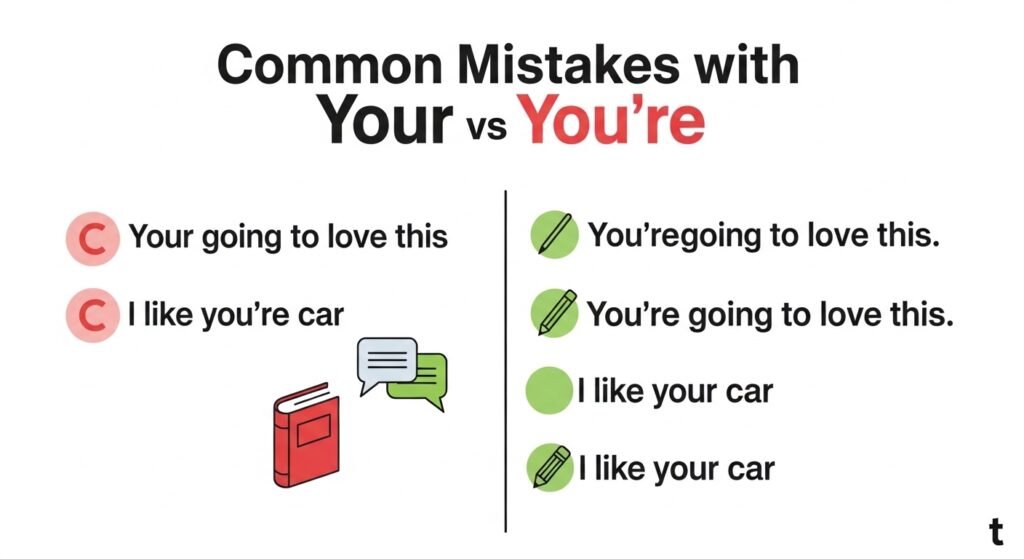
Many people mix these words in everyday writing. Here are some common errors.
1. Using “Your” Instead of “You’re”
Incorrect:
- Your very smart.
Correct:
- You’re very smart.
2. Using “You’re” for Possession
Incorrect:
- I like you’re shirt.
Correct:
- I like your shirt.
3. Writing “Your Welcome”
Incorrect:
- Your welcome!
Correct:
- You’re welcome!
This is one of the most common grammar mistakes online.
Your or You’re in Everyday Examples
These words appear everywhere in daily communication.
Emails
- Please send your report by tomorrow.
- You’re scheduled for the meeting at 3 PM.
News Writing
- Experts say you’re safer when wearing a helmet.
Social Media
- You’re amazing! Keep going!
Formal Writing
- Please update your contact information.
These examples show how often the words appear in normal communication.
Your or You’re – Google Trends & Usage Data
Search data shows that “your vs you’re” is one of the most searched grammar questions online. This happens because:
- The words sound identical.
- Many people type quickly online.
- Autocorrect does not always catch the mistake.
Countries Searching Most
Common search locations include:
- United States
- United Kingdom
- Canada
- Australia
- India
Students, writers, bloggers, and professionals all search this topic to improve their grammar.
Interestingly, grammar check tools like Grammarly and Microsoft Word frequently flag this mistake, showing how common it is.
Your vs You’re – Side-by-Side Comparison
| Feature | Your | You’re |
| Word Type | Possessive adjective | Contraction |
| Meaning | Something belongs to you | You are |
| Apostrophe | No | Yes |
| Example | Your house | You’re happy |
| Usage | Ownership | Action or description |
This table makes it easy to remember the difference.
FAQs
1. What is the difference between your and you’re?
Your shows possession, while you’re is the short form of you are.
2. Is “your welcome” correct?
No. The correct phrase is “you’re welcome.”
3. How can I remember the difference?
Replace the word with “you are.” If it works, then you’re is correct.
4. Do British and American English use different spellings?
No. Both forms are used the same way worldwide.
5. Why do people confuse these words?
Because your and you’re sound exactly the same when spoken.
6. Is it okay to use you’re in formal writing?
Yes. However, some formal writing prefers “you are” instead of contractions.
7. Is your a pronoun?
Not exactly. Your is a possessive adjective, used before a noun.
Conclusion
The difference between your and you’re is simple but very important in English writing. Even though the words sound the same, they have completely different meanings.
The word your shows possession, meaning something belongs to someone. It always appears before a noun, such as your phone, your house, or your idea. On the other hand, you’re is a contraction of “you are.” It describes a person or action, such as you’re happy or you’re going to win.
Many writers make mistakes because they type quickly or rely on sound instead of grammar rules. However, remembering one simple trick can solve the problem: replace the word with “you are.” If the sentence still makes sense, then you’re is correct.
By understanding this rule and practicing with examples, you can avoid one of the most common grammar mistakes in English and write more clearly and confidently.
Read more about!
Is or Are: Which One Is Correct and How to Use It Properly? 📚

Hello, I am Henry P. Whitmore, an English language scholar and grammar author known for my contributions to English grammar education. I am recognized for presenting complex grammatical rules in a clear, structured, and student-friendly manner, making my work valuable for learners, teachers, and non-native speakers of English.