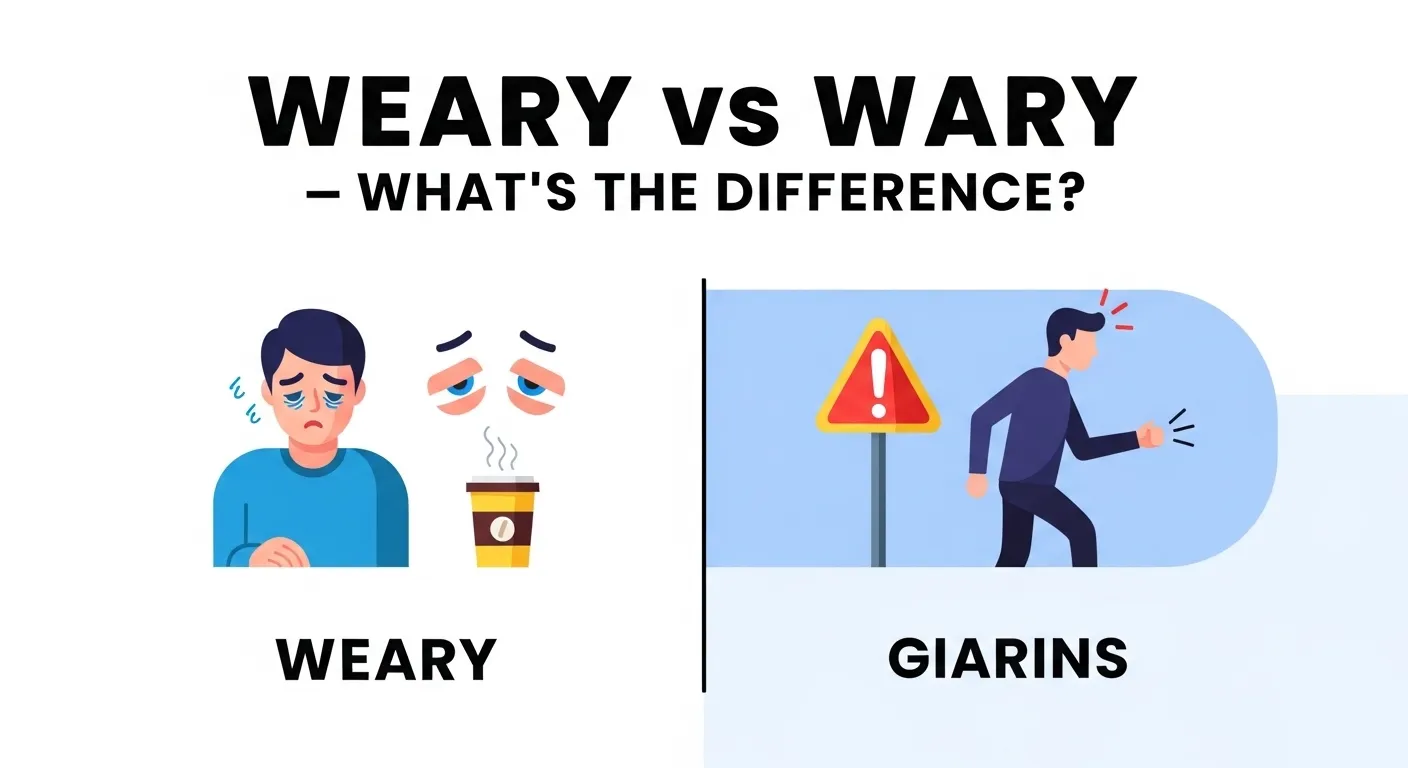
Weary” means tired or exhausted, while “wary” means cautious or alert. 😴⚠️
English has many words that look similar but have very different meanings. One common pair that causes confusion is “weary” and “wary.”
Because the words sound alike and differ by only one letter, many writers mix them up in everyday writing. People often search online for “weary or wary” when they are unsure which word fits their sentence.
The confusion usually happens because both words appear in situations involving feelings or reactions. For example, someone might say they are weary of working late, while another person may be wary of trusting strangers. If you use the wrong word, the meaning of the sentence can change completely.
Understanding the difference is important for clear communication. Whether you are writing emails, school essays, articles, or social media posts, choosing the correct word improves your grammar and professionalism.
In this guide, you will learn the quick difference between weary and wary, their origins, common mistakes, real-life examples, and usage trends.
By the end, you will easily know when to use weary and when to use wary, helping you write with more confidence and accuracy.
Weary or Wary ; Quick Answer
The quick answer is simple: weary and wary have different meanings.
- Weary means very tired or exhausted.
- Wary means careful or cautious about something.
Examples
Using weary:
- After the long trip, she felt weary.
- He was weary after working all day.
Using wary:
- She was wary of the stranger.
- Investors are wary about risky markets.
Simple Rule
| Word | Meaning |
| Weary | Feeling tired |
| Wary | Feeling cautious |
Remember:
Weary = tired.
Wary = careful or cautious.
The Origin of Weary or Wary
Understanding the origins of these words helps explain why they look similar but mean different things.
Origin of “Weary”
The word weary comes from Old English “wērig.” It originally meant tired, exhausted, or worn out. The word has been used for centuries to describe physical or emotional fatigue.
Examples from history include descriptions of:
- tired travelers
- exhausted soldiers
- people worn out by work
Over time, the meaning remained almost the same.
Origin of “Wary”
The word wary comes from Old English “wær,” meaning careful or watchful. It was used to describe someone who is alert and cautious about possible danger.
The meaning evolved slightly but still refers to being careful or suspicious of something.
Word Origin Table
| Word | Origin | Meaning |
| Weary | Old English wērig | Tired or exhausted |
| Wary | Old English wær | Careful or cautious |
Although they sound similar today, they come from different roots and meanings.
British English vs American English Spelling
Unlike many English words, weary and wary are spelled the same in both British and American English.
There is no spelling difference between regions.
Examples
American English:
- The traveler felt weary after the journey.
- Investors remain wary of inflation.
British English:
- The traveler felt weary after the journey.
- Investors remain wary of inflation.
Comparison Table
| Word | American English | British English |
| Weary | Same spelling | Same spelling |
| Wary | Same spelling | Same spelling |
The difference between these words is meaning, not regional spelling.
Which Spelling Should You Use?
Choosing between weary and wary depends entirely on the message you want to express.
Use “Weary” When Talking About Being Tired
Examples:
- She felt weary after the long meeting.
- The hikers were weary after climbing the mountain.
- Workers felt weary after overtime shifts.
This word describes physical or emotional exhaustion.
Use “Wary” When Talking About Being Careful
Examples:
- He is wary of online scams.
- Travelers should be wary of unsafe areas.
- Investors are wary of unstable markets.
This word describes caution or suspicion.
Advice for Global Writing
For international readers:
- Use weary when describing tiredness.
- Use wary when describing caution or distrust.
These meanings are universal across English-speaking countries.
Common Mistakes with Weary or Wary
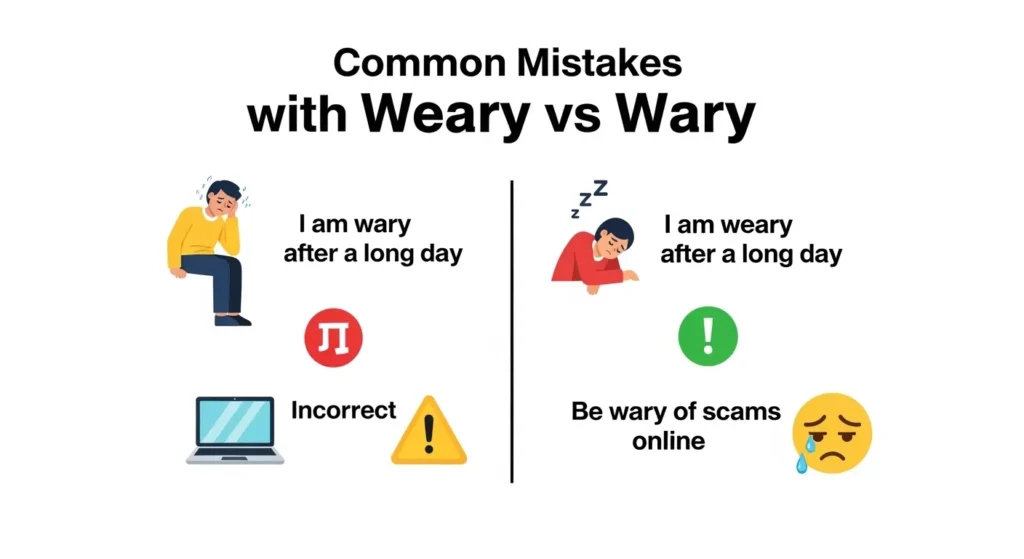
Many writers confuse these words because they look and sound alike.
Here are the most common mistakes.
Mistake 1: Using “Weary” Instead of “Wary”
Incorrect:
- She was weary of the suspicious offer.
Correct:
- She was wary of the suspicious offer.
The correct meaning is cautious, not tired.
Mistake 2: Using “Wary” Instead of “Weary”
Incorrect:
- He felt wary after working all night.
Correct:
- He felt weary after working all night.
The sentence describes tiredness, not caution.
Mistake 3: Thinking the Words Are Interchangeable
They are not interchangeable.
Each word has a distinct meaning.
Quick Memory Trick
A helpful trick:
- Weary → “Wear” (tired from wear and tear)
- Wary → “Aware” (careful and alert)
Weary or Wary in Everyday Examples
These words appear often in daily communication.
Emails
- I feel weary after this busy week.
- Please be wary of suspicious emails.
News
- Citizens are wary of new economic policies.
- Rescue workers looked weary after long shifts.
Social Media
- After a long day, I feel so weary.
- Be wary of fake online giveaways.
Formal Writing
- Employees reported feeling weary due to heavy workloads.
- Experts remain wary about the future of the market.
Weary or Wary ; Google Trends & Usage Data
Search data shows that many people look up “weary or wary” because they are unsure of the difference.
Search Intent
People often search questions like:
- weary vs wary meaning
- difference between weary and wary
- how to use weary or wary
Popularity by Context
| Word | Common Context |
| Weary | Work, travel, exhaustion |
| Wary | Safety, risk, warning |
Regional Interest
| Country | Common Search |
| United States | weary vs wary |
| United Kingdom | wary meaning |
| Canada | difference between weary and wary |
| Australia | weary meaning |
This shows that the confusion is global.
Comparison Table: Weary vs Wary
| Feature | Weary | Wary |
| Meaning | Tired or exhausted | Careful or cautious |
| Emotion | Fatigue | Suspicion |
| Usage frequency | Common | Common |
| Context | Work, travel, stress | Safety, risk, danger |
| British spelling | Same | Same |
| American spelling | Same | Same |
FAQs ;
1. What is the difference between weary and wary?
Weary means tired, while wary means cautious or careful.
2. Are weary and wary pronounced the same?
They sound very similar, which is why people often confuse them.
3. Can weary mean bored?
Sometimes yes. It can mean tired or tired of something.
Example:
- I am weary of constant complaints.
4. Can wary mean afraid?
Not exactly. Wary means cautious, not necessarily scared.
5. Are these words used in both British and American English?
Yes. Both words are spelled and used the same way worldwide.
6. Which word is more common?
Both are common but used in different situations.
7. How can I remember the difference?
Remember:
- Weary = tired
- Wary = careful
Conclusion
The difference between weary and wary may seem small, but understanding it can greatly improve your writing.
These words look and sound similar, which is why many people confuse them. However, their meanings are completely different.
The word weary describes a feeling of tiredness or exhaustion. People often use it when talking about long workdays, difficult journeys, or emotional fatigue. For example, someone might feel weary after working late or traveling for many hours.
On the other hand, wary describes a feeling of caution or carefulness. It is used when someone is alert to possible risks or dangers. For example, a person might be wary of online scams or suspicious offers.
Another helpful thing to remember is that there is no spelling difference between British and American English for these words. The correct choice depends only on the meaning of the sentence.
By remembering the simple rule “weary means tired, wary means careful,” you can avoid common mistakes and communicate your ideas clearly.
Mastering small differences like this helps make your writing stronger, more accurate, and easier to understand.
Read more about ;
Sewing or Sowing 🧵🌱 — Meaning, Differences, and How to Use the Right Word

My name is Noam Chomsky. I am a linguist, philosopher, and political thinker. I am best known for my work in English grammar and linguistics, especially for developing generative grammar.I studied at the University of Pennsylvania, where I earned my PhD in linguistics. Later, I joined the Massachusetts Institute of Technology (MIT) and taught there for many years. My book “Syntactic Structures” changed the way people understand language and grammar.