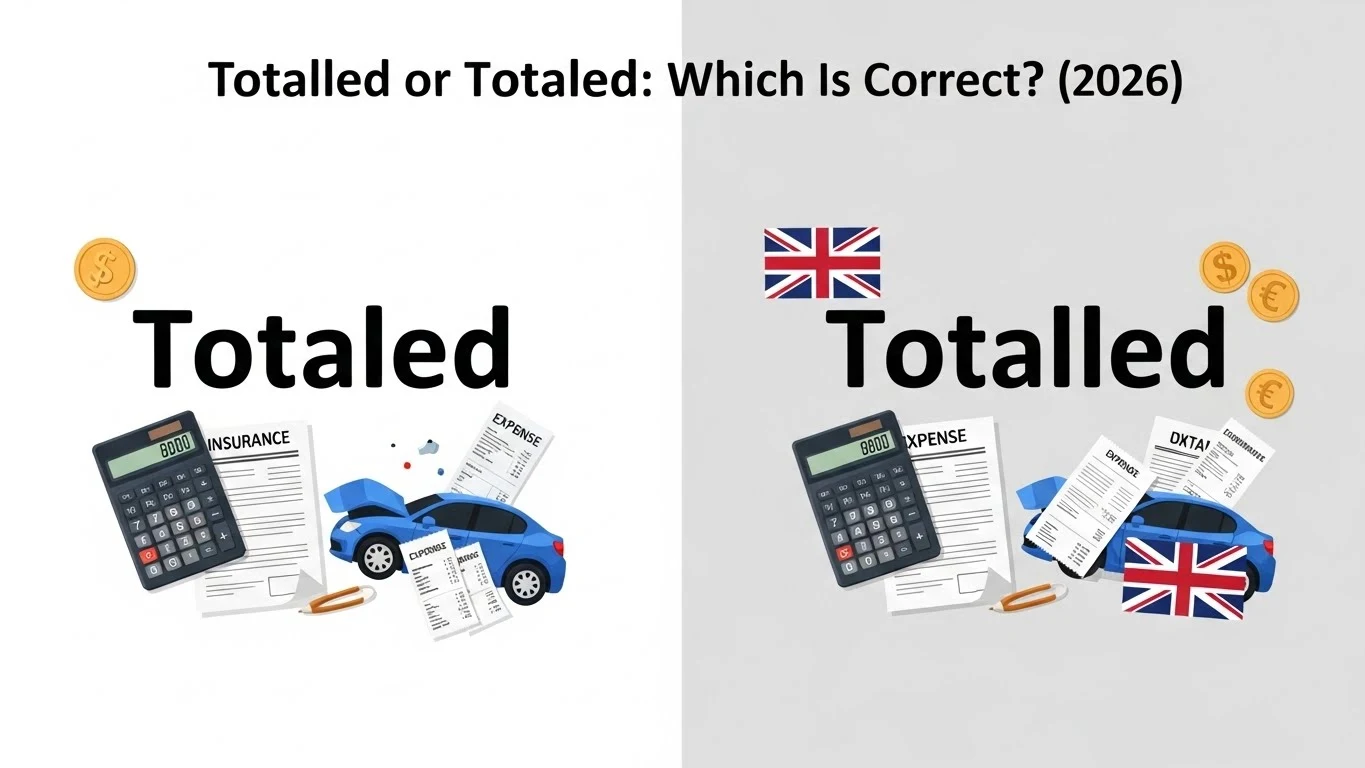
Both spellings are correct: “totaled” is preferred in American English, while “totalled” is preferred in British English.
Many people search for “totalled or totaled” because they see both spellings used online, in news articles, insurance reports, and official documents.
This creates confusion. If both spellings appear everywhere, which one is correct? Are they mistakes, or are both acceptable?
The confusion becomes bigger when writing something important, like an insurance claim, car accident report, academic paper, or professional email.
People worry about using the wrong spelling and looking unprofessional. English learners feel even more unsure because spelling rules change depending on the country.
The truth is simple: both totalled and totaled are correct, but they are used in different types of English. This article explains the difference in a clear and easy way.
You will learn where each spelling comes from, how British and American English handle it, and which one you should use based on your audience. By the end, you will know exactly when to write totalled and when to write totaled—with confidence.
Totalled or Totaled : Quick Answer
✅ Totaled is preferred in American English
✅ Totalled is preferred in British English
Examples:
- 🇺🇸 The car was totaled in the accident.
- 🇬🇧 The car was totalled in the accident.
👉 Both spellings are correct. The difference is regional, not grammatical.
The Origin of Totalled or Totaled
The word total comes from the Latin word totalis, meaning whole or entire. It entered English through French and became commonly used as both a noun and a verb.
When English verbs end in -l, spelling rules change depending on the variety of English:
- British English usually doubles the “l”
- American English usually keeps a single “l”
That is why:
- Total → totalled (UK)
- Total → totaled (US)
This same pattern appears in many other words, which makes the rule consistent rather than random.
Read more about: Supposed or Suppose: Which Word Is Correct and When to Use It? 2026
British English vs American English Spelling
This is a classic British vs American spelling difference.
Spelling Rule Comparison
| English Type | Spelling Rule | Example |
| British English | Double the “l” | total → totalled |
| American English | Single “l” | total → totaled |
Similar Word Examples
| British English | American English |
| travelled | traveled |
| cancelled | canceled |
| labelled | labeled |
| fuelled | fueled |
Both systems are correct. You just need to be consistent.
Which Spelling Should You Use?
The best spelling depends on your audience.
Use Totaled if:
- You write for a US audience
- You use American English spelling
- You write insurance or legal documents in the US
Example:
- The vehicle was totaled after the crash.
Use Totalled if:
- You write for a UK audience
- You follow British or Commonwealth English
- You write for audiences in the UK, Australia, or New Zealand
Example:
- The building was totalled by the fire.
For Global or SEO Writing:
- Choose one spelling
- Stay consistent throughout the content
- American English is often preferred for global audiences
Common Mistakes with Totalled or Totaled
1. Mixing spellings in one document
❌ The car was totaled, and the bike was totalled.
✅ The car was totaled, and the bike was totaled.
2. Thinking one spelling is wrong
❌ Totalled is incorrect.
✅ Both spellings are correct.
3. Assuming grammar rules are different
❌ Totalled is past tense only in UK.
✅ Both are past tense forms of total.
Easy Memory Tip
👉 US = one “l” → totaled
👉 UK = two “l”s → totalled
Totalled or Totaled in Everyday Examples
Emails
- ✅ The laptop was totaled during shipping.
- ✅ The equipment was totalled beyond repair.
News Writing
- ✅ The storm totaled hundreds of homes.
- ✅ The crash totalled three vehicles.
Social Media
- ✅ My phone is completely totaled 😭
- ✅ Car totalled, but everyone is safe 🙏
Formal & Legal Writing
- ✅ The asset was declared totaled.
- ✅ The property was officially totalled.
Totalled or Totaled : Google Trends & Usage Data
Search trends show that “totaled” is searched more in:
- United States
- Canada (mixed usage)
- Philippines
“Totalled” is more common in:
- United Kingdom
- Australia
- New Zealand
- India (British English influence)
Context Where It Appears Most:
- Car insurance
- Accident reports
- News articles
- Legal documents
- Repair estimates
Both spellings are widely recognized by search engines.
Totalled vs Totaled : Comparison Table
| Feature | Totaled | Totalled |
| English type | American | British |
| Correct spelling | ✅ Yes | ✅ Yes |
| Past tense | Yes | Yes |
| Used in US documents | ✅ Yes | ❌ Rare |
| Used in UK documents | ❌ Rare | ✅ Yes |
| Grammar difference | None | None |
FAQs
1. Is totalled a spelling mistake?
No. It is correct in British English.
2. Is totaled only American English?
Yes. It is the standard American spelling.
3. Can I use both spellings?
Yes, but not in the same document.
4. Which spelling is better for SEO?
American spelling (totaled) often works better globally.
5. Is there a meaning difference?
No. Both mean completely destroyed or ruined.
6. Are insurance companies strict about spelling?
They usually follow regional standards.
7. Do grammar checkers accept both?
Yes, depending on language settings.
Conclusion
The debate between totalled or totaled is not about right or wrong. It is about where and who you are writing for. Both spellings come from the same word, have the same meaning, and follow consistent spelling rules in their respective forms of English.
American English prefers totaled with one “l”. British English prefers totalled with two “l”s. Neither spelling is a mistake. The real mistake is mixing them in the same piece of writing.
Understanding this difference helps you write more clearly and professionally. Whether you are writing an insurance report, news article, or everyday message, choosing the correct regional spelling improves trust and clarity. Once you know your audience, the choice becomes easy.

Hello, I am Henry P. Whitmore, an English language scholar and grammar author known for my contributions to English grammar education. I am recognized for presenting complex grammatical rules in a clear, structured, and student-friendly manner, making my work valuable for learners, teachers, and non-native speakers of English.