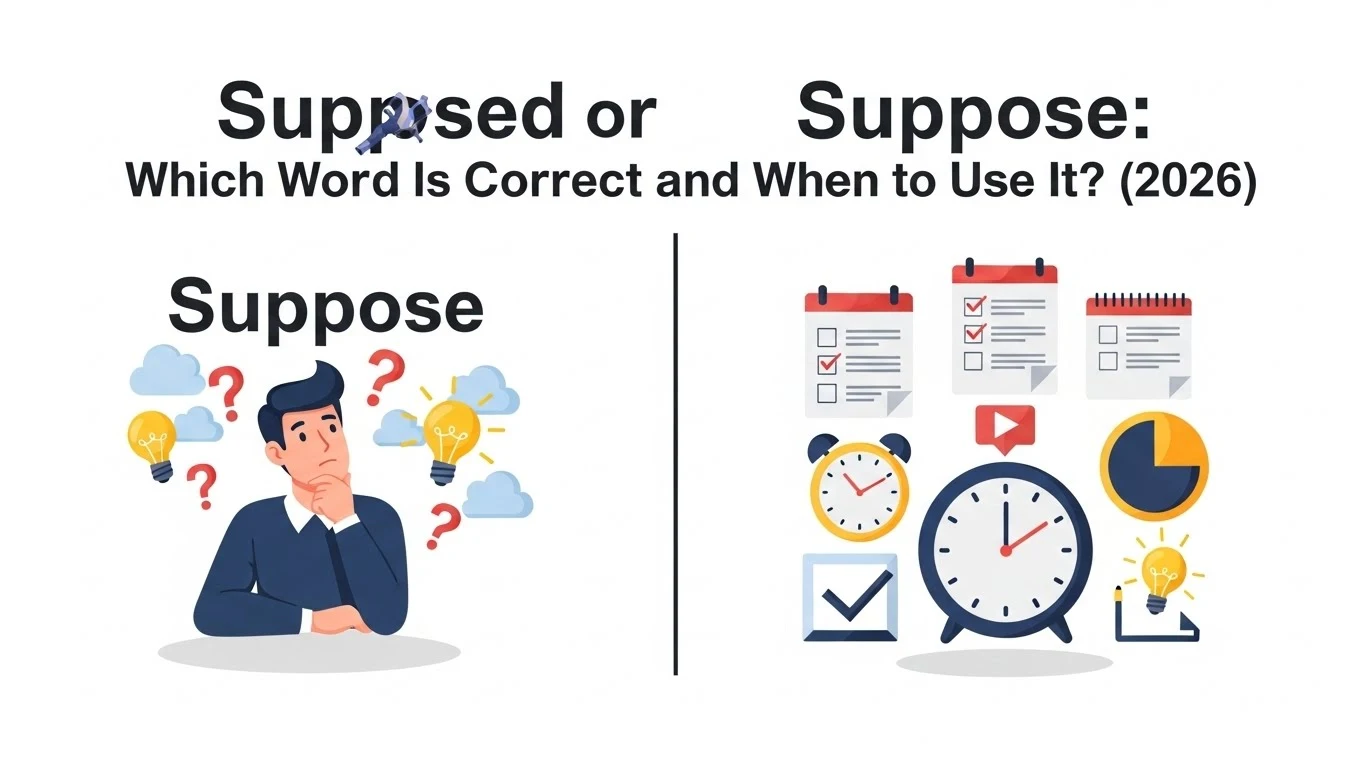
“Suppose” is a verb meaning to assume or imagine, while “supposed” is the past tense or past participle used to describe something expected or assumed.
Many people search for “supposed or suppose” because these two words look very similar and sound almost the same. This makes them easy to confuse. Students, English learners, and even native speakers often use one when they mean the other. The mistake is very common in daily writing, emails, and social media.
The main reason for this confusion is that suppose and supposed come from the same root word. One is a verb, and the other is a form of that verb. People are unsure when to use each one. Another problem is that supposed to is a very common phrase in spoken English, so people often forget the grammar behind it.
Using the wrong word can change the meaning of a sentence or make it sound incorrect. This article clears up the confusion in a simple way. You will learn what each word means, how they are different, and how to use them correctly in real life. By the end, you will feel confident using supposed or suppose without hesitation.
Supposed or Suppose : Quick Answer
✅ Suppose is a verb.
✅ Supposed is the past tense or past participle of suppose, or part of the phrase “supposed to.”
Examples:
- ✅ I suppose he is right.
- ✅ I was supposed to call you.
❌ Do not use suppose when you need supposed, and vice versa.
Read more about: Homage or Omage : Which Spelling Is Correct ?2026
The Origin of Supposed or Suppose
Both suppose and supposed come from the Latin word supponere, which means to assume or to place under. This word entered English through Old French and became suppose.
The word suppose stayed as the base verb. Later, English grammar added -ed to form supposed, which is used for:
- Past actions
- Passive voice
- Fixed expressions like supposed to
There are no spelling differences here. The confusion is not about spelling, but about grammar and usage. People hear these words used casually in speech and try to copy them in writing, often without understanding the structure.
British English vs American English Spelling
There is no spelling difference between British and American English for these words.
Key point:
👉 Both US and UK English use suppose and supposed in the same way.
Comparison Table
| English Type | Verb Form | Past / Phrase Form |
| British English | suppose | supposed |
| American English | suppose | supposed |
Grammar rules are the same in all English varieties.
Which Spelling Should You Use?
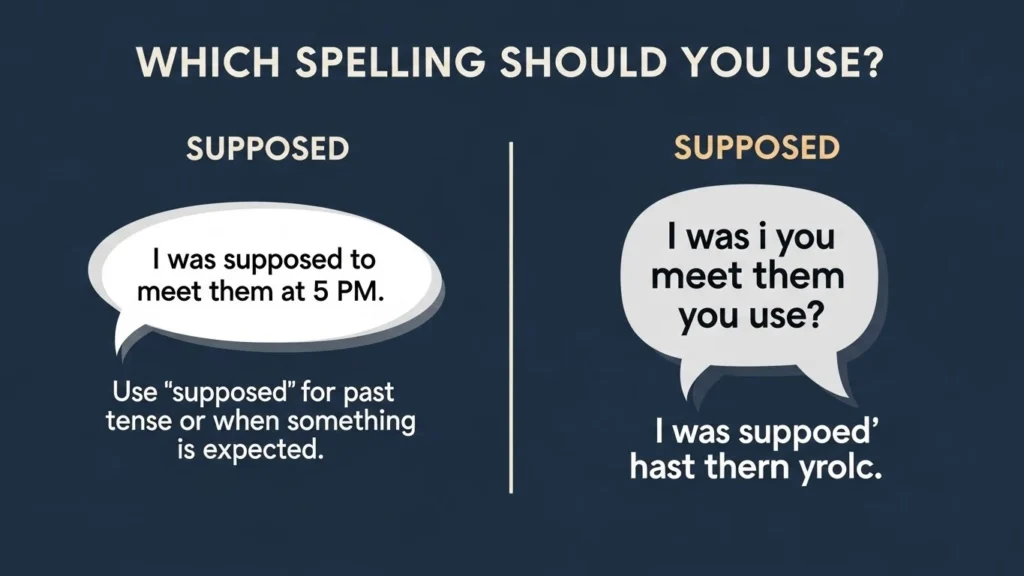
The correct choice depends on how the word functions in the sentence.
Use suppose when:
- You mean to think or to assume
- You are talking about the present or future
Example:
- I suppose she will arrive soon.
Use supposed when:
- You talk about the past
- You use the phrase supposed to (expectation or duty)
Example:
- She was supposed to arrive earlier.
Audience-based advice:
- US audience: same rules
- UK/Commonwealth: same rules
- Global writing: same rules
There is no regional difference, only grammatical correctness.
Common Mistakes with Supposed or Suppose
Here are the most common errors people make:
1. Using suppose instead of supposed to
❌ I am suppose to help you.
✅ I am supposed to help you.
2. Using supposed as a base verb
❌ I supposed you like coffee.
✅ I suppose you like coffee.
3. Forgetting “to” after supposed
❌ I am supposed finish the work.
✅ I am supposed to finish the work.
Easy Memory Tip
👉 Suppose = think / guess
👉 Supposed to = duty or expectation
Supposed or Suppose in Everyday Examples
Emails
- ✅ I suppose we can meet tomorrow.
- ✅ I was supposed to send this earlier.
News Writing
- ✅ The plan is supposed to reduce costs.
- ✅ Experts suppose the weather will change.
Social Media
- ✅ I suppose this makes sense 🤔
- ✅ I was supposed to post yesterday 😅
Formal Writing
- ✅ The system is supposed to improve safety.
- ✅ Researchers suppose the results are accurate.
Supposed or Suppose : Google Trends & Usage Data
Search data shows that “supposed or suppose” is a common grammar query. Many users search this phrase because they are unsure which form to use in a sentence.
Usage Insights:
- High search volume in:
- India
- Pakistan
- Philippines
- United States
- United Kingdom
- India
- Search intent:
- Grammar correction
- Writing accuracy
- ESL learning
- Grammar correction
Supposed to is far more common in spoken and written English than the base verb suppose, which increases confusion.
Suppose vs Supposed : Comparison Table
| Feature | Suppose | Supposed |
| Part of speech | Verb | Verb form / adjective |
| Time reference | Present / future | Past / expectation |
| Used with “to” | ❌ No | ✅ Yes |
| Common phrase | I suppose | supposed to |
| Common mistake | ❌ Misused | ❌ Misused |
FAQs
1. Is “I am suppose to” correct?
No. The correct form is “I am supposed to.”
2. Can supposed be used without “to”?
Yes, but mostly in passive or past tense sentences.
3. Does suppose mean guess?
Yes. It means to think or to assume.
4. Is there a spelling difference in UK and US English?
No. Both use the same spelling.
5. Why do people confuse these words?
Because they sound similar and are used casually in speech.
6. Is supposed an adjective?
Sometimes. In phrases like the supposed reason, it acts like an adjective.
7. Which word is more common?
Supposed is more common, especially in the phrase supposed to.
Conclusion
The confusion between supposed or suppose is very common, but it is easy to fix once you understand the difference. Suppose is the base verb that means to think or to assume. Supposed is the past form or part of the phrase “supposed to,” which shows expectation or duty.
There is no difference between British and American English in this case. The rules are the same everywhere. Most mistakes happen because people write the way they speak, without thinking about grammar.
Learning this difference improves both written and spoken English. It helps you sound clearer, more confident, and more professional. Once you remember that suppose = think and supposed to = expectation, the confusion disappears.
If accuracy matters in your writing, always choose the correct form based on the sentence. With this knowledge, you will never struggle with supposed or suppose again.

Hello, I am Henry P. Whitmore, an English language scholar and grammar author known for my contributions to English grammar education. I am recognized for presenting complex grammatical rules in a clear, structured, and student-friendly manner, making my work valuable for learners, teachers, and non-native speakers of English.