“Skies” is the correct plural of sky, while “sky’s” is possessive (showing ownership), not plural.
Many people search for “sky’s or skies” because they are unsure which spelling is correct in different situations. This confusion is very common, especially for English learners, students, bloggers, and even native speakers. At first glance, both words look similar, but they serve very different grammatical purposes.
English can be tricky. Sometimes we add ’s to show possession. Other times we change the word ending to make it plural. Because sky ends with a -y, many writers pause and wonder: Should I write sky’s or skies? This small choice can change the meaning of a sentence completely.
Using the wrong form can make writing look unprofessional or unclear. In writing, academic work, emails, and social media posts, this mistake happens often. That is why people actively search for clear guidance on sky’s vs skies.
This article removes all confusion in a simple way. You will learn the correct spelling, the grammar rule behind it, how British and American English handle it, and how to use each form correctly in real-life examples. By the end, you will confidently know when to use sky’s and when to use skies without guessing.
Sky’s or Skies – Quick Answer
Short Answer:
- Skies is the plural form of sky.
- Sky’s is the possessive form of sky.
Examples:
- The skies were clear today. ✅ (more than one sky)
- The sky’s color changed at sunset. ✅ (ownership)
The Origin of Sky’s or Skies
The word sky comes from Old Norse ský, meaning cloud. Over time, English adopted the word to describe the space above the earth. As English evolved, clear grammar rules developed for plural forms and possessive forms.
When a noun ends in -y, English often changes y → ies to form the plural—but only when the y comes after a consonant.
- baby → babies
- city → cities
- sky → skies
The apostrophe ’s has a completely different role. It shows possession or ownership, not plurality.
- the sky’s color
- the sky’s limit
The confusion exists because both forms sound similar when spoken, but in writing, their meanings are very different.
Read more about:Tardys or Tardies ⏰🤔: Which Spelling Is Correct?
British English vs American English Spelling
Good news: British and American English follow the same rules for sky’s and skies. There is no spelling difference between UK and US English here.
Comparison Table
| Form | British English | American English | Meaning |
| skies | ✔️ Correct | ✔️ Correct | Plural of sky |
| sky’s | ✔️ Correct | ✔️ Correct | Possessive form |
| skys | ❌ Incorrect | ❌ Incorrect | Not standard English |
So no matter where you live, the rules stay the same.
Which Spelling Should You Use?
Use skies when:
- You are talking about more than one sky
- You are being poetic or descriptive
- You mean different skies in different places or times
Use sky’s when:
- The sky owns something
- You are describing a quality or feature of the sky
Audience-Based Advice
- US audience: Follow standard grammar rules—skies for plural, sky’s for possession
- UK/Commonwealth audience: Same usage
- Global or ESL audience: Focus on meaning—plural vs ownership
Common Mistakes with Sky’s or Skies
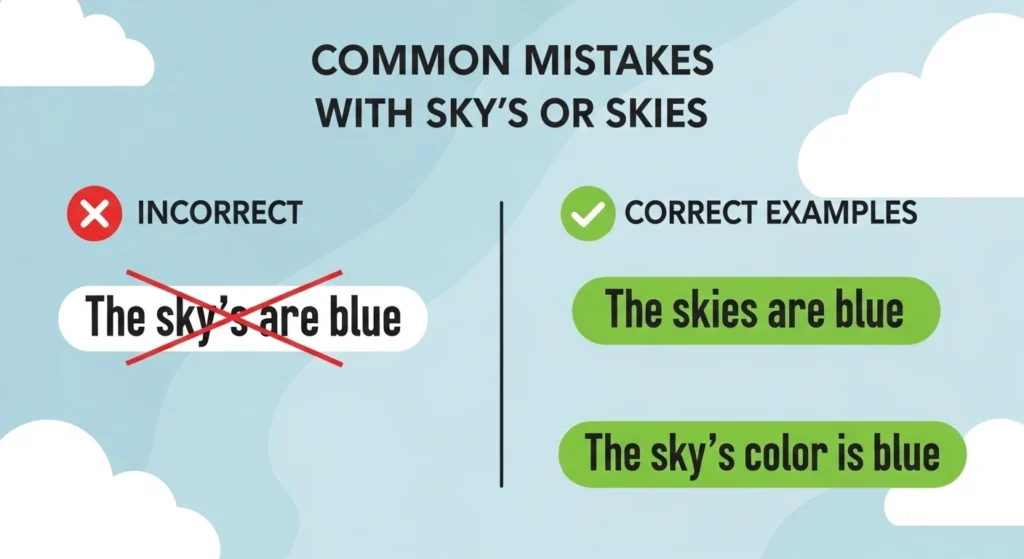
Here are the most common errors people make:
❌ The sky’s are blue today.
✅ The skies are blue today.
❌ The color of the skies brightness was amazing.
✅ The sky’s brightness was amazing.
❌ Clear skys make me happy.
✅ Clear skies make me happy.
Tip:
- If you can replace the word with “of the sky”, use sky’s
- If you mean more than one, use skies
Sky’s or Skies in Everyday Examples
Emails
- The sky’s condition looks perfect for flying today.
- Clear skies are expected tomorrow.
News
- Storm clouds covered the skies across the region.
- The sky’s color turned orange due to pollution.
Social Media
- Loving these blue skies 💙
- The sky’s the limit!
Formal Writing
- Astronomers studied the skies for unusual activity.
- The sky’s appearance changed after sunset.
Sky’s or Skies – Google Trends & Usage Data
Search data shows that:
- “skies” is searched more often in weather, travel, and poetry contexts
- “sky’s” is searched when users are confused about apostrophe usage
Popularity by Region
- United States: “skies” dominates weather-related searches
- United Kingdom: Similar usage pattern
- Global ESL regions: High searches for “sky’s or skies” due to grammar confusion
This proves that users want both a quick answer and a clear explanation—exactly what this article provides.
Comparison Table: Sky’s vs Skies
| Feature | Sky’s | Skies |
| Type | Possessive noun | Plural noun |
| Apostrophe | Yes | No |
| Meaning | Belonging to the sky | More than one sky |
| Grammar Role | Ownership | Quantity |
| Common Error | Used instead of plural | Misspelled as skys |
FAQs
1. Is “skys” ever correct?
No. Skys is not correct in standard English.
2. Does sky’s mean more than one sky?
No. Sky’s only shows possession, not plural.
3. Why does sky become skies?
Because nouns ending in consonant + y change y to ies in plural form.
4. Is “the sky’s the limit” correct?
Yes. It shows possession and is a fixed expression.
5. Are rules different in British English?
No. British and American English use the same rule.
6. Can skies be used metaphorically?
Yes. Writers often use skies poetically.
7. Which is more common in daily use?
Skies is more common than sky’s.
Conclusion
The confusion between sky’s or skies is small but important. One tiny apostrophe can completely change the meaning of a sentence. Skies is the plural form, used when talking about more than one sky. Sky’s is the possessive form, used when something belongs to the sky.
There is no difference between British and American English here, which makes the rule easier to remember. Most mistakes happen because writers confuse plural rules with possessive rules. Once you understand that apostrophes never make words plural, the problem disappears.
Whether you are writing emails, blog posts, social media captions, or formal documents, choosing the correct form makes your writing clearer and more professional. Remember: quantity = skies, ownership = sky’s.
With this simple rule in mind, you will never be confused about sky’s or skies again.

Hello, I am Henry P. Whitmore, an English language scholar and grammar author known for my contributions to English grammar education. I am recognized for presenting complex grammatical rules in a clear, structured, and student-friendly manner, making my work valuable for learners, teachers, and non-native speakers of English.