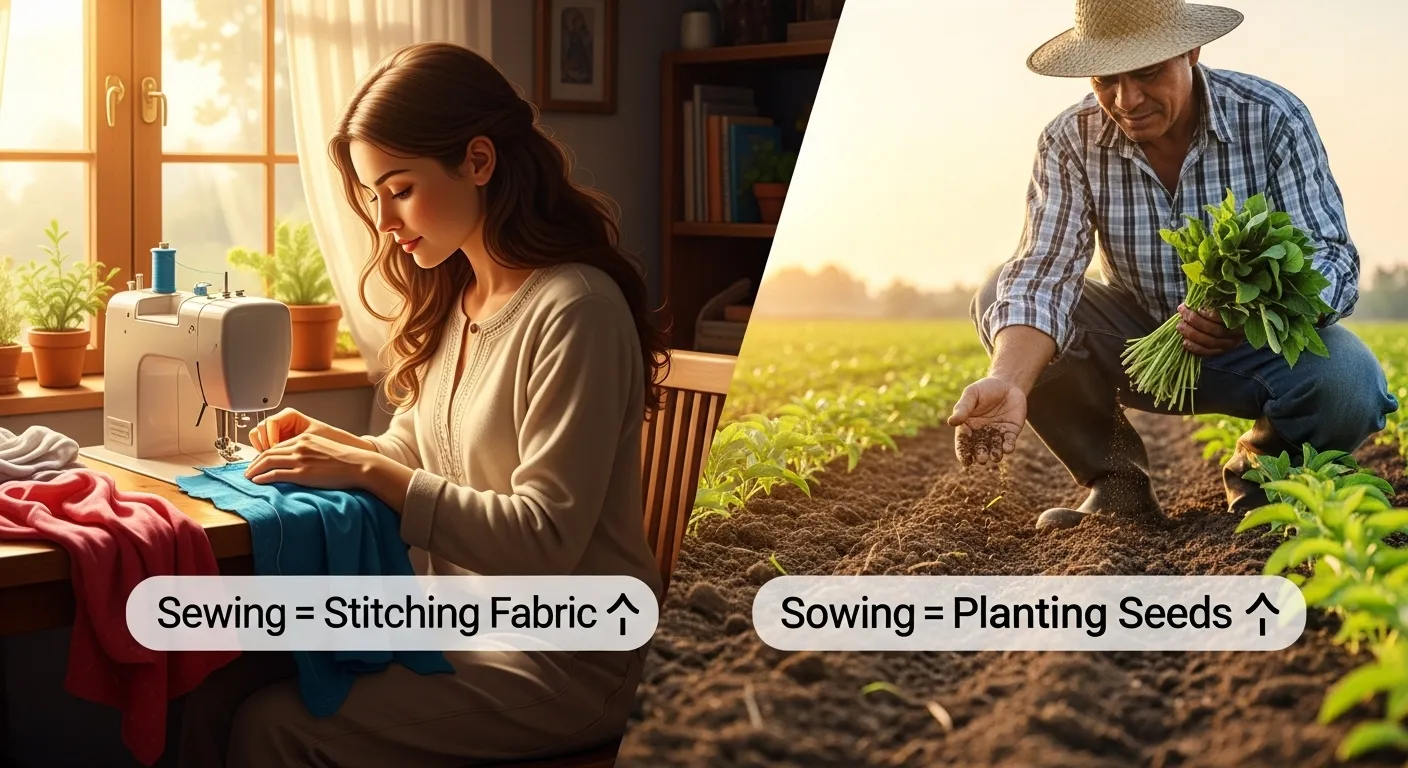
Sewing means stitching fabric with needle and thread, while sowing means planting seeds in soil.
Many people search for “sewing or sowing” because the two words sound almost the same. When spoken, they can be confusing. But their meanings are very different. One relates to clothes and fabric. The other relates to seeds and farming.
This confusion often happens in school writing, gardening blogs, craft tutorials, and social media posts. A small spelling mistake can change the whole meaning of a sentence. For example, “She is sowing a dress” sounds strange because we do not plant dresses in the ground. But new English learners and even native speakers sometimes mix them up.
English has many homophones—words that sound alike but have different meanings and spellings. Sewing and sowing are classic examples. That is why so many people look for a clear answer online.
In this guide, you will get a quick answer first. Then you will learn the origin, spelling rules, common mistakes, and real-life examples. By the end, you will confidently know when to use sewing and when to use sowing.
Sewing or Sowing – Quick Answer
Short Answer:
- Sewing = making or repairing clothes with a needle and thread.
- Sowing = planting seeds in the ground.
Examples:
- She is sewing a new shirt. ✅
- The farmer is sowing wheat seeds. ✅
They sound similar, but they mean different things.
The Origin of Sewing or Sowing
The word sewing comes from the verb sew. It has Old English roots from the word siwian, which meant to stitch fabric together.
The word sowing comes from the verb sow. It also comes from Old English, from the word sawan, meaning to plant seeds.
Even though they sound alike today, they developed from different root words. Over time, English pronunciation changed, but the spelling stayed different. That is why we now have two similar-sounding words with very different meanings.
English keeps both spellings because they represent different actions:
- Sewing = stitching fabric
- Sowing = planting seeds
British English vs American English Spelling
Good news: there is no spelling difference between British and American English for these words.
Both regions use:
- Sewing
- Sowing
Comparison Table
| Word | British English | American English | Meaning |
| Sewing | ✔️ Yes | ✔️ Yes | Stitching fabric |
| Sowing | ✔️ Yes | ✔️ Yes | Planting seeds |
The spelling stays the same in both countries.
Which Spelling Should You Use?
Choose the word based on meaning, not country.
Use “Sewing” when:
- Talking about clothes
- Talking about fashion
- Talking about stitching or tailoring
Example:
- She enjoys sewing dresses.
Use “Sowing” when:
- Talking about farming
- Talking about gardening
- Talking about planting seeds
Example:
- They are sowing corn in spring.
For Global Writing:
Always double-check the context. Ask yourself:
Am I talking about fabric or seeds?
That simple question solves the confusion.
Common Mistakes with Sewing or Sowing

❌ She is sowing a button on her shirt.
✅ She is sewing a button on her shirt.
❌ The farmer is sewing rice in the field.
✅ The farmer is sowing rice in the field.
❌ I love sowing clothes at home.
✅ I love sewing clothes at home.
Tip:
Think of “sewing” with “thread.”
Think of “sowing” with “soil.”
Sewing or Sowing in Everyday Examples
Emails
- I am sewing the curtains today.
- We are sowing grass seeds this weekend.
News
- The designer is known for hand sewing techniques.
- Farmers began sowing crops after the rain.
Social Media
- Sunday night sewing project 🧵
- Spring is here! Time for sowing 🌱
Formal Writing
- The company specializes in industrial sewing machines.
- Early sowing improves crop yield.
Sewing or Sowing – Google Trends & Usage Data
Search data shows:
- “Sewing” is very popular in craft, fashion, and DIY searches.
- “Sowing” is common in farming and gardening searches.
- Many users search “sewing or sowing” to check the difference.
Popular Countries Searching:
- United States
- United Kingdom
- Australia
- India
- Canada
Most confusion comes from students and ESL learners. The search term spikes during:
- School assignments
- Gardening season
- Craft holidays
This shows people want quick clarity between the two words.
Comparison Table: Sewing vs Sowing
| Feature | Sewing | Sowing |
| Meaning | Stitching fabric | Planting seeds |
| Related to | Clothes | Farming |
| Verb form | Sew | Sow |
| Used in fashion | ✔️ Yes | ❌ No |
| Used in agriculture | ❌ No | ✔️ Yes |
| Spelling correct | ✔️ Yes | ✔️ Yes |
Frequently Asked Questions (FAQs)
1. Are sewing and sowing pronounced the same?
Yes, in most accents they sound the same.
2. Is sewing related to farming?
No. Sewing is about stitching fabric.
3. Is sowing related to clothes?
No. Sowing is about planting seeds.
4. Do British and Americans spell them differently?
No. The spelling is the same in both regions.
5. How can I remember the difference?
Sewing = thread.
Sowing = soil.
6. Can both be used as nouns?
Yes. Sewing and sowing are both gerund forms.
7. Is this a common mistake?
Yes. It is a common homophone confusion.
Conclusion
The confusion between sewing or sowing is very common because the words sound almost the same. But their meanings are very different. Sewing relates to stitching clothes and fabric. Sowing relates to planting seeds in soil.
There is no spelling difference between British and American English. The key to choosing the right word is context. Ask yourself what action is happening. If it involves fabric and thread, use sewing. If it involves seeds and farming, use sowing.
Many English mistakes happen because of homophones. But once you link sewing with thread and sowing with soil, the difference becomes easy to remember.
Correct word choice makes your writing clear and professional. Whether you are writing an email, a blog post, or a school essay, using the right spelling shows attention to detail.
Now you know the rule clearly:
👉 Sewing is for fabric. Sowing is for seeds.
Read more about!
Croppie or Crappie 🎣 : Correct Spelling, Meaning, and Usage Guide

Hello, I am Henry P. Whitmore, an English language scholar and grammar author known for my contributions to English grammar education. I am recognized for presenting complex grammatical rules in a clear, structured, and student-friendly manner, making my work valuable for learners, teachers, and non-native speakers of English.