Both are correct: “rumor” is American English, while “rumour” is British English.
Many people search for “rumor or rumour” because they see both spellings used in news articles, social media posts, books, and websites.
This creates confusion, especially for students, writers, and English learners. If both versions appear correct, which one should you use?
The confusion usually comes from British and American English spelling differences. English is spoken worldwide, but spelling rules change slightly from country to country. Words ending in -or and -our are one of the most common sources of spelling mistakes.
Using the wrong spelling does not usually change the meaning, but it can look unprofessional or inconsistent—especially in formal writing, exams, or business communication. This article explains the difference between rumor and rumour in a very simple way.
You will learn their meaning, origin, correct usage, common mistakes, and which spelling fits your audience best. By the end, you will know exactly which one to use and why.
Rumor or Rumour – Quick Answer
✅ Rumor is the preferred spelling in American English
✅ Rumour is the preferred spelling in British English
Examples:
- 🇺🇸 The rumor spread quickly online.
- 🇬🇧 The rumour spread quickly online.
👉 Both spellings are correct. The difference is regional, not grammatical.
Read more about: Signors or Signers: Which Word Is Correct and When to Use It?2026
The Origin of Rumor or Rumour
The word comes from the Latin word “rumor”, meaning noise, talk, or common report. It entered English through Old French, where it was spelled rumour.
When English evolved differently in Britain and America, spelling rules changed:
- British English kept the French-influenced spelling rumour
- American English simplified the spelling to rumor
This simplification was part of a larger spelling reform in the United States during the 18th and 19th centuries. Many words lost extra letters to make spelling easier and more phonetic.
British English vs American English Spelling
This is a classic UK vs US spelling difference.
Key Rule:
- British English prefers -our
- American English prefers -or
Comparison Table
| British English | American English |
| rumour | rumor |
| colour | color |
| favour | favor |
| honour | honor |
The meaning stays the same in both versions.
Which Spelling Should You Use?
The correct spelling depends on your audience.
Use Rumor if:
- You write for a US audience
- You follow American English rules
- You write for global SEO audiences
Example:
- There is a rumor about the new phone launch.
Use Rumour if:
- You write for a UK audience
- You follow British or Commonwealth English
- You write academic or UK-based content
Example:
- The rumour was denied by officials.
For Global or SEO Writing:
American English (rumor) is often preferred because it reaches a wider audience.
Common Mistakes with Rumor or Rumour
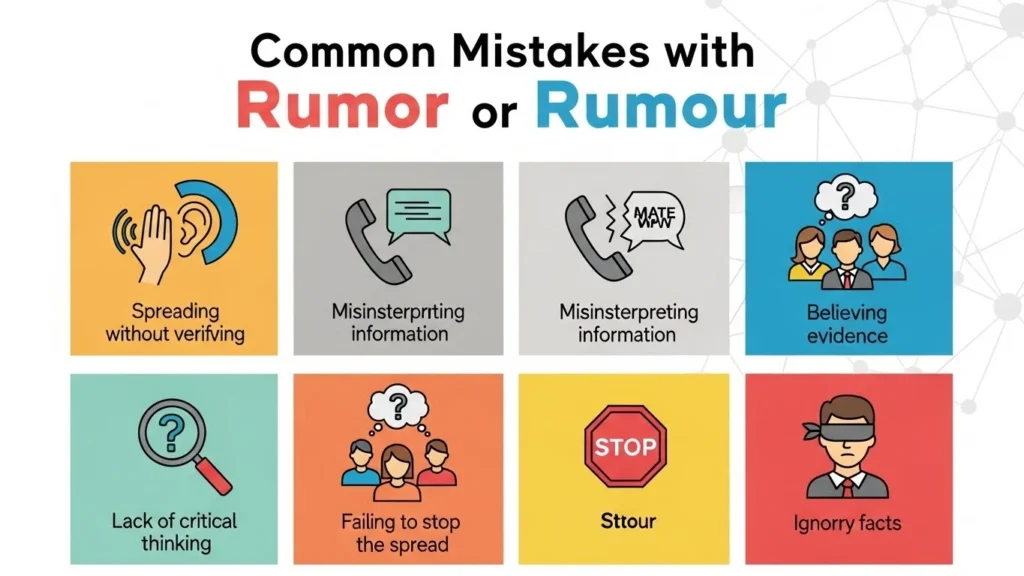
1. Mixing spellings in one document
❌ The rumor spread, but the rumour was false.
✅ The rumor spread, but the rumor was false.
2. Thinking one spelling is wrong
❌ Rumour is incorrect.
✅ Both spellings are correct.
3. Assuming meaning changes
❌ Rumor and rumour have different meanings.
✅ They mean the same thing.
Easy Memory Tip
👉 US drops “u” → rumor
👉 UK keeps “u” → rumour
Rumor or Rumour in Everyday Examples
Emails
- ✅ I heard a rumor about the meeting.
- ✅ I heard a rumour about the meeting.
News Writing
- ✅ The company denied the rumor.
- ✅ The minister addressed the rumour.
Social Media
- ✅ Is this rumor true? 🤔
- ✅ Just a rumour, nothing confirmed yet.
Formal Writing
- ✅ The rumor was officially dismissed.
- ✅ The rumour lacked evidence.
Rumor or Rumour – Google Trends & Usage Data
Search trends show that “rumor” is searched more often worldwide, mainly because of American English dominance online.
Popular by Region:
- Rumor: United States, Philippines, Canada (mixed), global SEO
- Rumour: United Kingdom, Australia, New Zealand, India
Common Contexts:
- Celebrity news
- Politics
- Business announcements
- Social media discussions
Search engines understand both spellings, but consistency matters for ranking and readability.
Rumor vs Rumour – Comparison Table
| Feature | Rumor | Rumour |
| English type | American | British |
| Correct spelling | ✅ Yes | ✅ Yes |
| Meaning | Unverified talk | Unverified talk |
| Used in US media | ✅ Yes | ❌ Rare |
| Used in UK media | ❌ Rare | ✅ Yes |
| SEO preference | High | Medium |
FAQs – Rumor or Rumour
1. Is rumour a spelling mistake?
No. It is correct in British English.
2. Is rumor American English only?
Yes. It is the standard US spelling.
3. Do both words mean the same thing?
Yes. There is no meaning difference.
4. Which spelling should students use?
Use the spelling taught in your country.
5. Which spelling is better for SEO?
Rumor usually performs better globally.
6. Can I use both spellings together?
No. Always stay consistent.
7. Are both accepted in exams?
Yes, if used consistently with the correct English style.
Conclusion
The difference between rumor or rumour is simple once you understand regional spelling rules. Both words come from the same origin and mean the same thing. The only difference is where they are used.
American English prefers rumor, while British English prefers rumour. Neither spelling is wrong. The real mistake is mixing them in the same piece of writing or using the wrong form for your audience.
Choosing the correct spelling improves clarity, professionalism, and trust in your writing. Whether you are writing a news article, an academic paper, or a social media post, knowing this difference helps you communicate better. Once you know your audience, choosing between rumor or rumour becomes easy.

Hello, I am Henry P. Whitmore, an English language scholar and grammar author known for my contributions to English grammar education. I am recognized for presenting complex grammatical rules in a clear, structured, and student-friendly manner, making my work valuable for learners, teachers, and non-native speakers of English.