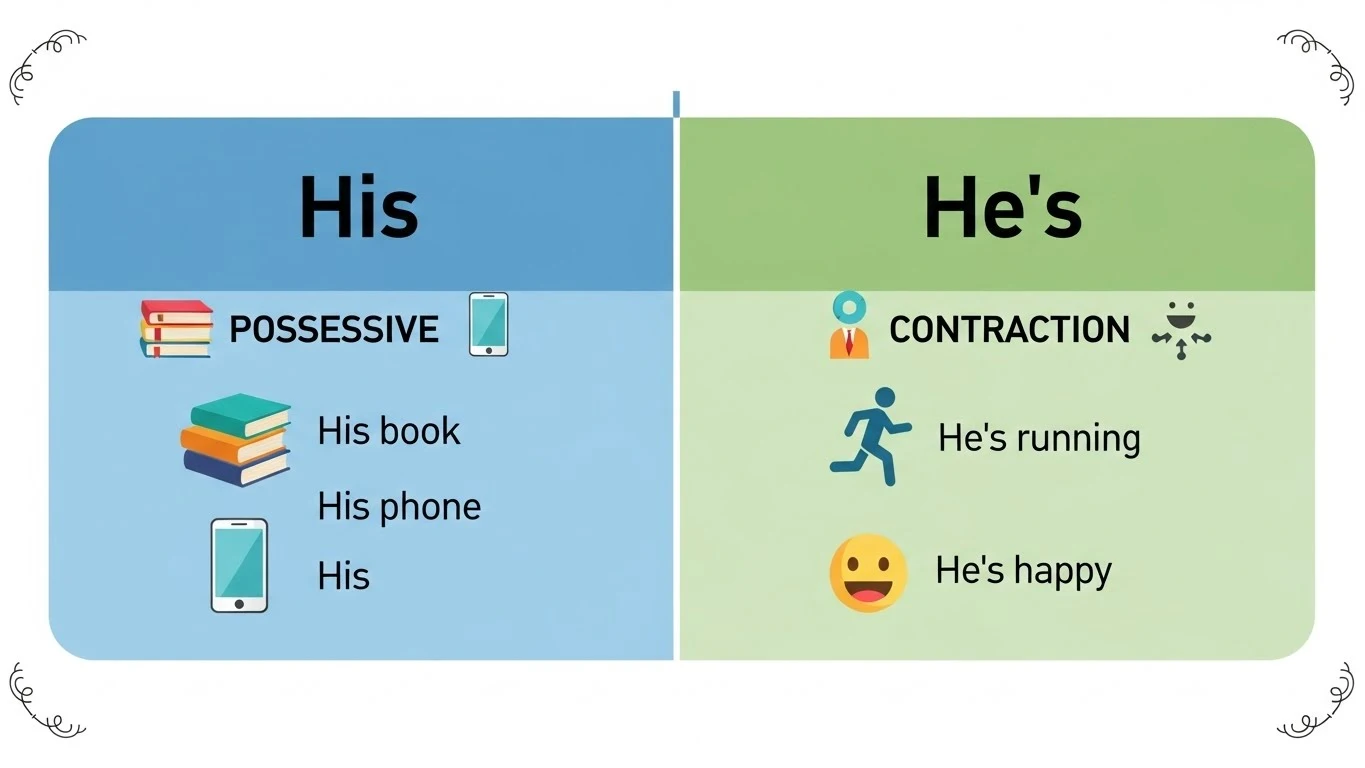
“His” is used to show possession, while “he’s” is only used as a short form of he is or he has.
Many people search for “his or he’s” because these two words look very similar but mean very different things. A small apostrophe can completely change the meaning of a sentence. This mistake is common in emails, social media posts, schoolwork, and even professional writing. Spellcheck does not always catch it, so the error keeps happening.
The confusion comes from the apostrophe. In English, apostrophes are used for contractions and possession, but “his” is an exception. Unlike many possessive words, his does not use an apostrophe. On the other hand, he’s is a contraction and always needs an apostrophe.
This article clearly explains his or he’s. You will learn the quick answer, word origins, spelling rules, examples, common mistakes, and usage tips for different audiences. By the end, you will confidently know which one to use every time.
His or He’s – Quick Answer
✅ His = shows ownership or possession
✅ He’s = short form of he is or he has
Simple Examples
- ✅ This is his book.
- ✅ He’s going to school.
- ❌ This is he’s book. (wrong)
👉 If you can replace the word with “he is” or “he has,” use he’s. Otherwise, use his.
The Origin of His or He’s
Understanding where these words come from makes the rule easier.
Origin of His
- Comes from Old English his
- Used to show possession
- Related to her and their
- No apostrophe needed
Origin of He’s
- A contraction formed in modern English
- Short for he is or he has
- Apostrophe replaces missing letters
Why the Confusion Exists
Most possessive nouns use apostrophes:
- John’s book
- The dog’s toy
But possessive pronouns do NOT:
- his
- hers
- yours
- theirs
This rule breaks expectations and causes mistakes.
Read more about: 🐴 Donkies or Donkeys: Which Spelling Is Correct and Why It Matters?
British English vs American English Spelling
This is not a UK vs US spelling issue.
Important Rule
👉 Both British and American English use the same rules
Comparison Table
| English Type | His | He’s |
| British English | ✅ Correct | ✅ Correct |
| American English | ✅ Correct | ✅ Correct |
| Global English | ✅ Correct | ✅ Correct |
The difference is grammar, not spelling style.
Which Spelling Should You Use?
Use His When:
- Showing ownership
- Talking about something belonging to a male
Examples
- His phone is ringing.
- I met his brother.
- That is his car.
Use He’s When:
- You mean he is
- You mean he has
Examples
- He’s tired. (he is tired)
- He’s finished his work. (he has finished)
Audience-Based Advice
- US audience: Follow grammar rule
- UK/Commonwealth: Same rule
- Global: Correct usage improves trust and clarity
Common Mistakes with His or He’s
1. Using He’s for Possession
❌ He’s bag is on the table.
✅ His bag is on the table.
2. Forgetting the Apostrophe in He’s
❌ Hes coming home.
✅ He’s coming home.
3. Thinking His Needs an Apostrophe
❌ Hi’s jacket is blue.
✅ His jacket is blue.
Easy Memory Tip
👉 He’s = he is / he has
👉 His = belongs to him
His or He’s in Everyday Examples
Emails
- ✅ He’s available for the meeting.
- ❌ His available for the meeting.
News Writing
- ✅ The actor shared his thoughts.
- ❌ The actor shared he’s thoughts.
Social Media
- ✅ He’s doing great today 👍
- ❌ His doing great today
Formal Writing
- ✅ The company announced his appointment.
- ❌ The company announced he’s appointment.
His or He’s – Google Trends & Usage Data

Search engines show very high searches for “his or he’s”.
Why People Search This
- Apostrophe confusion
- ESL learning
- Autocorrect issues
- Grammar checking
Usage Insights
- His appears more often in writing
- He’s is common in speech and informal text
- Grammar mistakes reduce credibility quality
Correct grammar improves reader trust and search rankings.
His vs He’s – Comparison Table
| Feature | His | He’s |
| Part of speech | Possessive pronoun | Contraction |
| Shows ownership | ✅ Yes | ❌ No |
| Means “he is” | ❌ No | ✅ Yes |
| Needs apostrophe | ❌ No | ✅ Yes |
| Common mistake | Adding apostrophe | Removing apostrophe |
| Professional use | ✅ Yes | ⚠️ Informal |
FAQs
1. Is “he’s” possessive?
No. It is a contraction.
2. Why doesn’t “his” use an apostrophe?
Possessive pronouns never use apostrophes.
3. Can “he’s” mean “he was”?
No. Only he is or he has.
4. Is this mistake common?
Yes, very common.
5. Does autocorrect cause this error?
Often, yes.
6. Which word is safer in formal writing?
His (when showing possession).
7. How can I check quickly?
Replace the word with he is. If it works, use he’s.
Conclusion
The difference between his or he’s is small but very important. His shows ownership and never uses an apostrophe. He’s is a contraction that means he is or he has and always needs an apostrophe. Mixing them up can make writing look careless or unprofessional.
This mistake is common because English grammar has exceptions, and possessive pronouns break the usual apostrophe rule. The good news is that the fix is simple. If you remember one rule apostrophes are not used in possessive pronouns you will avoid this error.
Clear grammar improves communication, confidence, and credibility. Whether you are writing an email, post, or article, using his or he’s correctly makes your message clear and professional.

Hello, I am Henry P. Whitmore, an English language scholar and grammar author known for my contributions to English grammar education. I am recognized for presenting complex grammatical rules in a clear, structured, and student-friendly manner, making my work valuable for learners, teachers, and non-native speakers of English.