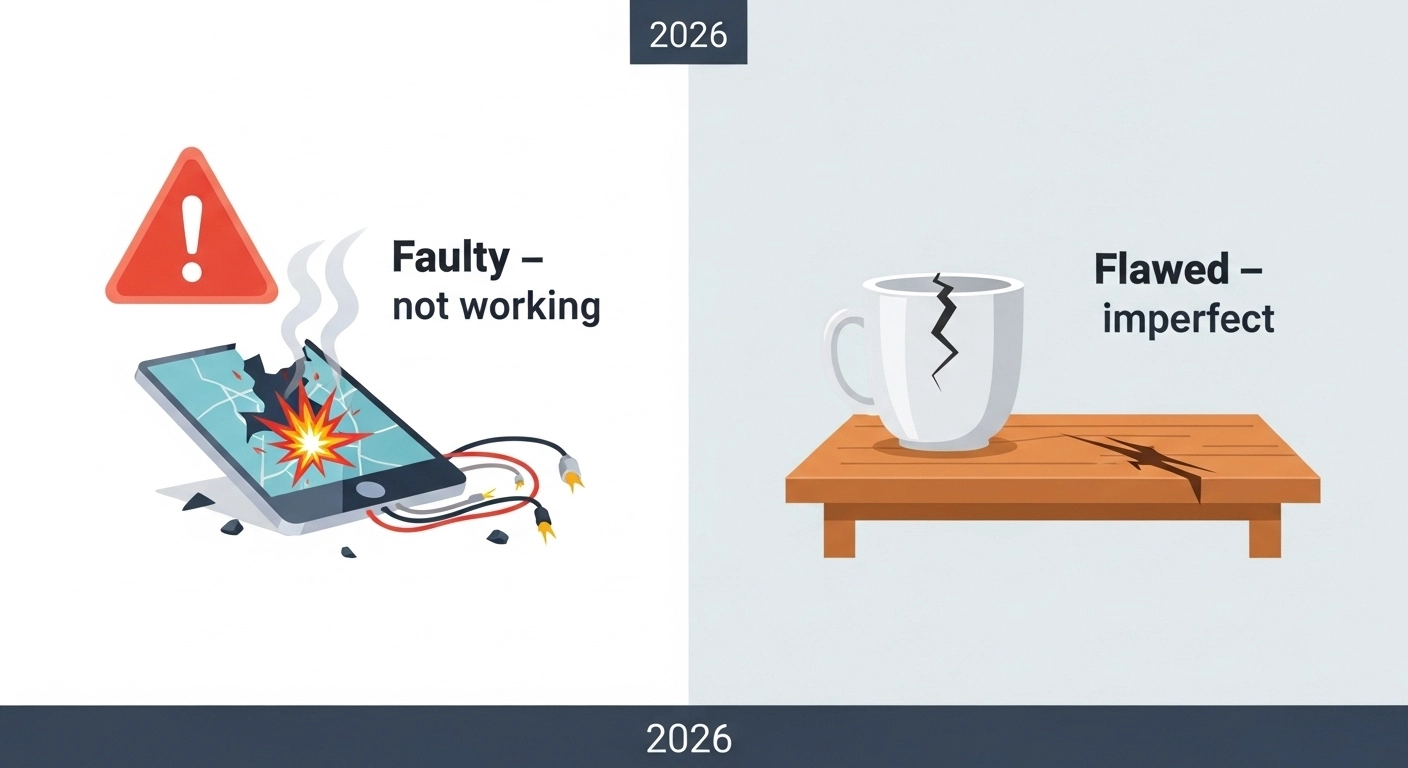
Faulty means not working correctly, while flawed means having a weakness or imperfection.
Many people search for “faulty or flawed” because these two words look similar and are often used in similar situations. Both words suggest that something is not perfect, but they are not interchangeable. Choosing the wrong word can slightly or sometimes greatly change the meaning of your sentence.
For example:
- A faulty machine stopped working.
- A flawed argument failed to convince anyone.
Both sentences talk about problems, but the type of problem is different. One is about something that does not work properly, while the other is about something that is weak in design or logic.
This article explains the difference between faulty and flawed in very simple language. You will learn their meanings, origins, correct usage, common mistakes, real-life examples, and how to choose the right word in writing and speech. By the end, you will confidently know when to use faulty and when to use flawed.
Faulty or Flawed / Quick Answer
- Faulty → Something that does not work correctly
- Flawed → Something that has a weakness or imperfection in design, idea, or character
Simple examples:
- A faulty phone charger stopped working. ✅
- The plan was flawed from the start. ✅
👉 Faulty = broken or malfunctioning
👉 Flawed = imperfect or poorly designed
What Does “Faulty” Mean?
Faulty means not working properly or having a defect that causes failure.
Key idea:
👉 A faulty thing fails to function as it should.
Common uses of “faulty”:
- Machines
- Equipment
- Electronics
- Wiring
- Systems
- Products
Examples:
- A faulty engine
- Faulty wiring
- Faulty equipment
- Faulty brakes
Examples of “Faulty” in Everyday Life
In technology
- The laptop shut down due to a faulty battery.
- The phone was returned because of faulty software.
In safety situations
- The fire started because of faulty wiring.
- The accident happened due to faulty brakes.
In business and products
- Customers complained about faulty products.
- The company recalled faulty devices.
👉 Faulty usually describes physical or technical problems.
Read more about:🐴 Donkies or Donkeys: Which Spelling Is Correct and Why It Matters?
What Does “Flawed” Mean?
Flawed means having a weakness, mistake, or imperfection, especially in ideas, plans, designs, or character.
Key idea:
👉 A flawed thing may still work, but it is not perfect.
Common uses of “flawed”:
- Plans
- Arguments
- Ideas
- Systems
- Research
- Characters
- Designs
Examples:
- A flawed plan
- A flawed argument
- A flawed character
- A flawed study
Examples of “Flawed” in Everyday Life
In thinking and ideas
- The theory was flawed and lacked evidence.
- His logic was flawed.
In planning
- The project failed because of a flawed strategy.
- The design is creative but flawed.
In people and characters
- The movie shows a flawed hero.
- Everyone is flawed in some way.
👉 Flawed often refers to abstract or human-related issues.
Origin of the Words
Origin of “Faulty”
- Comes from the word fault
- Old French: faute (meaning mistake or defect)
Originally used to describe errors or failures, especially physical ones.
Origin of “Flawed”
- Comes from the word flaw
- Old Norse: flaga (meaning crack or weakness)
Over time, it came to mean imperfections, especially in ideas and people.
Faulty vs Flawed: Side-by-Side Comparison
| Feature | Faulty | Flawed |
| Meaning | Not working correctly | Imperfect or weak |
| Type of problem | Functional defect | Design or logical weakness |
| Common with | Machines, systems | Ideas, plans, people |
| Physical failure | Yes | Not usually |
| Can still work? | Usually no | Often yes |
British English vs American English
There is no spelling difference between British and American English.
- Faulty → same in UK and US
- Flawed → same in UK and US
The difference is about meaning, not region.
Which One Should You Use?
Ask yourself this simple question:
Does it fail to work properly?
→ Use faulty
Does it have a weakness or imperfection?
→ Use flawed
Examples:
- Broken device → faulty
- Weak argument → flawed
Common Mistakes with Faulty or Flawed
❌ Using faulty for ideas
- A faulty plan ❌ (usually wrong)
✅ Better:
- A flawed plan
❌ Using flawed for broken machines
- A flawed engine ❌
✅ Correct:
- A faulty engine
❌ Mixing meanings
- The study failed because the computer was flawed ❌
✅ Correct:
- The computer was faulty
Faulty or Flawed in Professional Writing
In business
- A faulty system caused delays.
- A flawed strategy led to losses.
In academic writing
- The experiment used faulty equipment.
- The research had flawed assumptions.
In legal or technical writing
- The accident was due to faulty machinery.
- The argument was flawed and misleading.
Correct word choice improves clarity and credibility.
Faulty or Flawed in News Writing
- The fire was caused by faulty wiring.
- The investigation revealed a flawed process.
News writing relies on precise language.
Faulty or Flawed in Everyday Speech
- “My charger is faulty.”
- “That idea sounds flawed.”
In spoken English, people sometimes mix them, but correct usage matters in writing.
Google Search & Usage Intent
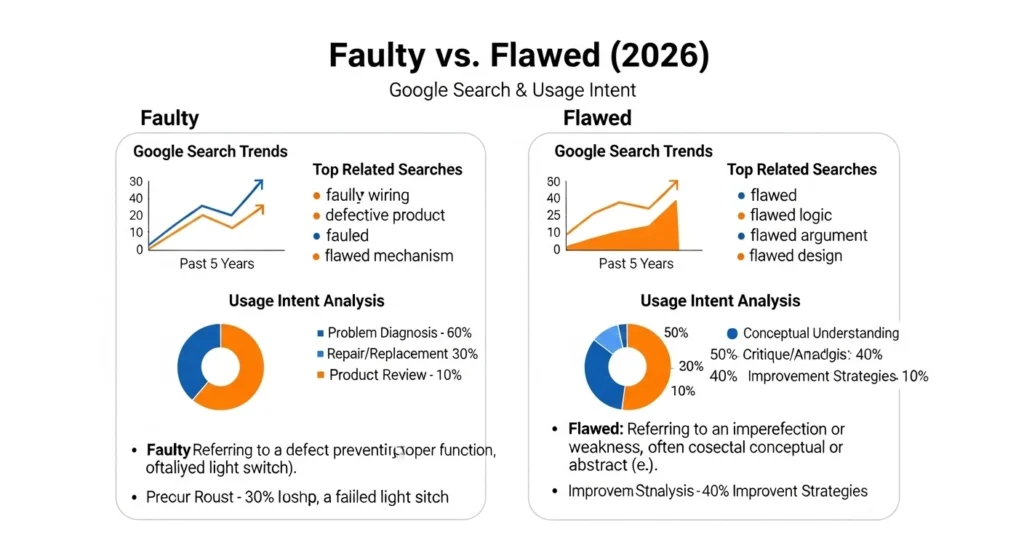
People search for “faulty or flawed” because:
- Both words suggest problems
- Spellings look similar
- Meanings overlap slightly
- Writers want accuracy
User intent is usually:
- Grammar clarification
- Better writing
- Professional correctness
Comparison Table: When to Use Which
| Situation | Correct Word |
| Broken phone | Faulty |
| Weak logic | Flawed |
| Defective product | Faulty |
| Imperfect plan | Flawed |
| Malfunctioning system | Faulty |
| Human weakness | Flawed |
Easy Memory Trick
- Faulty → Fails to function
- Flawed → Has a flaw (weakness)
If it breaks, it’s faulty.
If it’s imperfect, it’s flawed.
FAQs
1. Can faulty and flawed mean the same thing?
Sometimes, but usually no.
2. Is faulty always physical?
Mostly yes.
3. Can a person be faulty?
Rarely. Use flawed instead.
4. Can a system be flawed?
Yes, if the design is weak.
5. Can a machine be flawed?
Rarely. Use faulty for machines.
6. Which word sounds more serious?
Faulty often suggests danger.
7. Which word is better for opinions?
Flawed.
Practice Examples
Choose the correct word:
- The accident was caused by ___ brakes.
✅ faulty - His reasoning was deeply ___.
✅ flawed - The product stopped working due to a ___ part.
✅ faulty - The plan looked good but was ___.
✅ flawed
Why Correct Usage Matters
Using the correct word:
- Improves clarity
- Avoids misunderstanding
- Makes writing professional
- Shows strong language skills
Small word choices can change meaning greatly.
Conclusion
The difference between faulty or flawed is simple once you understand the core idea. Faulty describes something that does not work properly, especially machines, systems, or equipment. Flawed describes something that has a weakness or imperfection, especially ideas, plans, arguments, or people.
Although both words suggest problems, they point to different types of problems. Using the wrong word can confuse readers or reduce the quality of your writing. By remembering that faulty things fail to function and flawed things are imperfect, you can choose the right word every time.
With this guide, you can now use faulty and flawed correctly and confidently in everyday, academic, and professional writing.

Hello, I am Henry P. Whitmore, an English language scholar and grammar author known for my contributions to English grammar education. I am recognized for presenting complex grammatical rules in a clear, structured, and student-friendly manner, making my work valuable for learners, teachers, and non-native speakers of English.