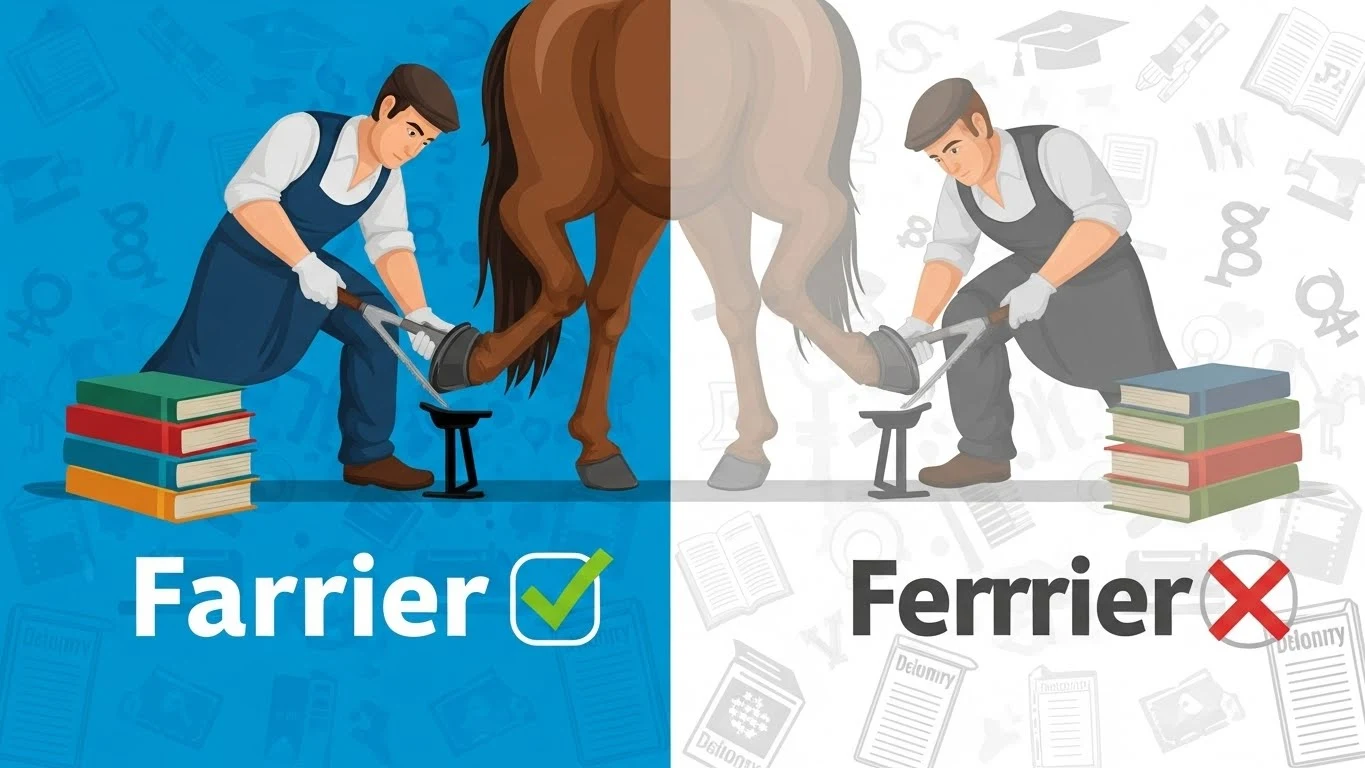
A farrier is a trained specialist who trims horse hooves and fits horseshoes.
Many people search for “farrier or ferrier” because they are unsure which spelling is correct. You may have seen both words online, in names, or in written text and wondered if they mean the same thing.
This confusion is very common, especially among students, writers, horse owners, and non-native English speakers. One spelling refers to a real profession, while the other often appears due to spelling mistakes or as a surname.
This article solves that confusion clearly and simply. It explains what farrier means, the ferrier meaning (if it is ever correct), and why people mix the two up.
You will learn the origin of both words, how British and American English treat them, and which spelling you should use depending on your purpose. By the end, you will know the correct word to use in writing, exams, emails, and professional contexts without hesitation.
Farrier or Ferrier : Quick Answer
The correct word for the profession is farrier.
- ✅ The farrier came to shoe the horse.
- ❌ The ferrier came to shoe the horse.
Ferrier is not the correct spelling for the job. It is usually:
- A surname (last name)
- A misspelling of farrier
So when choosing between farrier or ferrier, the correct answer for the profession is farrier.
The Origin of Farrier or Ferrier
Origin of Farrier
The word farrier comes from Old French ferrier, which itself comes from fer, meaning iron. Early farriers worked with iron horseshoes and were closely linked to blacksmiths.
Over time:
- Ferrier evolved into farrier in English
- The spelling stabilized to avoid confusion
A farrier’s role became specialized, focusing on hoof care and shoeing rather than general metalwork.
Origin of Ferrier
Ferrier still exists, but mainly as:
- A family name
- A historical spelling
- A French-derived surname
This historical connection is the main reason people confuse farrier or ferrier today.
To read more adout ; Beavercreek : A Complete Guide to the City, Lifestyle, History, and Attractions
British English vs American English Spelling
Good news: British and American English both use the same spelling farrier.
There is no regional spelling difference for this word.
Comparison Table
| Term | British English | American English | Meaning |
| Farrier | Farrier | Farrier | Hoof care professional |
| Ferrier | ❌ Incorrect | ❌ Incorrect | Surname / error |
Unlike colour/color or centre/center, farrier stays the same worldwide.
Which Spelling Should You Use?
Your choice depends on meaning, not location.
Use farrier if:
- You are talking about horses
- You mean hoof care or shoeing
- You are writing professionally or academically
Use Ferrier only if:
- It is someone’s last name
- You are referring to a historical family name
Audience-Based Advice
- US audience: Always use farrier
- UK/Commonwealth: Always use farrier
- Global audience: Farrier is universally understood
If you use ferrier by mistake, readers may think you mean a person’s name, not a job.
Common Mistakes with Farrier or Ferrier
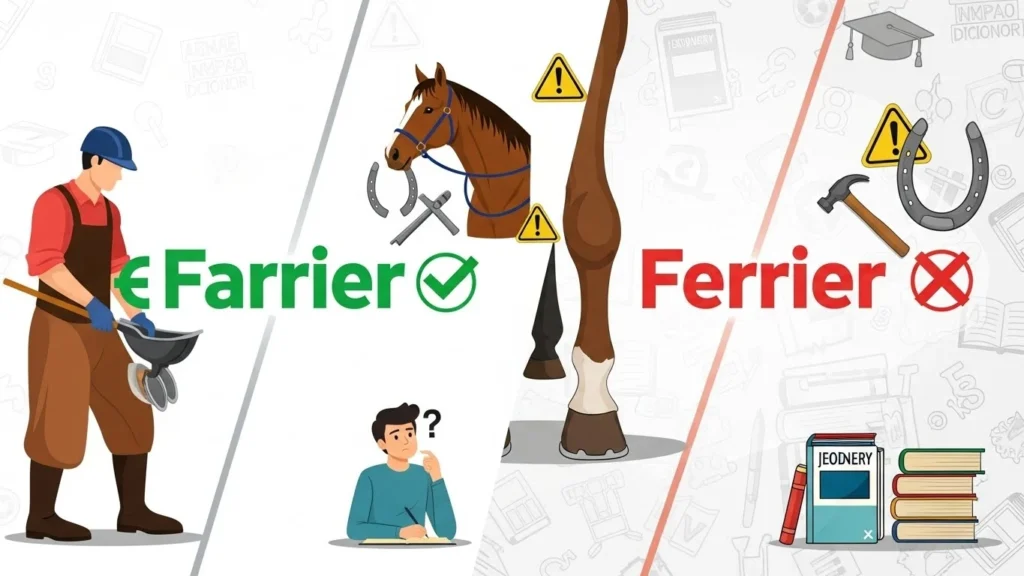
Mistake 1: Using ferrier for the profession
❌ The ferrier shoes horses.
✅ The farrier shoes horses.
Mistake 2: Assuming ferrier is British spelling
It is not a UK variant.
Mistake 3: Mixing farrier with blacksmith
A farrier may work with metal, but hoof care is the key role.
Mistake 4: Autocorrect errors
Spellcheck may suggest ferrier because it exists as a surname.
Farrier or Ferrier in Everyday Examples
Emails
- The farrier will arrive at 10 a.m.
- ❌ The ferrier will arrive at 10 a.m.
News
- A skilled farrier helped rehabilitate the injured horse.
Social Media
- Our farrier did an amazing job today.
Formal Writing
- Regular visits from a qualified farrier are essential for equine health.
These examples show how farrier is correctly used in real communication.
Farrier or Ferrier ; Google Trends & Usage Data
Search data shows that “farrier or ferrier” is commonly typed as a comparison query. This means users already suspect one spelling may be wrong.
Why People Search It
- Confusion from surnames
- Historical spelling exposure
- ESL spelling uncertainty
- Academic or exam preparation
Popular Regions
- English-speaking countries with horse culture
- Farming and rural areas
- Veterinary and equine studies communities
The data clearly shows farrier dominates correct usage worldwide.
Comparison Table: Farrier vs Ferrier
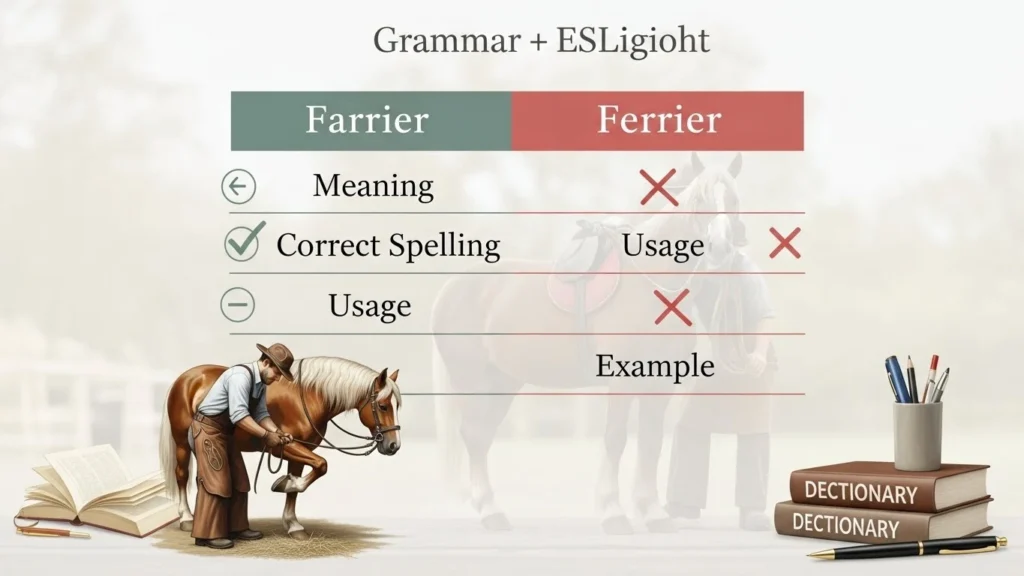
| Feature | Farrier | Ferrier |
| Correct for profession | ✅ Yes | ❌ No |
| British English | Farrier | Surname only |
| American English | Farrier | Surname only |
| Meaning | Hoof care specialist | Family name |
| Common mistake | Rare | Very common |
| Professional usage | High | None |
FAQs
1. Is ferrier ever correct?
Yes, but only as a surname, not a profession.
2. Is farrier the same as a blacksmith?
No. A farrier specializes in horse hooves.
3. Is farrier spelled differently in the UK?
No. The spelling is the same everywhere.
4. Why does ferrier appear online?
Because of historical roots and family names.
5. Can autocorrect cause this mistake?
Yes. Many dictionaries recognize Ferrier as a name.
6. What is the plural of farrier?
Farriers
7. Is farrier a licensed profession?
In many countries, yes or formally trained.
Conclusion
The confusion between farrier or ferrier comes from history and spelling similarity, not from modern English rules. Farrier is the only correct spelling when you are referring to the professional who cares for horse hooves. Ferrier is not a variant it is mainly a surname or a spelling error.
Understanding this difference helps you write clearly and professionally. Whether you are a student, horse owner, writer, or researcher, using the correct word builds trust and accuracy. When in doubt, remember this simple rule: horses = farrier. Avoid relying on autocorrect or search suggestions, and always choose the word that matches your meaning.

Hello, I am Henry P. Whitmore, an English language scholar and grammar author known for my contributions to English grammar education. I am recognized for presenting complex grammatical rules in a clear, structured, and student-friendly manner, making my work valuable for learners, teachers, and non-native speakers of English.