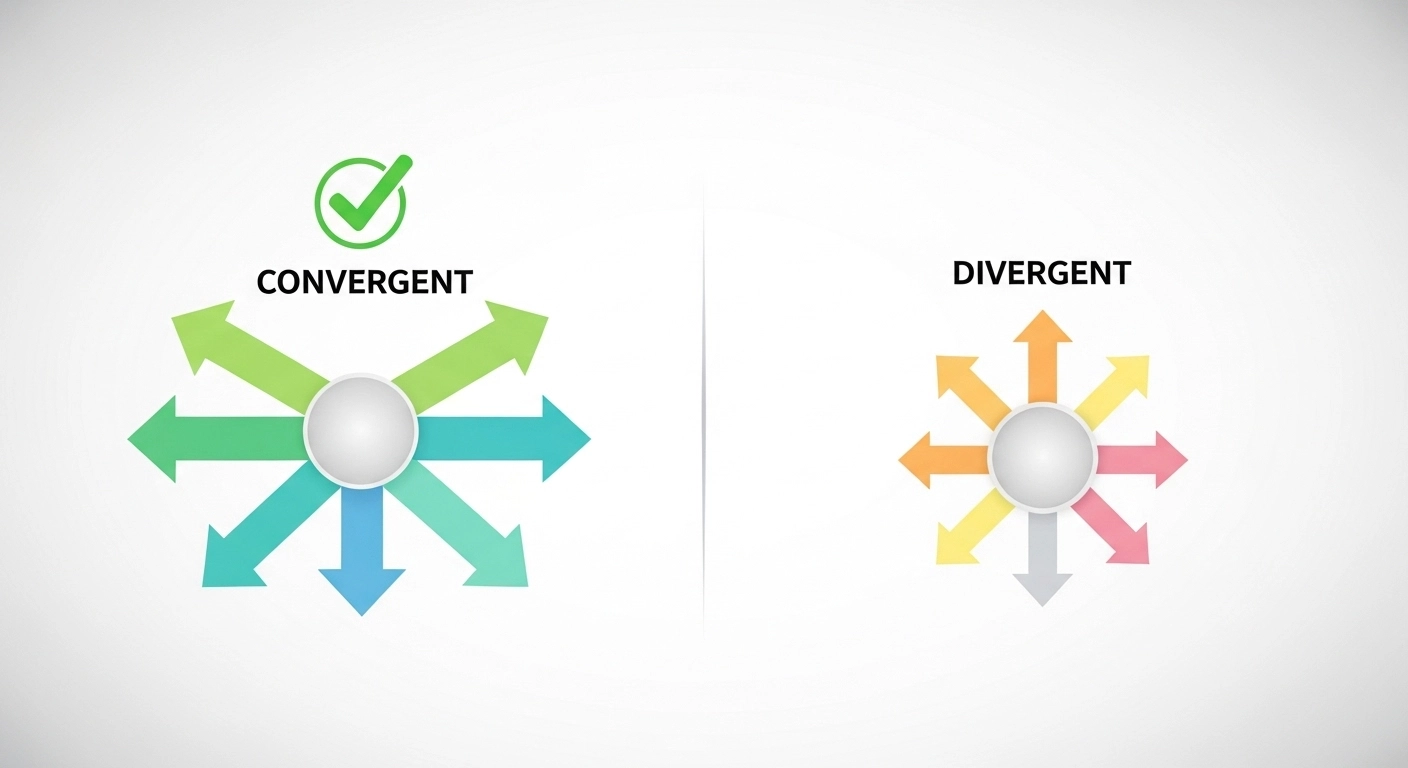
Convergent means coming together or moving toward one point, while divergent means spreading apart or moving in different directions.
Many people search for “convergent or divergent” because these two words appear in many subjects and often cause confusion.
You may see them in science, biology, geography, physics, math, psychology, and even business or creative thinking. The words look complex, and their meanings feel opposite, which makes people unsure.
The main confusion comes from one simple idea: Are things coming together or moving apart? Both words describe direction and behavior, but in opposite ways.
If you mix them up, the meaning of a sentence can completely change.This article clears that confusion step by step. You will first get a quick answer.
Then you will learn the origin of both words, how they are used in British and American English, where each one is used, common mistakes, real-life examples, comparison tables, FAQs, and professional advice.
By the end, you will clearly understand convergent or divergent and use them with confidence.
Convergent or Divergent ; Quick Answer
The difference is about direction.
- Convergent → Things come together
- Divergent → Things move apart
Simple examples:
- ✅ Ideas convergent toward one solution.
- ✅ Opinions divergent among the group.
The Origin of Convergent or Divergent
Origin of Convergent
- Comes from Latin “convergere”
- Meaning: to turn together
Convergent always suggests movement toward one point.
Origin of Divergent
- Comes from Latin “divergere”
- Meaning: to turn apart
Divergent always suggests spreading away from a point.
The origins clearly show that the words are opposites.
Read more about: Deuce or Duece 🎾🤔: Which Spelling Is Correct?
British English vs American English Usage
There is no spelling difference between British and American English.
| Term | British English | American English | Meaning |
| Convergent | convergent | convergent | Coming together |
| Divergent | divergent | divergent | Moving apart |
The difference is conceptual, not regional.
What Does Convergent Mean?
Convergent means:
- Moving toward one point
- Becoming similar
- Focusing into one result
Simple explanation:
Many things → one outcome
Examples:
- The roads are convergent.
- The discussion became convergent.
Convergent often suggests focus, agreement, or unity.
What Does Divergent Mean?
Divergent means:
- Moving away from one point
- Becoming different
- Spreading in many directions
Simple explanation:
One point → many outcomes
Examples:
- The paths are divergent.
- Their views are divergent.
Divergent often suggests difference, variety, or expansion.
Convergent or Divergent ; Comparison Table
| Feature | Convergent | Divergent |
| Direction | Together | Apart |
| Focus | Narrow | Wide |
| Result | One solution | Many options |
| Nature | Similar | Different |
Convergent or Divergent in Science
In Biology
- Convergent evolution → Different species develop similar traits
- Divergent evolution → Same species develop different traits
Example:
- Wings in birds and bats → Convergent
- Darwin’s finches → Divergent
Convergent or Divergent in Geography
Convergent boundaries:
- Plates move toward each other
- Causes mountains or earthquakes
Divergent boundaries:
- Plates move away
- Creates new land or ocean ridges
Convergent or Divergent in Physics
- Convergent lens → Brings light together
- Divergent lens → Spreads light apart
Example:
- Camera lens → Convergent
- Magnifying lens → Divergent
Convergent or Divergent in Mathematics
- Convergent series → Approaches a fixed value
- Divergent series → Does not settle at a value
This is common in calculus.
Convergent or Divergent in Psychology
- Convergent thinking → One correct answer
- Divergent thinking → Many creative answers
Example:
- Math test → Convergent
- Brainstorming → Divergent
Which One Should You Use?
Use convergent when:
- Things move together
- Agreement happens
- Focus narrows
Example:
- The team reached a convergent decision.
Use divergent when:
- Things move apart
- Opinions differ
- Ideas spread
Example:
- The group showed divergent opinions.
Common Mistakes with Convergent or Divergent
Mistake 1: Mixing directions
- ❌ Ideas were convergent in many directions.
- ✅ Ideas were divergent in many directions.
Mistake 2: Using one for the other
They are opposites, never interchangeable.
Mistake 3: Forgetting context
Always check the movement or outcome.
Convergent or Divergent in Everyday Examples
Emails
- Our plans are now convergent.
News
- Economic views remain divergent.
Social Media
- Creative thinking needs divergent ideas.
Formal Writing
- The study shows convergent results.
Convergent or Divergent ; Google Trends & Usage Data
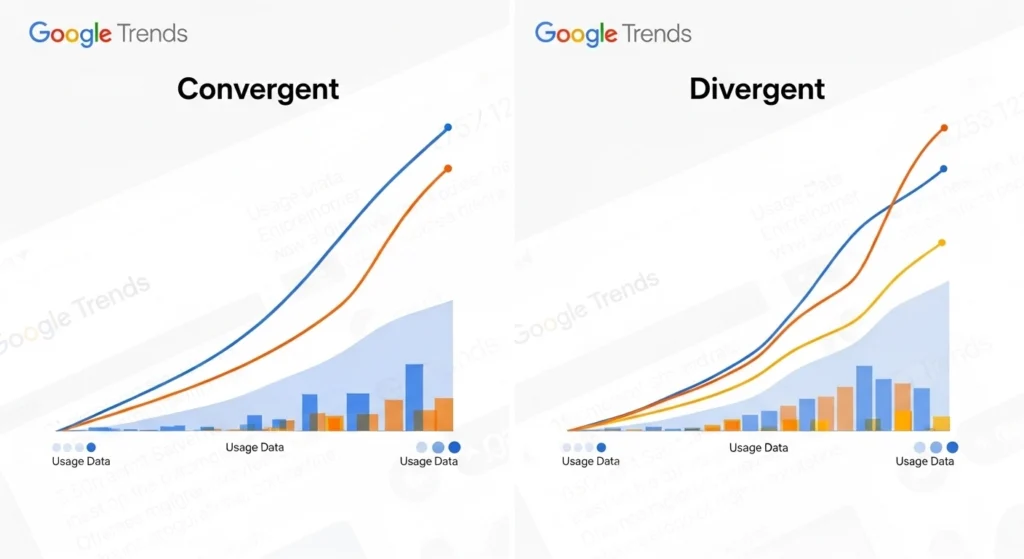
Search trends show:
- Convergent is searched with:
- Evolution
- Lenses
- Thinking
- Evolution
- Divergent is searched with:
- Creativity
- Opinions
- Boundaries
- Creativity
People search “convergent or divergent” mainly for learning and exams.
Convergent vs Divergent Thinking
| Thinking Type | Description |
| Convergent | One correct answer |
| Divergent | Many possible answers |
Both are important:
- Convergent for solutions
- Divergent for creativity
Easy Memory Tricks
- Convergent → Come together
- Divergent → Different directions
Or:
- Converge = Combine
- Diverge = Divide
Convergent or Divergent in Exams
Common exam tasks:
- Define both terms
- Compare them
- Give examples
Exam tip:
Always mention direction and result.
Convergent or Divergent in Business
- Convergent strategy → One clear goal
- Divergent strategy → Many ideas explored
Businesses use both at different stages.
Convergent or Divergent ; Final Comparison Table
| Aspect | Convergent | Divergent |
| Movement | Inward | Outward |
| Outcome | Single | Multiple |
| Agreement | High | Low |
| Creativity | Limited | High |
FAQs
1. Are convergent and divergent opposites?
Yes.
2. Which is more creative?
Divergent.
3. Which is used in exams?
Both.
4. Can thinking be both?
Yes, at different stages.
5. Is convergent always good?
Not always.
6. Is divergent always better?
No, it depends on goal.
7. Are they used outside science?
Yes, widely.
Why This Difference Matters
Using the wrong term:
- Changes meaning
- Confuses readers
- Affects grades or clarity
Correct usage shows clear thinking.
Professional Advice
- Use divergent when exploring ideas
- Use convergent when deciding
- Match the word to the direction
This is how experts use them.
Conclusion
The confusion between convergent or divergent is very common because the words sound complex. But the idea is simple.
Convergent means coming together toward one point. Divergent means moving apart in many directions.
These terms are used across science, education, psychology, business, and daily language. Understanding them improves clarity, exam performance, and professional writing. Neither word is better. Each serves a different purpose.
Once you remember the direction together or apart you will never confuse convergent or divergent again.

My name is Noam Chomsky. I am a linguist, philosopher, and political thinker. I am best known for my work in English grammar and linguistics, especially for developing generative grammar.I studied at the University of Pennsylvania, where I earned my PhD in linguistics. Later, I joined the Massachusetts Institute of Technology (MIT) and taught there for many years. My book “Syntactic Structures” changed the way people understand language and grammar.