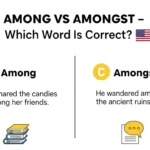
Both “among” and “amongst” are correct, but “among” is more common in modern English while “amongst” sounds more formal or British. 📚✨
Many English learners and writers often feel confused about “among” or “amongst.” Both words look very similar and have the same meaning, but their usage can vary depending on style, region, and context. This small difference causes many people to search online to find out which one is correct.
The confusion usually happens because both words are used in English writing, especially in books, news, and everyday conversation.
Some people think “amongst” is more formal, while others believe “among” is the correct modern spelling. In reality, both words are correct, but they are used differently depending on the situation.
Understanding the difference can help you write more clearly and confidently. Whether you are writing an email, a school essay, a blog post, or professional content, choosing the right word improves your grammar and readability.
In this guide, you will learn the quick answer, the history of both words, British vs American usage, common mistakes, and real life examples.
By the end of this article, you will clearly understand when to use “among” and when to use “amongst.”
Among or Amongst ; Quick Answer
The quick answer is simple: both “among” and “amongst” are correct, but “among” is more common in modern English.
Among is widely used in both American English and British English.
Amongst is mostly used in British English and often sounds more formal or traditional.
Examples
- She shared the snacks among her friends.
- The secret was hidden among the old books.
Using amongst:
- The prize was divided amongst the winners.
- He felt comfortable amongst his colleagues.
In most everyday writing, “among” is the safer and more natural choice.
The Origin of Among or Amongst
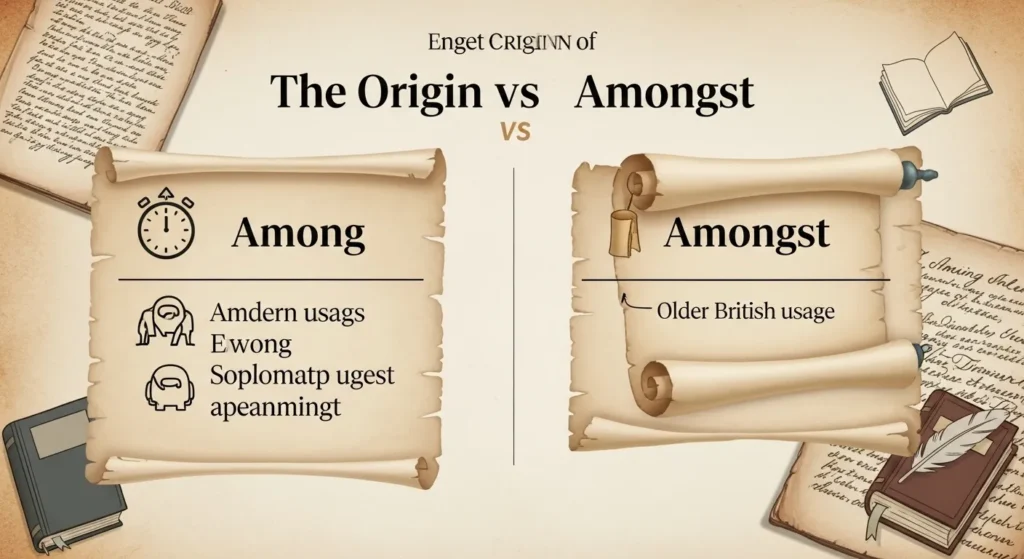
The words “among” and “amongst” come from Old English. The word “among” developed from the phrase “on gemang,” which meant “in the middle of” or “mixed with.”
Over time, the word evolved into “among.”
Later, the form “amongst” appeared. The “ st” ending was added in Middle English. During that time, many English words had extra endings to make them sound more formal or poetic.
For example:
| Base Word | Older/Formal Variant |
| amid | amidst |
| while | whilst |
| among | amongst |
These variations became common in British writing, especially in literature and formal speech.
Today, “among” remains the modern and widely used form, while “amongst” sounds more traditional or formal.
British English vs American English Spelling
The difference between among and amongst is also related to regional language style.
American English prefers shorter and simpler words, while British English sometimes keeps older forms.
Main Differences
| Feature | Among | Amongst |
| Usage | Very common | Less common |
| American English | Preferred | Rare |
| British English | Common | Acceptable but formal |
| Tone | Modern and simple | Formal or traditional |
Example in American English
- The teacher distributed books among the students.
Example in British English
- The teacher distributed books amongst the students.
Even in the UK, “among” is still more commonly used today.
Which Spelling Should You Use?
Choosing between among and amongst depends on your audience and writing style.
If Your Audience Is American
Use among.
It is the standard and most natural choice.
Example:
- The reward was shared among the team members.
If Your Audience Is British or Commonwealth
You can use among or amongst, but among is still more common in modern writing.
Example:
- The responsibility was divided amongst the committee members.
If Your Audience Is Global
Use among because it is clear, simple, and widely understood.
Most blogs, academic writing, and professional content prefer among.
Common Mistakes with Among or Amongst
Many writers make simple mistakes when using these words.
Mistake 1: Thinking “Amongst” Is More Correct
Some people believe amongst is the correct form.
In reality, both are correct, but among is more common.
Incorrect belief:
- Amongst is the only proper form.
Correct understanding:
- Both words are correct.
Mistake 2: Using Them with Two Items
“Among” and “amongst” should usually be used when talking about more than two things.
Example:
Correct:
- The candy was shared among the children.
Incorrect:
- The candy was shared among Tom and Jerry.
For two items, use between.
Correct:
- The candy was shared between Tom and Jerry.
Mistake 3: Overusing “Amongst” in Modern Writing
Many learners use amongst everywhere because it sounds sophisticated.
However, in modern writing, among is clearer and more natural.
Among or Amongst in Everyday Examples
Let’s look at how these words appear in real life communication.
Emails
- Please distribute the documents among the team members.
- The information was shared among all departments.
News Writing
- The funds were divided among several charities.
- The excitement spread amongst the fans.
Social Media
- Happiness is best when shared among friends.
- Memories were created amongst family members.
Formal Writing
- The responsibilities were shared among the committee members.
- The debate continued amongst scholars.
Among or Amongst ; Google Trends & Usage Data
When looking at search data and writing trends, it is clear that “among” is much more popular than “amongst.”
Global Usage Pattern
| Region | Preferred Word |
| United States | Among |
| Canada | Among |
| Australia | Among |
| United Kingdom | Among / Amongst |
| Global Internet Content | Among |
Studies of books, blogs, and news articles show that “among” appears far more frequently in modern writing.
“Amongst” appears mainly in:
- Traditional literature
- Formal speeches
- Historical writing
This shows that language naturally evolves toward simpler forms.
Comparison Table: Among vs Amongst
| Feature | Among | Amongst |
| Meaning | In the middle of a group | Same meaning |
| Usage Frequency | Very common | Less common |
| American English | Standard | Rare |
| British English | Common | Acceptable |
| Tone | Modern | Formal / traditional |
| Recommended for global writing | Yes | No |
FAQs ;
1. Is “amongst” grammatically correct?
Yes. Amongst is grammatically correct, but it is less common in modern English.
2. Which word is more common?
Among is far more common in modern English writing and conversation.
3. Is “amongst” British English?
Yes, amongst is mostly used in British English, though even there it is less common today.
4. Can I use “among” in formal writing?
Yes. Among is perfectly correct in formal writing, academic papers, and professional communication.
5. Do “among” and “amongst” have different meanings?
No. Both words have the same meaning. The difference is mainly style and regional preference.
6. Should I avoid using “amongst”?
You do not have to avoid it, but among is usually the better choice for modern writing.
7. Which word should students use in essays?
Students should usually use among because it is clearer and more widely accepted.
Conclusion
Understanding the difference between among and amongst is easier than it seems. Both words share the same meaning: being in the middle of a group or surrounded by many things. The main difference lies in usage style and regional preference, not grammar.
The word “among” is the modern, widely accepted, and most frequently used form in English today.
It is common in American English, British English, academic writing, blogs, and professional communication. Because it is shorter and simpler, it has become the preferred choice for most writers.
On the other hand, “amongst” is still correct but appears more often in British English, older literature, and formal or traditional writing. Some writers choose it for stylistic reasons, but it is not necessary in everyday communication.
For most situations especially if you are writing for a global audience the safest and clearest choice is “among.”
By remembering this simple guideline, you can avoid confusion and write with confidence. Whether you are composing emails, essays, articles, or social media posts, using the right word will make your writing clearer, more professional, and easier to understand.
Read more about ;
Ax or Axe: Which Spelling Is Correct and When Should You Use It? 🪓

Hello, I am Henry P. Whitmore, an English language scholar and grammar author known for my contributions to English grammar education. I am recognized for presenting complex grammatical rules in a clear, structured, and student-friendly manner, making my work valuable for learners, teachers, and non-native speakers of English.